
The government has suffered a crushing defeat in the House of Lords over its plans to cut future support for hundreds of thousands of disabled people found “not fit for work”, thanks to an amendment proposed by a disabled peer.
Lord [Colin] Low’s amendment – to remove the proposed cuts from the welfare reform and work bill – was passed by 283 to 198 votes during the bill’s report stage last night (27 January).
Although the government is likely to reintroduce the measure when the bill returns to the House of Commons, the vote is likely to be seen as a fresh blow to the credibility of work and pensions secretary Iain Duncan Smith.
His proposals would see new claimants of employment and support allowance (ESA) who are placed in the work-related activity group (WRAG) see their weekly payments drop by nearly £30 a week from April 2017.
Another proposal – also thrown out following an amendment moved by Lord Low – would introduce similar cuts for those placed in the equivalent group of the new universal credit, which is gradually replacing income-related ESA and other means-tested benefits.
Duncan Smith and his fellow ministers and Tory MPs have repeatedly argued that cutting the financial support for sick and disabled people found not fit for work, but able to carry out some work-related activity, would “incentivise” them to find jobs.
But that argument was torn apart during the debate, with only a single Tory peer willing to support the government’s position.
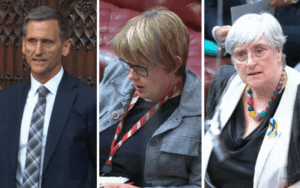
Lord Low (pictured speaking in the debate) said the proposed cuts would see new ESA WRAG claimants facing a drop in their income of £29.05 a week, which would mean a “catastrophic” fall of £1,500 in their annual income and would “push many further towards, or actually into, poverty”.
He said: “The barrier to employment for disabled people is not any financial disincentive created by the ESA premium.
“What stops disabled people getting jobs are things such as employer attitudes, their health condition, illness or impairment, difficulty with transport, and lack of qualifications, experience, confidence and job opportunities.”
Although existing WRAG claimants would be protected from the government’s proposals, he said, they would be hit by the cut if they moved into work and then returned to claiming ESA and were placed back in the WRAG.
Disabled peers Baroness [Jane] Campbell, Baroness [Celia] Thomas and Baroness [Tanni] Grey-Thompson also spoke out against the government’s plans during the debate.
Pointing to the government’s imminent white paper on employment support for disabled people, Baroness Campbell said: “Disabled people are fearful that the assault on their personal finances does not end with today’s proposals, and I think that they are right to be anxious.
“Frankly, disabled people are worn down by the relentless changes and cuts to their support arrangements and are right to be afraid of what is to come.”
Baroness Grey-Thompson said that the universal credit measure would mean even greater losses for disabled people in work.
She warned that single disabled parents working 16 hours or more, living in rented accommodation and making a new claim for universal credit in 2017, would receive about £70 a week, or £3,500 a year, less than they would receive now through tax credits.
She said the impact of the universal credit proposals on hundreds of thousands of disabled people would be “devastating”.
Baroness Thomas said that “cutting the benefit of those who are fit for work but unemployed might act as an incentive but it will really not work for those who are found not fit for work”.
She said: “It is likely to have the opposite effect, pushing some in the WRAG further from employment.”
The only peer, apart from the welfare reform minister, Lord Freud, who spoke in favour of the proposed cuts was Lord [Andrew] Lansley, the Tory former health secretary.
He said that work was “a valid route out of poverty, a route to dignity and a route for people to be no longer dependent on benefits—and they do not want to be dependent on benefits”, and that it was vital to use the government’s proposals “to change the current situation and make that happen”.
Lord Freud said the government wanted to “recycle some of the money currently spent on cash payments, which are not achieving the desired effect of helping people to move closer to the labour market, into practical support that will make a genuine difference to people in these groups”.
The government plans eventually to spend an extra £100 million a year of the annual £640 million savings from the WRAG cut on improving employment support for disabled people.
Lord Freud said it was “important to stress once again that claimants in the work-related activity group have been found to have ‘limited capability for work’, which is very different to being unfit for any work”.
He added: “That is an important distinction, as this misconception helps drive people further away from the labour market and perpetuates the benefit trap.”
He claimed that some of the universal credit figures mentioned by Baroness Grey-Thompson “do not accurately reflect the situation”.
 Decision to order level boarding trains is ‘massive victory’ for disabled campaigners
 Aviation bill will improve access to air travel but there is far more to do, say campaigning disabled peers
 Railways bill must ensure accessibility becomes a reality, disabled peers tell minister