
 A disabled peer has warned that the latest attempts to legalise assisted suicide will make it almost impossible for disabled and terminally-ill people to have their voices heard in the debate.
Baroness [Jane] Campbell said the issue was too complex to address through a private member’s bill, and would not involve enough of those people who would be directly affected by such a change in the law.
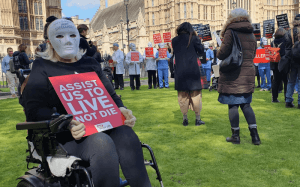
She spoke out as she and other disabled campaigners prepared for a major protest outside the House of Lords tomorrow (Friday), as peers debated the bill for the first time.
They were hoping to show the strength of opposition among terminally-ill and disabled people to the Labour peer Lord Falconer’s assisted dying bill, which is receiving its second reading tomorrow.
The protest is being organised by Not Dead Yet UK, with support from other organisations campaigning against the bill, which would make it legal for doctors to help end the lives of those they judge to be terminally-ill, if the individual requests such help.
Baroness Campbell told Disability News Service: “The danger of addressing such a complex ethical issue such as assisted suicide through a parliamentary private member’s bill is that it will not involve enough the people who will be most affected by a change in the law.
“They will only be able to brief parliamentarians, who may or may not read or take notice of the material.”
She believes there should be a select committee or royal commission set up to take written and oral evidence from disabled and terminally-ill people, their doctors, and health and social care support services, including those from countries where assisted suicide is legal.
She said that a select committee set up as a result of a previous attempt at legalisation – by the Labour peer Lord Joffe – gave “a fair summation of the situation at that time”.
Baroness Campbell added: “This bill is far too momentous to leave in the sole hands of a few parliamentarians without a greater understanding of its potential consequences.
“Yes, they should decide in the end but only when they are equipped to legislate in the very best possible way.
“Others may not be as fortunate, especially if their families have little or only negative experiences of terminal illness and disability.
“I have been privileged to be supported by excellent health and social care services and people who love me and think my life has value.
“Others may not be as fortunate, especially if their families have little or only negative experiences of terminal illness and disability.
“This bill purports to offer choice – the option of premature death instead of pain, suffering and disempowerment. But it is a false choice. It is the burglar who offers to mug you instead.”
Tomorrow’s protest comes as the UK media has been flooded with features and interviews supportive of legalised euthanasia.
Baroness Campbell said it was the “same old story – the prejudices of the many, drowning out the few voices of truth and experience”.
Not Dead Yet UK opposes any change in the law because its members believe it would be “unacceptably dangerous” to make it legal for one individual to end the life of another. Its supporters say that any safeguards introduced as part of the bill could not be made effective.
They also say that clear evidence from other countries where such laws have been introduced shows people are being assisted to die when they are not terminally-ill, often because they perceive themselves to be a burden, particularly at a time when support services are being cut.
Not Dead Yet UK was set up in 2006 by terminally-ill and disabled people in response to Lord Joffe’s attempt to introduce assisted suicide legislation.
17 July 2014
 Review dismisses claims of widespread over-diagnosis across mental health, ADHD and autism
 Burnham delivers significant blow to assisted dying bill as he launches attempt to ‘fix’ social care funding
 Disabled MP stays silent over key concerns as she says she will co-sponsor assisted dying bill