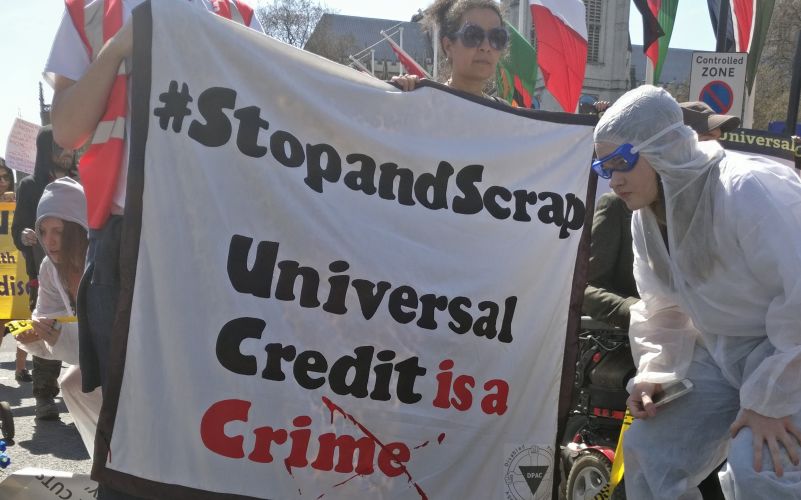
The Department for Work and Pensions (DWP) has finally agreed to pay compensation to two disabled men who saw their benefits drastically reduced when they were forced onto the new universal credit.
The high court had ruled in June that DWP unlawfully discriminated against the two men, known as TP and AR for legal reasons, under the European Convention on Human Rights.
But DWP forced their lawyers to another court hearing to prove the losses they experienced.
An agreement announced this week meant the full hearing did not need to take place, with each of the men now set to receive thousands of pounds in compensation.
But DWP is still appealing the finding of discrimination.
TP had been forced to move to an area where universal credit had been rolled out so he could access specialist healthcare, following a diagnosis of end stage non-Hodgkin Lymphoma cancer.
AR had also had to move to a universal credit “full service” area, in his case because the imposition of the bedroom tax meant his previous home was unaffordable.
Before moving, both men had received the severe disability premium (SDP) and enhanced disability premium (EDP) on top of employment and support allowance.
SDP and EDP are aimed at meeting the additional care needs of disabled people with high support needs who live alone with no carer, but these premiums are being scrapped under universal credit.
When they moved home, both men were advised by DWP staff that their benefits would not change, but each of them saw their income drop by about £178 a month when they were moved onto universal credit.
They were told government policy was that no top-up “transitional protection” payments would be paid for disabled people in their position until July 2019, when the so-called “managed migration” of those on “legacy benefits” like ESA onto universal credit begins.
Transitional protection should mean that those with existing premiums who are moved over to universal credit, as long as it is part of managed migration, should not see their benefits reduced, as long as their circumstances remain the same.
TP said in a witness statement: “The constant money worries have made me more isolated and more depressed; both because of my social isolation and because of the anxiety.
“The stem-cell transplant and chemotherapy was very gruelling and the anxiety around my finances and universal credit has made it all a lot worse.”
AR said: “Since moving from Middlesbrough to Hartlepool, with the consequent reduction in my benefits, my quality of life and my happiness has markedly reduced.
“Not seeing my family regularly contributes to my depressive/manic cycle. If you are isolated it means that you spiral further into a depressive cycle.”
TP will now receive £3,277 for past financial losses and £3,240 for the pain and distress he has been caused, as well as £173.50 a month to cover the shortfall in his benefits pending transitional protection coming into force.
AR will receive £2,108 for past financial losses and £2,680 for the anxiety and distress he was caused, as well as a monthly payment of £176 to make up the shortfall in his benefits.
DWP had initially attempted to keep the terms of the agreement secret.
Ariane Sacco, from the disabled women’s organisation WinVisible, said AR and TP “should never have been put through this loss of benefit”.
She said: “The compensation amount seems small for the stress, anxiety and deprivation they suffered, in Mr P’s case, while undergoing chemotherapy.
“Immediately after the judge’s ruling in June, the cruel DWP asked to appeal the judgement, then they had to be pressured with another court hearing to settle compensation, then wanted it kept secret.”
She said work and pensions secretary Esther McVey and DWP were “continuously battling and undermining” disabled people’s successful court victories, “but all of us who support the legal challenges are determined to fight for what people need.
“More and more is coming out about how universal credit creates poverty, eviction, destitution – including from DWP staff speaking out, and from official agencies.”
Sacco said that mothers and children were “particularly hit by the harsh and bureaucratic universal credit regime, computerisation, delayed payments, the two-child limit and loss of income support premiums.
“There is a growing movement for universal credit to be stopped and scrapped.”
Marsha de Cordova, Labour’s shadow minister for disabled people, said: “This again demonstrates the government’s mistreatment of disabled people.
“These men were assured by the government that they wouldn’t lose out on universal credit but they were left thousands of pounds out of pocket, which severely impacted on their wellbeing.
“Esther McVey should now compensate all those who lost out, reverse cuts to transitional protection, and withdraw her appeal against the original finding of discrimination.
“The government must also stop the roll out of universal credit and fix its fundamental flaws.
“The next Labour government will transform our social security system, ensuring it is there to support disabled people to live independently and with dignity.”
Tessa Gregory, from the law firm Leigh Day, who represented AR and TP, welcomed the financial settlements.
But she called on McVey to compensate all other claimants in similar positions, and to reconsider her decision to appeal the finding of discrimination.
She said AR and TP had called on McVey to “urgently” reconsider draft regulations which currently only compensate disabled people in their position with a flat rate payment of £80 a month.
Gregory said: “This plainly does not reflect the actual loss suffered by our clients and thousands like them and compounds the unlawful treatment to which they have been subjected.”
DWP refused to answer a series of questions about the case, including how many disabled people it believed had so far lost out on EDP and SDP in the move to universal credit, and whether McVey would reconsider her decision to compensate others in the same position as AR and TP by only £80 a month.
But a DWP spokesman said: “The government is appealing the decision of the judicial review, but in the interim we have agreed to make payments to the lead claimants.”
Figures published by DWP suggest that, in February this year, there were 4,000 SDP claimants and 14,000 EDP claimants (including 3,000 who received both EDP and SDP) who have been moved onto universal credit.
DWP has previously said it will stop moving claimants of SDP onto universal credit until the introduction of transitional protection next year, while all those who have already lost out through such a move will receive some backdated payments.
But it has not offered them the full compensation agreed with AR and TP and there has been no mention so far of claimants who previously received EDP but not SDP before their move onto universal credit.
And DWP has still not been able to explain how it justifies not providing equivalent levels of support to new disabled claimants of universal credit, who will receive lower payments than those transferred onto universal credit from legacy benefits such as income-related ESA.
DNS has been forced to complain to the Information Commissioner’s Office about DWP’s refusal to offer a detailed description of how the introduction of universal credit – and the loss of the premiums – will impact disabled people financially.
A note from the editor:
For nine years, Disability News Service has survived largely through the support of a small number of disability organisations – most of them user-led – that have subscribed to its weekly supply of news stories. That support has been incredibly valuable but is no longer enough to keep DNS financially viable.
For this reason, please consider making a voluntary financial contribution to support the work of DNS and allow it to continue producing independent, carefully-researched news stories that focus on the lives and rights of disabled people and their user-led organisations.
Please do not contribute if you cannot afford to do so, and please remember that DNS is not a charity. It is run and owned by disabled journalist John Pring, and has been from its launch in April 2009.
Thank you for anything you can do to support the work of DNS…
 Leaked DWP ‘corner-cutting’ plans reveal changes to checks on assessments that will cause ‘even more risk’
 Information Commission orders DWP to release secret report that examined quality of PIP phone assessments
 DWP silent after Tory member of PIP review publishes report demanding child disability benefits are slashed