
The disability minister has once again ducked questions on the Department for Work and Pensions’ (DWP) covert programme of cuts to the Access to Work (AtW) disability employment scheme.
In a parliamentary written question, Liberal Democrat work and pensions spokesperson Steve Darling asked the secretary of state to confirm what data it was that prompted the department to direct staff to reduce AtW grants.
Another Darling question, also tabled on 18 March, queried whether the DWP has “conducted a review or internal audit” to assess staff consistency in decision-making over AtW awards.
But Sir Stephen Timms failed to provide a clear answer to either line of enquiry.
Instead, the minister’s responses conflict with information senior civil servants at the DWP recently disclosed over the cuts.
Sir Stephen told Darling that the department “routinely focuses on strengthening case manager learning”. In his stock response, he claimed this is so that staff have the “skills and expertise required to apply Access to Work policy and guidance fairly and consistently”.
Replying to the internal audit query, he said that the department holds “regular consistency meetings with all Service Assurance Managers”. Sir Stephen told Darling that it is during these meetings that DWP reviews cases and “discuss[es] any instances where inconsistencies may arise”.
He added: “This ensures that all managers apply processes and guidance correctly and uniformly, helping to support a fairer process”.
Darling first challenged DWP on its cuts to the scheme via a written question in July 2025. It was then that Sir Stephen first insisted that the department had issued no guidance to reduce support.
Instead, he suggested that the cuts disabled campaigners had exposed were because of work to “improve [AtW] decision-making by applying the guidance with greater consistency, to provide a fairer process”.
Since then, Disability News Service (DNS) has been in a protracted battle with the department to find out when and how it told staff to make this change.
At Labour’s annual conference in September, Sir Stephen admitted to DNS that he had signed off on a proposal from senior civil servants to require AtW staff to more “scrupulously” apply this guidance. He also agreed to confirm to DNS the date he approved the order that appears to have led to widespread cuts to AtW.
But the minister has since twice refused to provide that date.
DWP’s freedom of information team later disputed the claims made by Sir Stephen, telling DNS there was “no submission regarding Access to Work training for case managers”.
The minister’s latest responses now also contradict evidence the department’s senior civil servants gave to a recent parliamentary inquiry.
On 12 March, the public accounts committee (PAC) held an oral evidence session for its inquiry into AtW.
DWP permanent secretary Sir Peter Schofield told the committee that references to the lack of consistency in staff decision-making revolve around their failure to apply the five “principles of Access to Work”.
Cathy Waller, founder of Decode – which supports thousands of disabled creatives in navigating AtW applications – has spoken out on how AtW staff have been using one of these principles in particular to justify cutting AtW awards.
Specifically, the AtW staff guide sets out how the scheme should provide support that meets disabled people’s “minimum needs”. Waller previously told the Canary how in interactions with multiple case managers, none were able to explain to her what this principle means.
Crucially, during the PAC session Schofield told MPs the DWP had “identified” these failures “through a management investigation” and “an internal audit report”.
During the same evidence session, Neil Couling, DWP’s director general of services and fraud, told the committee that the department had been “making mistakes” on cases throughout 2023 and 2024. He suggested disabled people were now seeing a lower award at renewal because AtW staff were correcting these mistakes and applying the guidance more rigorously.
Couling said that “over the next three years, as we work through the cases that were made without the consistency that Peter’s [Schofield] been talking about, you will see those awards fall, not to zero, but to what the scheme actually provides for”.
The National Audit Office’s (NAO) February 2026 report into AtW also made reference to an “internal audit”. According to the NAO report, DWP carried this out in August 2024. This reportedly found that “DWP’s guidance for Access to Work is high-level and limits what case managers can do to challenge applicants”.
It seems to corroborate Schofield’s evidence to the committee.
The internal audit took place just weeks after the Labour government came to power. Disabled people widely reported substantial reductions to their AtW awards in the months after the audit.
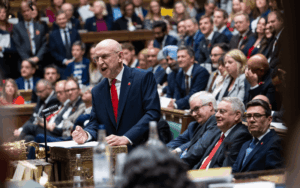
Picture of Sir Stephen Timms via Youtube/Channel 4 News
 Budget extends the agony, as disabled people face further wait for Labour’s decisions on benefit cuts
 Alarm bells ringing after minister says all work is good for health, and he wants ‘everyone’ to get a job
 PIP review member delivers powerful rebuttal to research by colleague that called for cuts to child DLA