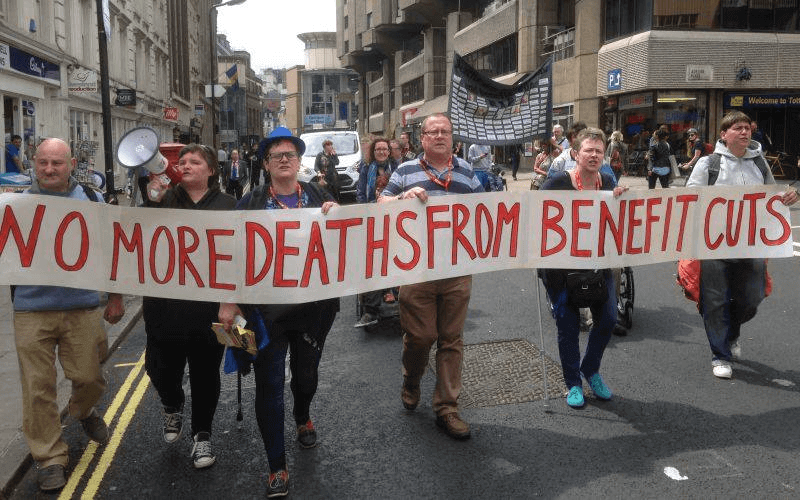
Activists say the government’s decision to slash disabled people’s out-of-work benefits is a “recipe for greater hardship” and will risk claimants’ lives, as ministers this week pushed through cuts agreed last summer by MPs.
Regulations laid in parliament this week implement measures from the Universal Credit Act that will cut the health element of universal credit for most new claimants from about £430 a month to just £217 from 6 April.
Existing claimants already assessed as having limited capability for work-related activity (LCWRA), and those new claimants who meet the “severe conditions criteria” or the rules for those who are terminally-ill, will not be affected by the cuts.
But most new claimants who are found not currently fit for work will, from April, see their extra payment drastically cut compared with existing LCWRA claimants.
Separately, the government continues to stress that the standard allowance received by all universal credit claimants will have an above-inflation increase in April, which will be worth £295 extra this year in cash terms for a single person aged 25 or over, with further above-inflation rises set for the following three Aprils.
It claimed this week that the cuts would “tackle perverse incentives that discourage work and trap people on long-term benefits” and would “rebalance the benefits system”, while it would spend more than £3.5 billion on employment support by the end of the decade.
Work and pensions secretary Pat McFadden claimed the system had been “rigged with the wrong incentives and wrote people off instead of backing them”, and that his reforms would “put more money in the pockets of working people on universal credit”.
Ministers have pushed ahead with the cuts despite research by public health experts at the University of Liverpool warning last year that they were likely to have “devastating” consequences for disabled people’s mental health, and could drive many into serious poverty.
They are also likely to impose major costs on other public services, such as the NHS, social care and other local authority support, the research found, while having no impact on people’s employment chances.
The cuts were condemned by disabled people’s organisations this week.
Linda Burnip, co-founder of Disabled People Against Cuts (DPAC), told Disability News Service (DNS): “How ridiculous it is trying to get more disabled people into work at the same time as they’re slashing Access to Work.
“It makes you think they aren’t serious about getting disabled people into work and their only intention is to push people even further into poverty and destitution.
“I’d also question why a welfare state safety net exists to get people into work rather than supporting them when they can’t.”
Caroline Collier, from Inclusion Barnet’s Campaign for Disability Justice, said: “We welcome any increase to the basic rate of universal credit, which should be subject to a thorough review to ensure it provides an adequate safety net for all.
“However, we believe that cutting the higher rate of universal credit is wrong.
“The government is knowingly subjecting disabled people to deeper poverty, and failing to recognise the need to ensure that those of us who may be unable to work in the long term have the means to get by.
“It is a recipe for greater hardship which will do nothing to tackle the barriers that exclude disabled people from the labour market, and it should be reversed.”
Mikey Erhardt, policy lead for Disability Rights UK, said: “Now that the dust has settled and the government’s benefit plans become clearer, we can see that MPs over the summer voted to make many of our lives worse.
“The minister can speak about perverse incentives till he is blue in the face, but there’s nothing more perverse than claiming that slashing vital support, often used to make ends meet for those at the sharpest edge of our economy, will help us into work.
“Instead, we are seeing a doubling down on a system of work that fundamentally doesn’t work for disabled people.
“In pursuing arbitrary savings figures, the government risks our lives rather than testing new approaches that benefit disabled people, and the wider economy and society.
“Make no mistake: the government’s floundering and their obvious fear of bringing forward more changes are a direct result of the steadfast work of disabled campaigners and our allies, who have made it clear that we won’t stand for this.
“Despite their attempts to silence us, through our collective campaigning, we made them drop billions of pounds worth of cuts, but with two months to go, we will need to continue the fight.”
Ben Golightly, from DPAC Cymru, said it was “wrong that people who become unable to work through disability tomorrow, or young disabled people becoming adults, will be £200 a month worse off than those disabled today”.
Golightly was another to point to the troubled Access to Work scheme as evidence that DWP would not deliver on its employment support promises, and they said the promise of future employment support was just “a slap in the face”.
They said: “If the government is genuine about supporting disabled people into work, they should listen to us and give us the help we need, instead of demonising and infantilising us.
“It is not siding with disabled workers; it is ignoring our views and siding with business.”
They also said the ministerial rhetoric of “perverse incentives” was “a continuation of decades of application of the right-wing ‘biopsychosocial’ model”, which underpinned Labour’s much-criticised work capability assessment in the 2000s.
Golightly said it was a “flawed model embraced by successive Labour and Tory governments and the private sector outsourcing giants carving up the welfare system for profit”.
Paula Peters, a member of DPAC’s national steering group, said the government had “taken the axe” to the health element when the welfare state was supposed to support those found unfit to work.
She said that disabled people newly found not fit for work, often faced with hundreds of pounds of extra costs a month, and the continuing cost-of-living crisis, would find it increasingly difficult to meet their basic living costs.
She said the government’s “callous cut” would cause “serious distress and harm”, and that she feared it would lead to deaths.
Disabled activist Andy Mitchell, a member of the Unite union, said: “Timms [Sir Stephen Timms, the minister for social security and disability] has said these changes are required to address economic inactivity, but… being ‘economically inactive’ does not mean you’re not working, it simply means you’re not in paid employment.
“In my daily life I see disabled people volunteering in their communities [and] caring for loved ones.
“They save the government billions each year, but this work is ignored by politicians.
“Economic inactivity is a misleading and dangerous term which has led to disabled people receiving abuse.
“That’s not the right way to achieve balance, nor is cutting the incomes of people who require universal credit for health reasons in the future.
“DWP says their reforms are designed to tackle a perverse incentive, but what is really perverse are their cuts to disability benefits.”
Ministers also claimed this week that more than 1,000 Pathways to Work advisers in jobcentres across England, Wales and Scotland were now offering personalised help to people on health-related benefits who were not required to work, and that many of them had previously received no support.
They claimed that 65,000 people were expected to benefit from this support in 2025-26, and that the government was “on track to meet its promise that everyone affected by these universal credit reforms will be offered personalised help”.
But Mitchell said the 1,000 Pathways to Work advisers were not new positions, but DWP work coaches who had been moved into these new roles.
He said: “That isn’t investment, it is a repurposing of staff which puts further pressure on the caseloads of the work coaches who remain.”
The new regulations – which apply to England, Scotland and Wales – have now become law, although they could theoretically be annulled if a parliamentary motion is agreed within 40 days, although this is highly unlikely to happen.
 DWP silent after Tory member of PIP review publishes report demanding child disability benefits are slashed
 Labour’s inactivity adviser swears at DNS editor after being challenged on safety of young claimants
 Timms refuses four times to rule out cuts to PIP, but makes firm promise on cash payments