Transport industry managers are failing to budget for access to be embedded from the start of major projects because of the lack of national accessibility standards, a meeting at this week’s Conservative party conference has heard.
The fringe meeting in Birmingham – hosted by the National Centre for Accessible Transport (ncat) – heard from an accessible transport expert that the lack of accessibility standards was a “significant problem” for the UK transport system.
Clive Gilbert, head of accessible transport for the thinktank Policy Connect, said the industry was “extremely fragmented”, complex and diverse, with an “enormous variety of jobs” across multiple forms of transport.
He said this variety “gives the industry endless scope for innovation, but it also creates barriers to developing a shared approach to disability and to designing, building, and running accessible products, services, and infrastructure.”
And he pointed to other countries, like the United States, Canada, and Australia, that do have accessibility standards.
Gilbert, who is himself a powerchair-user, said the failure to have such standards for transport products, services, and infrastructure in the UK means there is “no consensus about what transport professionals in different roles should know or be working towards in relation to accessibility and disability”.
And he said this helps explain “why project managers so often fail to budget to ensure accessibility is embedded in projects from the start”.
Gilbert, who manages the secretariat for ncat’s Accessible Transport Policy Commission, said ncat had been calling for the government to introduce co-produced national standards.
ncat also wants the government to work with the British Standards Institution to set up an accessible transport standards programme that would “build an industry-wide understanding of disability, and a joined-up approach to accessibility”, he said.
He said this would “identify gaps and update guidelines that have become out of date” and “help to establish accessibility as business as usual across transport”.
And he added: “Once the transport industry knows what accessibility looks like, it can train for it, plan for it, and fund it.
“And having accessibility standards available would make it easier for legislators to legislate for it.”
Dr Emma Partlow, ncat’s chief executive, added: “People need that guidance, particularly operators.
“They need that understanding and the standards to know how to shape an accessible transport system.”
Lana Hempsall, a disabled former Tory councillor, told the meeting that she wanted to see more disabled people in decision-making-positions on public bodies and seeking elected office.
Once that happens, she said, disabled people will be able to contribute their first-hand experience because they will be “in the room with able-bodied people” and will be able to “really influence every single project moving forward”.
She said this was “a key element if we are going to get accessible transport for disabled people”.
When the panel was asked later for one thing they would do to make the streets or transport system more accessible, she said: “I would insert into every level of government a representative number of people with disabilities to become decision-makers.
“I would ensure that disabled voices aren’t on the outside, yelling into the well, but actually inside the decision-making rooms co-producing those decisions alongside able-bodied people.”
Lord Moylan, a shadow transport minister, said the involvement of disabled people in decision-making was “key” and “they should be involved, they should be consulted, they should be in the room”.
He said his party was announcing during the conference that a Conservative government would scrap all new floating bus-stops.
But he said there would only be “a very small amount of money” to remove existing floating bus stops, which would allow them “to get rid of the worst ones”, with others removed “over time as things are rebuilt and so on”.
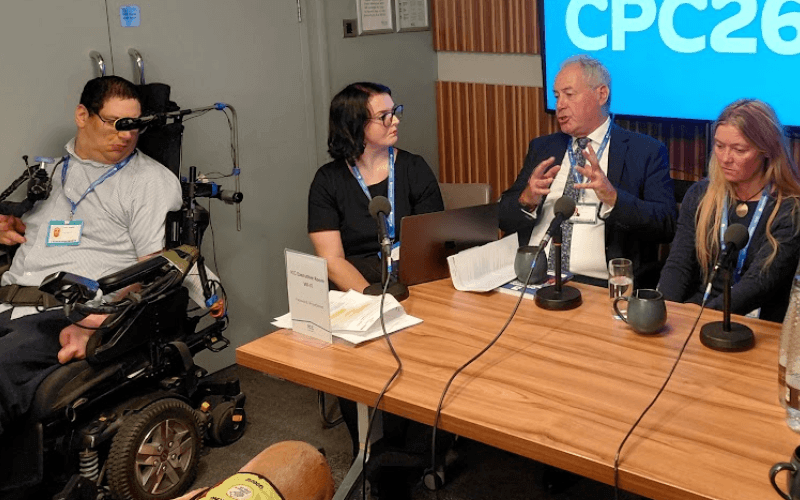
Picture: (From left to right) Clive Gilbert, Dr Emma Partlow, Conservative MP Bob Blackman, and Lana Hempsall
 Tories announce seven ways they will attack disability benefits if they win the next election
 Slow but steady progress on UK air travel access improvements, says report
 Conservatives’ £1 billion Motability VAT plan will decimate scheme and raise almost nothing, figures show