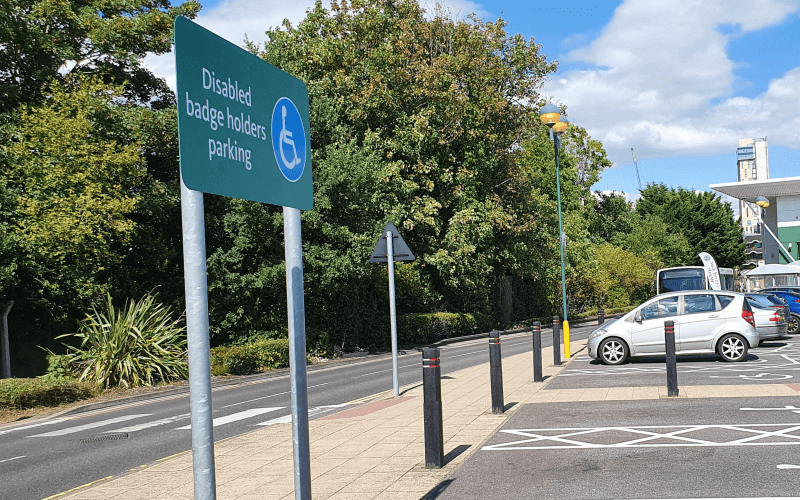
Disabled people with blue parking badges in England are frequently being threatened, insulted, followed and even attacked as part of a “never-ending ordeal”, new research has revealed.
The research found that nearly a third (97) of the 304 disabled people who took part in a survey had been threatened, while 68 of them said they had been laughed at, 52 were photographed or filmed, 43 had been followed and 19 subjected to violence while using their blue badges.
The most frequent negative encounters were staring (80 per cent of respondents) and intrusive questions (63 per cent), while the most common location was a supermarket carpark.
One disabled woman in her 60s with chronic illness, a mental health condition and a mobility impairment described how a man shouted at her after she parked in a blue badge space at a Waitrose supermarket in the south of England.
He shouted: “Why are you parking there? You’re not disabled. There’s nothing wrong with you. You’re a scrounger.”
No-one helped her so she walked to the store and asked for help, while he continued to follow her, shouting abuse and calling her a “fake” and a “scrounger” and refused to stop shouting even when a manager asked him to calm down.
She said: “I’m normally independent and resilient but this reduced me to tears and I couldn’t stop shaking.”
Nearly all those who took part in the survey said they occasionally (50 per cent) or frequently (41 per cent) worried about such encounters, and more than half said these concerns stopped them going out, with 16 per cent saying this happened frequently.
The research was carried out by Vera Kubenz, a disabled postgraduate researcher at the University of Birmingham, and is described in her report, The Politics of Parking, as part of an ongoing research project.
She highlights in the report how disabled people who behave in “incongruous” ways by failing to match stereotypes of how a disabled person should look and behave are more likely to be subjected to these negative encounters.
One young disabled woman, again with chronic illness, a mental health condition and a mobility impairment, said: “If I’m using my walking stick on a given day then I usually don’t have a problem.
“But I don’t always use my walking stick, because it causes pain in my arms, so I often don’t ‘look’ disabled.
“I’ve been stared at, tutted at, heard comments I couldn’t make out the words of but were in a hostile tone of voice, and seen people trying to take photos/video of me who weren’t being as subtle as they thought they were.
“It makes me afraid to use disabled spaces on days I don’t ‘look’ disabled, because I am scared of other people’s hostile behaviour.”
The negative encounters that have the biggest impact happen most often to those who are “further removed from the idea of a ‘normal’ disabled person”, says Kubenz in her report.
She says: “Gender and sexuality are frequently associated with negative encounters and impacts, suggesting that women and queer people are particularly affected by encounters.
“This is likely also the case for race, but less obvious due to the small sample size which makes it more difficult to achieve statistically significant results.”
Kubenz concludes in the report: “It is not just about looking the part, but about publicly enacting the inferior position disabled people have been assigned in an ableist society.
“Disabled people should not have new or expensive cars, wear nice clothes or make-up, have children, or be out at peak times.
“Disabled people should also be deferential and grateful in public spaces, even in the face of confrontation.
“The Blue Badge space, far from being an ‘accessible’ space, thus turns into a microcosm of wider negative societal prejudices about disability.”
But she also points out that more than two-thirds of those surveyed (69 per cent) reported at least one positive encounter while using their parking badges, with the most common positive experience being small talk with other blue badge-holders.
She says that this “solidarity” from other holders of blue badges, and strangers, “had a big positive impact for many participants”.
Kubenz stresses that the survey was not carried out in a random way and so those who took part cannot be considered representative of all blue badge-holders.
But she says the survey has “gone some way in documenting the cumulative impact of this never-ending ordeal” of hostility towards blue badge-holders and the “constant microaggressions of being interrogated, surveyed, and [having] unwanted help forced upon them”.
And she says it has “highlighted the importance of solidarity and support by both other Blue Badge holders and bystanders in lessening the impact of this constant negativity”.
A note from the editor:
Please consider making a voluntary financial contribution to support the work of DNS and allow it to continue producing independent, carefully-researched news stories that focus on the lives and rights of disabled people and their user-led organisations.
Please do not contribute if you cannot afford to do so, and please note that DNS is not a charity. It is run and owned by disabled journalist John Pring and has been from its launch in April 2009.
Thank you for anything you can do to support the work of DNS…
 Years of scapegoating rhetoric has led to ‘envy and resentment’ of those with blue badges, research finds
 Council attacked by MPs over blue badge security ban
 Disabled gig economy workers ‘must do hours of unpaid work to cope with oppression’