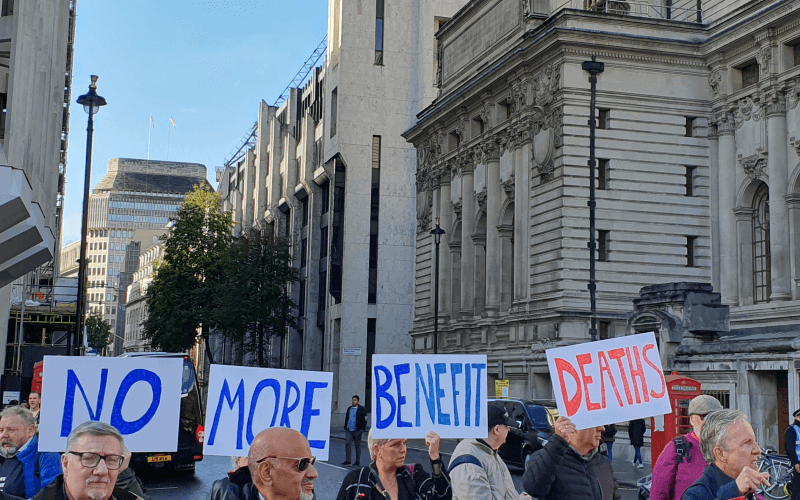
New figures have revealed that 50 secret investigations into the deaths of benefit claimants led to internal calls for improvements within the Department for Work and Pensions (DWP) last year.
Another 25 DWP investigations into cases of claimants suffering serious harm led to calls for improvements, or what the department calls “key findings”, in 2025-26.
The figures relate to the department’s internal process review (IPR) system and have been provided to Disability News Service through a freedom of information request.
The previous year, 2024-25, there were a total of 51 cases – including 31 that followed a claimant death – which led to “key findings”, and in 2023-24 there were 63 cases that led to key findings, including 50 that followed a claimant death.
The figures provide further confirmation of the depth of harm still being caused across the department, just as reports suggest DWP ministers are preparing for a further round of cuts to disabled people’s support over the next year.
The new information also shows how many key findings were linked to different parts of the department.
It reveals that, in 2025-26, there were 137 key findings relating to universal credit, including 100 that followed a death.
There were another 41 linked to disability services, including 21 following a death; and 20 key findings related to employment and support allowance, 15 of which followed a death.
The number of improvements linked to universal credit is increasing every year, with 100 key findings in 2023-24, 109 in 2024-25, and 137 last year.
Calls for improvements related to disability services are also increasing, from 23 in 2023-24, to 32 in 2024-25, and 41 last year.
It is likely that many of the cases of serious harm and death investigated through IPRs and linked to “disability services” will be related to personal independence payment (PIP), as there were 82 cases linked to PIP that were accepted for an IPR in 2025-26, out of a total of 166 cases accepted for an IPR.
The figures provide further evidence to justify long-standing calls for an independent inquiry into the years of deaths caused by DWP’s actions, policies and failings.
IPRs are carried out when there is a suggestion that DWP’s actions or failings may have negatively contributed to a claimant’s circumstances, and the claimant has suffered serious harm, has died, or there has been an attempted suicide.
DWP told DNS that the new figures were taken from “operational sources” and so were not “quality assured” statistics, while it would be “analytically unsound to draw conclusions from the raw data as to the prevalence of harm, or causation of death of those customers where key findings were identified following a review of their case”.
During evidence to the Commons work and pensions committee yesterday (Wednesday), Neil Couling, DWP’s director general for services and fraud, suggested that it would be a good thing if the number of IPRs continued to rise, because it meant DWP staff were “more confident to request one of these”.
He told the committee that he would “expect the numbers [of IPRs] to rise, and I don’t think you should be alarmed if they do” as it “might be a sign of the cultural change” the committee demanded in a critical report that called last year for DWP to address its “deficient” approach to safeguarding.
*The Department: How a Violent Government Bureaucracy Killed Hundreds and Hid the Evidence, DNS editor John Pring’s book on the years of deaths linked to DWP’s actions and failings, is published by Pluto Press
 Leaked DWP ‘corner-cutting’ plans reveal changes to checks on assessments that will cause ‘even more risk’
 Information Commission orders DWP to release secret report that examined quality of PIP phone assessments
 The Times ignores efforts to draw its attention to years of DWP deaths as it launches its own ‘welfare inquiry’