The Conservative shadow work and pensions secretary may finally have accepted that spending on social security is not “out of control”, just as her party says it wants to cut more than £36 billion a year from the “welfare” budget.
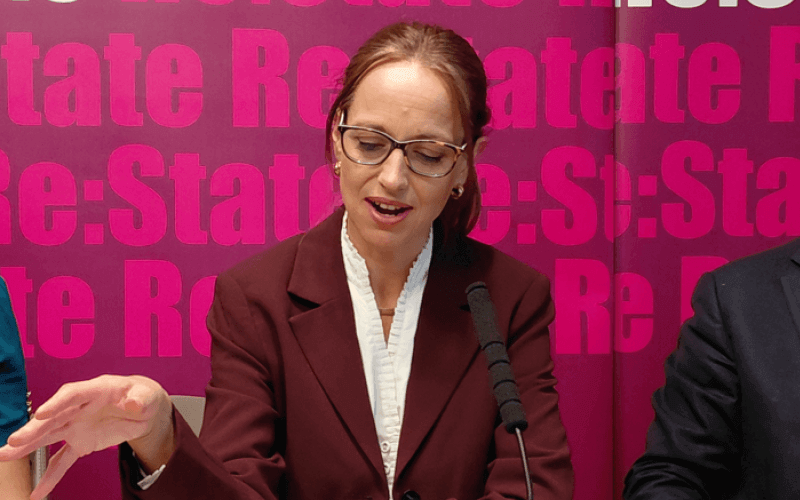
The apparent admission from Helen Whately (pictured) contrasted with comments by her leader Kemi Badenoch this week, and follows months of misleading claims to parliament and on social media by senior figures in the party.
Whately and other senior Tories, including Badenoch, have repeatedly – and wrongly – claimed that spending on social security is “spiralling out of control”.
They have used these claims to justify brutal cuts to social security spending under a future Conservative government, with the party promising even deeper cuts this week.
But at the annual Conservative conference in Birmingham this week, when confronted with the facts by Disability News Service (DNS), Whately did not deny that spending was stable and not spiralling out of control at all but appeared to argue that it needed to be cut anyway.
In her speech to conference yesterday (Wednesday), Badenoch referred to the “ballooning benefits bill” and said that “cutting the welfare bill will allow us to fund our defence”, although she announced no new policies on disability benefits and ignored social care and other disability policies such as accessible housing and transport and inclusive education.
But in figures later reported by the Guardian, the party claimed it was planning to save £1 billion a year through removing further VAT exemptions from the Motability scheme, £13.6 billion through “sickness and disability benefit reforms”, and £2.8 billion on child disability living allowance reforms, with a total of £36.1 billion a year cuts to “welfare” by 2029-30.
It was not possible to confirm these figures with the party as it continues to refuse to respond to questions from DNS (see separate story).
Earlier in the conference, Whately twice claimed she was too busy to answer a question from DNS about social security spending.
But on the second occasion, on Monday, DNS did manage to ask her about Office for Budget Responsibility figures that showed social security spending for this year, 2026-27, is forecast to be 11.2 per cent of GDP*, the same level it is predicted to be in 2030-31.
DNS said this meant that when she had repeatedly claimed that welfare spending was “out of control”, that was not correct.
In response, Whately did not deny that spending was stable but instead said: “It’s been too high for too long.”
This suggests that she accepts that social security spending is not spiralling but that the party wants to cut it anyway.
She refused to say anything else as she said she had another engagement to attend.
When she delivered her speech to conference the next day, she did not claim that social security spending was spiralling.
Instead, she repeated previous policy pledges, including planned cuts to “welfare” of even more than the £23 billion the party announced last year, which she said would be used to “cut taxes”, reduce the government’s budget deficit and help with spending three per cent of GDP on defence.
Her speech was one of the fiercest attacks on disabled benefit claimants ever heard from the main stage at the Conservative party conference.
In one of her most misleading lines, she told party members: “A welfare system intended to keep poverty at bay and help people dreadfully injured in war, now funds people to get free [Motability] cars for acne and tennis elbow.”
She also spoke of the “decline of personal responsibility and resilience, the expectation that your problem is the state’s problem, the growing belief that if you need something the state should provide it and if something goes wrong in your life, the state should fix it”.
She added: “In my grandparents’ generation, 16-year-olds lied about their age to enlist and go to war.
“It’s a far cry from today where TikTok ‘sickfluencers’ tell young people how to game the benefits system.”
Whately later claimed that there were more people with ADHD who received benefits than there were soldiers in the UK army, before asking the conference: “How did Great Britain become this country?”
And she said a Conservative government would “confront the change in our culture, that if others have it then you’re entitled to it too”, which she said “isn’t the British way”.
She added: “Don’t look to other people to do the hard work to pay for your lifestyle. If you want it, you should earn it.”
Whately also told the conference that, under a Conservative government, “the albatross of our inflated welfare bill will no longer hang round our neck”.
*The proportion of GDP (the size of the country’s economy in a particular year) spent on social security, according to the Office for Budget Responsibility (OBR): 2010-11: 12.0%, 2011-12: 12.0%, 2012-13: 12.1%, 2013-14: 11.7%, 2014-15: 11.5%, 2015-16: 11.3%, 2016-17: 10.9%, 2017-18: 10.5%, 2018-19: 10.3%. 2019-20: 10.2%, 2020-21: 11.9%, 2021-22: 10.4%, 2022-23: 10.0%, 2023-24: 10.9%, 2024-25: 10.7%, 2025-26 (latest OBR forecast): 10.9%, 2026-27 (latest OBR forecast): 11.2%, 2027-28 (latest OBR forecast): 11.1%, 2028-29 (latest OBR forecast): 11.0%, 2029-30 (latest OBR forecast): 11.1%, 2030-31 (latest OBR forecast): 11.2% [see chart 5.2, Economic and fiscal outlook – October 2024 and table 4.1, Economic and Fiscal Outlook – March 2026]
 Disabled activists ready to fight back against ‘unsafe’ and ‘punishing’ cuts demanded by Milburn report
 Government looks set to accept Milburn’s call for 41 per cent cuts to young people’s disability benefits
 Most Labour MPs appear to accept Milburn’s arguments for huge cuts to disabled young people’s benefits