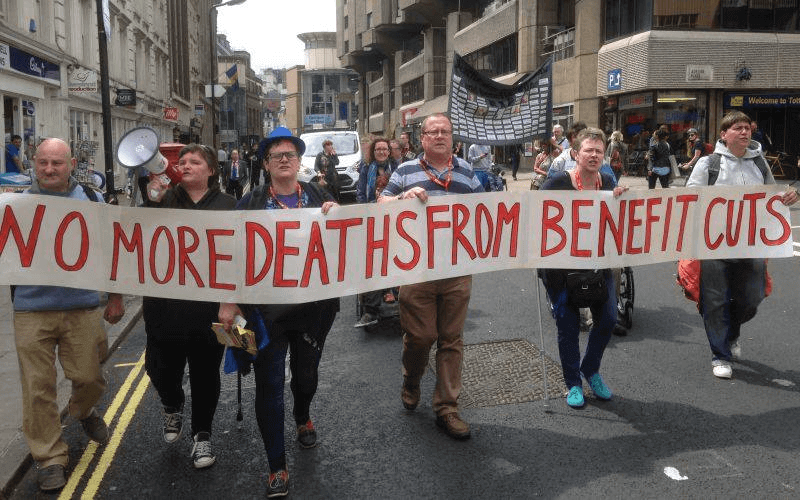
It is “crucial” that the government is shown new research which highlights that “obscene” plans to cut out-of-work disability benefits are likely to have “devastating” consequences for claimants, say disabled activists.
Disability News Service (DNS) reports today (see separate story) how research into the impact of past Conservative cuts in this area has revealed the significant impact they had on mental health and poverty, and that they are likely to have imposed major costs on other public services, such as the NHS and social care.
The research* by public health experts at the University of Liverpool – led by Professor Ben Barr – examined the impact of cuts to out-of-work disability benefits implemented by the Conservative government in April 2017 following the Welfare Reform and Work Act 2016.
It found that that the reduction of nearly £30-a-week to benefits paid to those placed in the work-related activity group (WRAG) of employment and support allowance (ESA) had a “serious” impact on disabled people who left work in that period.
The cuts were linked to an extra 92,000 people with long-term conditions a year self-reporting “common mental disorders” such as depression and anxiety, after leaving their jobs and being placed in the WRAG, and 31,000 a year more disabled people experiencing severe poverty.
The researchers also concluded that the WRAG cut had no impact on the likelihood of sick and disabled people moving into work, a key reason for the Labour government pushing through similar cuts to most new claimants of the health element of universal credit, which will be implemented in just five months’ time.
Linda Burnip, co-founder of Disabled People Against Cuts, said: “It is vital that this research is shared with the government before they go ahead with any proposed cuts to social security payments that will push many more disabled people into further and more extreme poverty.
“Not only does this research show that making people poorer will not in any way increase the likelihood of them getting into employment, but it will lead to higher overall costs to the economy as people become more ill than they already are.
“The probable increase in suicides and self-harm are also being ignored by a Labour government intent on reducing what they claim is too high a benefits bill.
“Of course, the government also seem to ignore the fact that the economy will only grow if people have disposable income to spend.
“Abject poverty does not lead to economic growth under any circumstances.”
Inclusion Barnet’s Campaign for Disability Justice (CDJ) agreed that it was crucial that the research was seen by the government.
Caroline Collier, from CDJ, said: “It’s important the government sees this (and reads it carefully).
“We all need the means to live decent lives.
“A key duty of government is to make sure those with the fewest resources and options are safeguarded from destitution, and successive governments have failed to do this.
“We welcome Professor Barr’s research, which paints a clear picture of the actual impacts of cuts: no improvement in employment rates and deteriorating mental health and income levels for claimants.
“This research, whilst important, is a damning indictment of policy to date, which has paid no regard to the income levels disabled people need to get by.
“In the light of this, we need MPs to decide to do the right thing rather than the easy thing.
“It’s easy to placate certain sections of the press by cutting benefits, but given that there are very few accessible roles, and many people are not well enough to do any work at all, the recently enacted cuts – due in April – were really just cruelty masquerading as incentivisation, just as much as those implemented in 2017.
“All MPs, particularly those that voted for the upcoming cuts, should read Professor Barr’s work and reflect on the actual consequences of that vote.”
Professor Barr* and his fellow authors warn in the new paper: “We do not know what the effect will be of the forthcoming plan to reduce the payment that new claimants for Universal Credit Health Element will receive; however it is similar to the 2016 reform that also reduced these payments.”
They add: “The UK government is introducing further reductions to these benefits.
“It is likely that these will not achieve their strategic objectives and will increase mental health problems and poverty amongst people with disabilities.”
The new paper also points to previous research from 2015 – again co-authored by Professor Barr – which linked the coalition government’s programme to reassess people on incapacity benefit through the work capability assessment to about 600 suicides in just three years, and an increase of 290,0000 in the number of people with mental health problems.
Disabled activist Rick Burgess, a spokesperson for Greater Manchester Coalition of Disabled People, said of the new research paper: “This is crucial research for this moment in time.
“The government’s approach to social security and employment incentives does not work; secondly, it harms people.
“This obscene policy trajectory has to end; this research proves it must.
“Disabled people’s victimisation by the DWP has to end.”
It was Burgess who originally came up with the idea for the 2015 research.
He said: “We also know at its extremity these policies are leading to deaths.
“The government know this and to intensify these policies shows it is engaged in democide against us.
“They must abandon the cuts to universal credit, and the Pathways to Work changes.
“Start with providing an adequate level of social security provided by a new department that does not have a long history of persecuting disabled people.
“And we must have justice for those we have lost and for the abusive conditions they are forcing upon people.”
Asked if the research would be taken into account in assessing future policy decisions, and whether work and pensions secretary Pat McFadden was concerned about the findings, DWP released a statement that failed to answer these questions**.
*The health, poverty and employment effects of cutting income replacement benefits for the disabled: A difference-in-difference analysis of the 2016 welfare reforms, by Benjamin Barr, Huihui Song, Roberta Piroddi and Philip McHale
**The statement is included here as a footnote, as it failed to answer the questions put to the department by DNS: “We want a welfare state that is there for those who need it and supports people into work, while delivering fairness to the taxpayer. We’re shifting our focus from welfare to work, skills and opportunities so more people can move out of poverty and into good, secure jobs as part of the Plan for Change.”
***The Department: How a Violent Government Bureaucracy Killed Hundreds and Hid the Evidence, DNS editor John Pring’s book on the years of deaths linked to DWP’s actions and failings, is published by Pluto Press
A note from the editor:
Please consider making a voluntary financial contribution to support the work of DNS and allow it to continue producing independent, carefully-researched news stories that focus on the lives and rights of disabled people and their user-led organisations.
Please do not contribute if you cannot afford to do so, and please note that DNS is not a charity. It is run and owned by disabled journalist John Pring and has been from its launch in April 2009.
Thank you for anything you can do to support the work of DNS…
 Leaked DWP ‘corner-cutting’ plans reveal changes to checks on assessments that will cause ‘even more risk’
 Information Commission orders DWP to release secret report that examined quality of PIP phone assessments
 DWP silent after Tory member of PIP review publishes report demanding child disability benefits are slashed