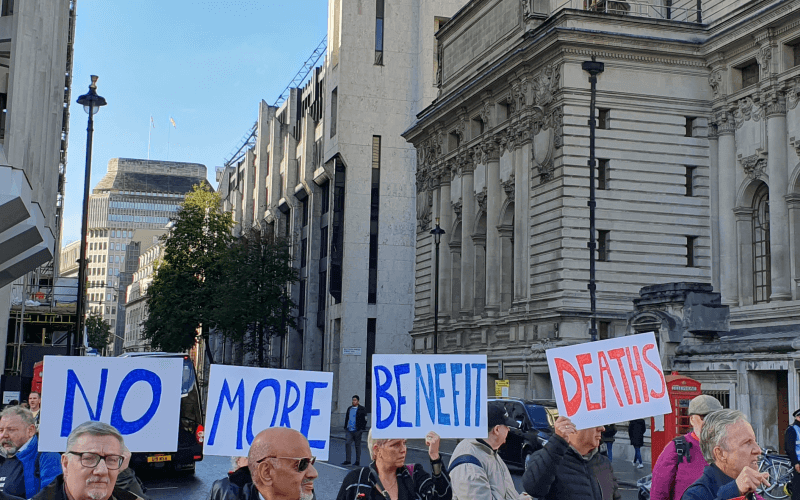
The government is facing accusations of a cover-up after refusing to release a report that examined the quality of personal independence payment (PIP) assessments, following a sub-standard test linked to the death or serious harm suffered by a disabled claimant.
The audit was ordered in 2020-21 after a secret review by the Department for Work and Pensions (DWP) into a claimant of personal independence payment (PIP) who either died or suffered serious harm following failings by DWP and one of its contractors.
The audit was mentioned in a release of information that was only published by DWP after a freedom of information battle with Disability News Service (DNS).
This information release included short summaries of internal process reviews (IPRs) completed by DWP in 2020-21.
The summaries showed that, in 2020-21, 20 IPRs identified the need to learn from DWP failures involving PIP claimants, and these produced a total of 34 “agreed activities” to put these failings right.
The short summary of the case of “Customer 23” – who either died or suffered serious harm – found that their PIP assessment “was not of required standard”, and that all the available evidence was “not considered when decision was made”.
DWP also failed to signpost Customer 23 to another benefit when one of their claims ended.
It is not clear from the summary whether the assessment was carried out by Atos or Capita, the two much-criticised private sector contractors in place at the time.
The summary reveals that the group of senior DWP officials who review IPR findings asked their PIP colleagues for assurances that assessment reports were “robust and meet the agreed standards” and that their decision-makers were “utilising all the evidence available to them”.
As a result, DWP ordered an audit of assessment reports and secured “a substantial assurance”, although it is not clear whether this assurance came from its PIP department, from Atos, Capita, or from both contractors.
But when DNS asked for copies of the audit and the “assurance” under freedom of information laws, DWP confirmed the information existed but refused to release it.
It told DNS that releasing the audit and the assurance would “inhibit the free and frank provision of advice”, “inhibit the free and frank exchange [of] views for the purpose of deliberation”, and “prejudice the effective conduct of public affairs”.
It reached this conclusion despite admitting a “strong public interest in transparency in the work of the DWP and in the learning outcomes from the Internal Process Reviews (IPRs) that the department has carried out”, and even though the audit and the assurance were produced more than five years ago.
It is the latest example of DWP refusing to release information that connects its actions and failings with the deaths of disabled people.
And it comes nearly two years after Labour’s new minister for social security and disability, Sir Stephen Timms, promised a new era of transparency in the department.
Sir Stephen told DNS in September 2024 that the government needed to “open up what is going on in the Department for Work and Pensions to public scrutiny” and that such scrutiny was “a good thing, and it puts pressure on ministers and on civil servants to have the consequences of what they are doing known about publicly”.
Since that pledge, DWP has continued to resist publishing reports that link its actions and failings with disabled people’s deaths.
Debbie Abrahams, who chairs the Commons work and pensions committee, told DNS this week: “Transparency was a major concern raised in our Safeguarding Vulnerable Claimants inquiry [which was] published in May 2025.
“In addition to this, the select committee is continuing to raise other recommendations from the report that the department has still not acted on, as well as new safeguarding issues with the DWP.
“We remain seriously worried about the culture issues in the department and how this affects safeguarding of vulnerable claimants.
“Because of this, we plan to hold a one-off evidence session to review progress of safeguarding in the DWP before the summer.”
DWP refused this week to say which of the assessment providers were subject to the audit, or whether the audit was targeted at its own PIP department; who provided the “substantial assurance”; and whether Customer 23 had died following the department’s failings.
Sir Stephen had not responded by noon today (Thursday) to a request to comment on his transparency pledge.
Asked how DWP justified refusing to release the information, more than five years after the audit took place and in the light of Sir Stephen’s pledge, a spokesperson for the department declined to add to its freedom of information response.
But a DWP spokesperson said: “The response outlines the sections of the [Freedom of Information Act] covering why information was withheld.
“If someone believes a response to [a freedom of information request] has been mishandled, they can ask for an internal review, and if still dissatisfied make a complaint to the Information Commissioner’s Office.”
The Department: How a Violent Government Bureaucracy Killed Hundreds and Hid the Evidence, DNS editor John Pring’s book on the years of deaths linked to DWP’s actions and failings, is published by Pluto Press
 Conservatives’ £1 billion Motability VAT plan will decimate scheme and raise almost nothing, figures show
 Leaked DWP ‘corner-cutting’ plans reveal changes to checks on assessments that will cause ‘even more risk’
 Information Commission orders DWP to release secret report that examined quality of PIP phone assessments