The government made a secret political decision that it would be too expensive and impractical to ensure that disabled people can safely evacuate from high-rise blocks of flats in emergencies, the high court has concluded.
A minister decided not to make the decision public because it would be “politically difficult to justify” and he feared “political fallout”, the court has found.
But despite these findings, the high court has dismissed an application by disabled campaigners for a judicial review and has found that the government’s decision was not unlawful.
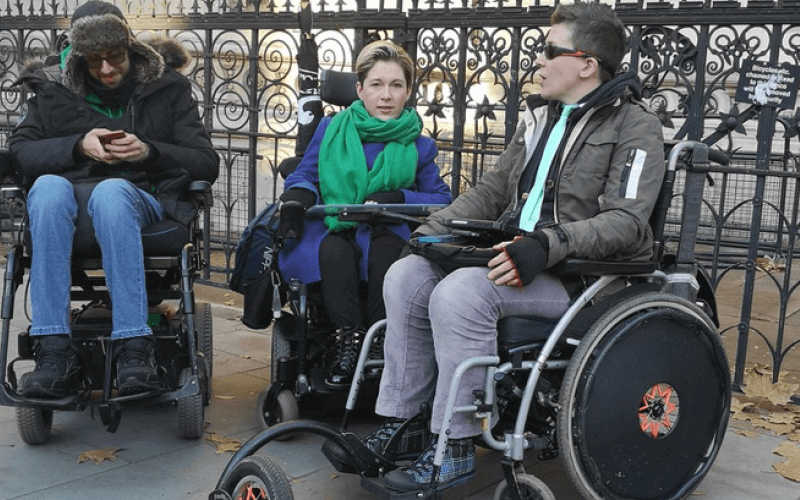
The case was taken by Sarah Rennie, Georgie Hulme, and CLADDAG, the organisation they founded to campaign for disabled leaseholders and tenants in residential buildings impacted by the building safety crisis.
They brought the case after the government rejected the Grenfell Tower Inquiry’s recommendation that owners and managers of high-rise residential buildings should prepare a personal emergency evacuation plan (PEEP) for all residents who might find it difficult to “self-evacuate”.
The rejection of the PEEPs recommendation came even though those who responded to a consultation on the proposal overwhelmingly supported their introduction.
The Home Office consulted instead on its own “alternative package” of measures, which it calls Emergency Evacuation Information Sharing Plus, which does not go as far as PEEPs and will only apply to the minority of buildings that have been assessed as being “at higher risk”.
The high court has now found that fire minister Lord Greenhalgh had decided by September 2021 “not to implement the PEEPs recommendations”, but also concluded that it would be too dangerous politically to make that decision public.
Instead, ministers continued to insist that the PEEPs recommendation would be implemented.
Earlier this month, housing secretary Michael Gove said in a letter to London mayor Sadiq Khan that the PEEPs recommendations remained a “key priority”.
Hulme and Rennie, wheelchair-users who live in high- and medium-rise buildings, had asked the court last December to rule that the government’s rejection of PEEPs was unlawful.
Among their arguments was that the failure to introduce the PEEPs recommendations was a breach of disabled people’s right to life under the European Convention on Human Rights.
But the high court has now ruled in favour of the Home Office.
Mrs Justice Stacey said ministers were entitled to make a “political judgment” that the PEEPs recommendations should not be implemented, after balancing “risk and safety” against “practicability, deliverability, complexity and cost”.
She also said the home secretary had “established a framework of laws and guidance sufficient to satisfy a reasonable minimum protection of the right to life”.
And she found that the disability discrimination demonstrated by the failure to implement the PEEPs recommendation was justified in law, despite the government’s earlier public pledges that it would introduce the new measures.
Mrs Justice Stacey said it was “essentially a political decision for the defendant to take” and not unlawful.
Rennie and Hulme, who were represented by Bhatt Murphy solicitors and barrister Raj Desai, of Matrix Chambers, said: “The court’s judgment makes clearer than ever to us and our community that a political decision has been made by this government to leave disabled and older people living in high rise buildings without means of escape.
“It is a decision to prioritise money over disabled persons’ lives. And it is a decision not to learn the lessons of the disproportionate deaths of disabled persons in the Grenfell Tower fire as identified by the chair of the public inquiry.”
But they said the legal case had started a national conversation and led to a “significant shift in thinking” within the housing sector and fire safety industry.
This week, the Home Office refused to say if it now accepted that ministers would not implement PEEPs; that the decision not to implement PEEPs was a political decision; and that that decision showed ministers had prioritised money over disabled people’s lives.
But a government spokesperson said: “We are pleased with the court’s decision as it allows us to get on with delivering proposals that enhance the safety of residents whose ability to self-evacuate in an emergency may be compromised.
“We are currently analysing responses to our public consultation on Emergency Evacuation Information Sharing Plus, which is an alternative to Personal Emergency Evacuation Plans, to understand how best to achieve this.”
The Grenfell fire led to 72 people losing their lives, including 19 of Grenfell’s 46 disabled residents (41 per cent of them) who were present on the night of 14 June 2017, and 28 of the 157 residents with no impairments (18 per cent).
The subsequent inquiry found that, with every disabled resident who died, there had been no plan in place to help them evacuate, or to ensure their information was available for the fire and rescue service to help them evacuate.
Picture by Eleanor Lisney: Sarah Rennie (centre), Georgie Hulme (right) and Adam Gabsi, a board member of Harrow Association of Disabled People and Inclusion London
A note from the editor:
Please consider making a voluntary financial contribution to support the work of DNS and allow it to continue producing independent, carefully-researched news stories that focus on the lives and rights of disabled people and their user-led organisations.
Please do not contribute if you cannot afford to do so, and please note that DNS is not a charity. It is run and owned by disabled journalist John Pring and has been from its launch in April 2009.
Thank you for anything you can do to support the work of DNS…
 Home secretary delays implementation of ‘long-overdue’ measure on disability hate crime
 Disability hate crime prosecutions tumble again, three years after CPS admitted figures were ‘woeful’