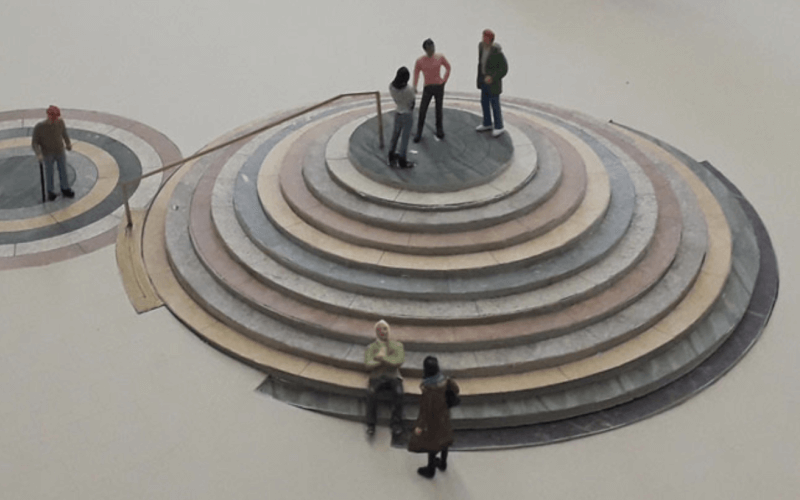
A memorial to the victims of the Peterloo massacre has been branded a “million-pound embarrassment” after Manchester City Council failed again to suggest a way to make it fully accessible to disabled people.
One disabled activist told an online public meeting that the Peterloo memorial, unveiled in August 2019 for the 200th anniversary of the massacre*, was “a folly which shames Manchester and opens the city up to derision and mockery”.
She branded it a “physical manifestation of inequality, exclusion and prejudice”.
The council promised in August 2019 to make the memorial accessible, following a grassroots campaign led by disabled activists furious at the decision to fund a monument that was designed to be used as a speaking platform but was completely inaccessible to many people.
This week, the council admitted that it had made mistakes in failing to give enough “time and consideration… to the original concept design and the emerging accessibility issues as the plans evolved”.
The council suggested at last week’s meeting that its preferred option was now to close the memorial to the public for all but one day every year, and then install a temporary ramp on that one day that would allow those with mobility impairments to reach the top level.
The meeting, organised by the council, heard from several disabled activists who have campaigned for the memorial – which was designed to be used as a platform for speakers and demonstrators, mirroring those who spoke during the protest in 1819 that led to the massacre – to be made accessible.
Dr Morag Rose, an artist, activist and lecturer in human geography at the University of Liverpool, told the council that a temporary ramp one day a year “stigmatises and blames disabled people for your failures”.
She said Peterloo had become “a symbol of working-class struggles, of the fight for equality, participation, democracy and inclusion” and that it was “beyond irony” that the memorial instead “embodies inequality, exclusion and segregation”.
She said: “Shame on everyone who failed to notice, or failed to listen or failed to speak up when we told you a flight of steps was an insult and a mockery.
“Shame on all who colluded or hoped the problem would go away. It has not. We have not.
“During the pandemic, disabled people have been made abundantly aware that our lives are perceived as less worthy than others.
“We knew it in our bones already, of course, but public discourse has made this more blatant than ever.
“The memorial as it stands embodies the belief that disabled people are not worthy, do not matter. It reminds us of that prejudice every time we encounter it.”
And she said it was “a folly which shames Manchester and opens the city up to derision and mockery” and was a “physical manifestation of inequality, exclusion and prejudice”.
Flick Harris, chair of Manchester Disabled People’s Access Group, said this week that she and other disabled campaigners wanted the council to look at other options, such as a permanent “glazed” ramp that would look less intrusive than other access solutions.
She said: “Their proposal is to have a horrible ramp which obscures everything but only have it there as a temporary ramp for one day a year and then close it for everybody for 364 days a year.
“We are all against it. It is ridiculous. We recognise the importance and the value of the memorial, but because the design is so inaccessible they are going to have to make modifications to the design to make it accessible to everybody.”
She said the council must also address the lack of accessible information around the memorial.
Dennis Queen, a committee member of Greater Manchester Coalition of Disabled People, said the memorial had become a “million-pound embarrassment” and that the council’s solution of one-day-a-year access “just feels wrong”.
She said: “Disabled people in Manchester have been campaigning for access to the city for 40 years.”
She said disabled people “got creative and found solutions” when faced with inaccessible public transport in the 1980s, and they could do the same again now.
She said: “We don’t want to stop other people using it.
“It was going to be something that the city could be proud of, but now it has become a big embarrassment to us and the council.”
A Manchester City Council spokesperson said: “The purpose of the meeting was not to present people with a fait accompli but to update them on where this issue was up to, including some of the challenges around solutions, and to hear their views and ideas.
“We will now take these away and further reflect on potential solutions. At this point, no decisions have been taken.”
Asked about the reaction to the “one-day-a-year” solution, he said the council “recognises the views which were strongly expressed on this matter by some of the attendees of the meeting and will take them on board as we consider the way forward”.
He said the council had learned lessons from its past mistakes and was using them to “inform current and future projects” and “ensure inclusive design is at their heart from the outset and that all of our disabled residents, visitors and workers can experience the city accessibly and on equal terms.
“We acknowledge the frustration that despite our best endeavours, and those of architects working on our behalf, it is has not yet been possible to come up with a satisfactory solution for the Peterloo Memorial given where we are with the project.”
He said the council had not gone back on its word to make the memorial fully accessible, but had yet to find a solution.
He said: “We have carefully considered seven options for a permanent ramp or lift but due to the constraints of the site none have proved feasible.
“Each would have either had an overbearing impact, obscuring the details of the people who died, or required the permanent use of a significant amount of extra land owned by Manchester Central** and used during major events there.”
*On 16 August 1819, paramilitary and military forces attacked more than 60,000 peaceful pro-democracy and anti-poverty protesters in Manchester, which led to 18 deaths and an estimated 700 serious injuries, in what became known as the Peterloo Massacre
**The memorial is situated outside the Manchester Central conference centre
Picture: A model of the memorial
A note from the editor:
Please consider making a voluntary financial contribution to support the work of DNS and allow it to continue producing independent, carefully-researched news stories that focus on the lives and rights of disabled people and their user-led organisations.
Please do not contribute if you cannot afford to do so, and please note that DNS is not a charity. It is run and owned by disabled journalist John Pring and has been from its launch in April 2009.
Thank you for anything you can do to support the work of DNS…
 Budget is ‘miniature sticking plaster’, disabled people warn as they await Timms and Milburn reports
 Burnham ‘must pay heed’ to new research which shows public do not back cuts to disability benefits
 DWP warned as it begins another ‘life-threatening’ disability benefits migration project