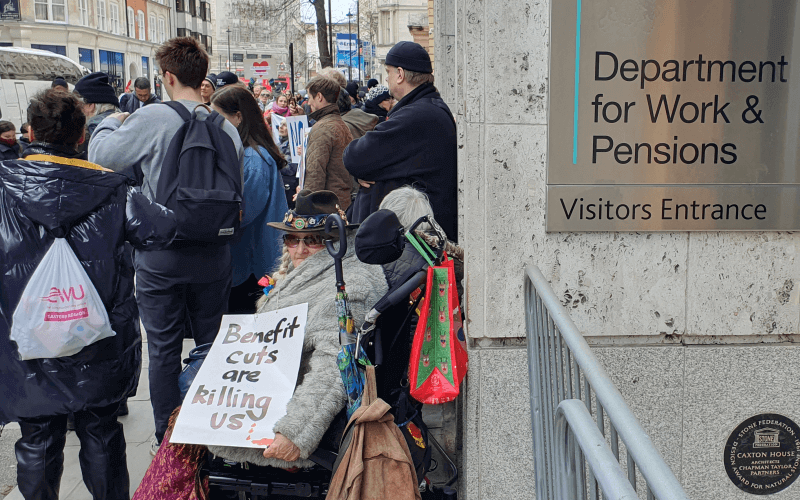
Disabled people’s organisations (DPOs) have raised grave concerns about last week’s “less than honest” report from the Timms Review and have warned that it has “diluted” disabled people’s concerns about possible cuts to their personal independence payment (PIP).
Last week’s interim report from the PIP review concluded that it was increasingly vital to disabled people to fill in the gaps caused by cuts to services, but it also pointed to “deep-rooted” problems with how the benefit is delivered.
But in the days after its publication, DPOs have begun to warn of what appears to be an attempt by the report to water down disabled people’s concerns about PIP reform, the likelihood of future cuts to support, and misleading claims that the review is being co-produced with disabled people.
Some of these concerns came from PIP review consultation events hosted by DPOs, such as Disability Wales.
Dr Natalie Jarvis, policy and research officer for Disability Wales, which hosted two consultation events in the last month, told Disability News Service this week that multiple disabled people had spoken of suicidal thoughts and losing sleep because of the risk of vital PIP support being cut.
They also reported a rise in disability hate crime, stirred up by the mainstream media that she said was intent on painting disabled people as “economically inactive” and “scroungers”, and which has left some now too scared to go out in public.
Disability Wales is so concerned at the interim report providing a “very diluted” account of these concerns that it plans to produce its own shadow report when the government’s final Timms Review report is published, which will probably happen in November.
Jarvis said they were also concerned at the lack of attempts to provide safeguarding support for organisations like Disability Wales that have hosted workshops in the last few weeks as part of the review’s consultation process.
Another DPO, BuDS Disability Service, which has engaged with the Department for Work and Pensions for nearly 20 years, said the interim report fails to acknowledge that PIP was designed by the Conservative-Liberal Democrat coalition in the early 2010s to cut the cost of disability benefits by a fifth.
He said the review’s account of the origins of PIP was “incomplete and less than honest” because many of the faults it describes were “not system defects which have arisen over time, but deliberately designed features of PIP”.
BuDS also said the review was “calculatedly dishonest” about changes to society – such as an ageing population, the ongoing Covid pandemic and the cost-of-living crisis – that are creating more disabled people and therefore contributing to the rise in PIP claimants.
Dr Edmore Masendeke, policy and research lead for The Alliance for Inclusive Education (ALLFIE), said the suggestion in the report that PIP was often used for basic “survival” could be “misinterpreted to suggest that Disabled people do not need PIP to meet disability-related costs”.
He said the inadequacy of wider financial support had “significant implications” for securing inclusive education in England.
He said: “When PIP is insufficient to meet disability-related costs because it is being used simply to survive, families may be unable to afford transport to school or college, specialist equipment, personal assistance, extracurricular activities, or other adjustments that enable participation in their studies.”
He said ALLFIE was also concerned that the report failed to highlight any intersectional experiences of disabled people receiving PIP, despite this being mentioned in the report as one of the steering group’s objectives.
He said this was “a repeated pattern that we have observed in several consultations and calls for evidence across different government departments”.
National Survivor User Network (NSUN) said the report “accurately identifies that the PIP system is failing Disabled people” and that it is a “vital lifeline”.
But it said the claim that the review was being co-produced with disabled people was “untrustworthy” and warned that the review had originated from government attempts to cut PIP spending last year, and that the report was “let down by its overemphasis on employment”.
NSUN said: “Despite its focus on work, the welfare system is not an employment programme; it’s about making sure that everyone, regardless of who they are, can afford to meet their basic needs.
“People deserve to survive irrespective of whether they are able to work.
“We strongly suspect the full report will propose cuts to PIP, dressing them up as ‘in our best interest’.
“This is not co-production, nor is it listening; it is the groundwork for cuts which will claim we asked for it.”
Disabled People Against Cuts Cymru described the review as “a cynical distraction from falling living standards and a failing economy”.
It strongly believes – with support from a coalition of organisations – that the review has not been genuinely co-produced and has sidelined Welsh disabled people, who it says have been “treated with particular contempt”.
The coalition is calling on the UK government to pause any further cuts to disability support until the Welsh government enables an independent disability review in Wales, led by disabled people and their organisations.
A DPAC Cymru spokesperson said: “The Timms Review is badly dressed in the language of disability activism, but uses none of the methods.
“About the only thing the interim report gets right is that PIP is not fit for purpose.
“Disabled people, more than anyone, want a better system. The Timms Review will not deliver that because it is not designed to.
“The review is weaponising our concerns in order to justify cuts in a ‘caring’ way. Meanwhile, the ‘nasty’ arm of the UK government is demonising us.
“Caught in that pincer movement, disabled people are a political football.”
Disabled People Against Cuts (DPAC) said it believed the interim report hinted clearly at planned cuts to PIP, with neurodivergent people and those with mental distress those with most reason to be concerned.
Merry Cross, a member of DPAC’s national steering group, said any cuts were likely to add more deaths to those already linked with the Department for Work and Pensions over the last 16 years (see separate stories).
She also pointed to the failure to ensure proper co-production of the review.
Disability Rights UK said it was “very unclear where the Review recommendations are heading”.
It said: “The Government’s approach to social security for Disabled people has so far been punitive, with 50 per cent of the health component of Universal Credit having been cut for new claimants from April 2026 and harsh cuts to the Motability Scheme introduced.
“Government continues to make unfounded claims about the ‘spiralling’ costs of welfare and has an ‘us and them’ approach to Disabled people.
“With the hostile political backdrop, Disabled people are fully justified in being concerned about the scope of the Review recommendations, which is set to be published this autumn.”
People First (Self Advocacy), although it has not yet analysed the interim report in detail, raised concerns about the impact of cuts on people with learning difficulties.
Andrew Lee, director of People First, said: “We are very worried that the benefits debate is being used as a political football, and I think that needs to change.”
He said PIP was “absolutely crucial” in meeting the disability-related costs faced by people with learning difficulties.
Members of the London Campaign Network, a group of self-advocates with learning difficulties across the capital that is coordinated by People First, have expressed their concerns about possible cuts to PIP, said Lee.
He said: “The London Campaign Network members are worried that a lot of what is being said by MPs generally and the government is going to take our benefits away.
“We kind of feel under threat.”
Svetlana Kotova, director of campaigns and justice at Inclusion London, said: “We understand and share the anxiety that many PIP recipients are feeling about the prospect of cuts to their vitally needed support.
“The PIP review panel must stand up for disabled people and protect our PIP.
“They should use the evidence they now have to refuse to co-produce cuts that would harm our community and drive many further into poverty.”
 Conservatives’ £1 billion Motability VAT plan will decimate scheme and raise almost nothing, figures show
 Leaked DWP ‘corner-cutting’ plans reveal changes to checks on assessments that will cause ‘even more risk’
 Information Commission orders DWP to release secret report that examined quality of PIP phone assessments