
The former Tory minister who wants to be chancellor in a Reform UK government has been unable to provide any evidence for his repeated claim that benefit claimants with mental ill-health are “gaming the system”.
Robert Jenrick ignored government figures that show tiny levels of personal independence payment (PIP) fraud, while he claimed that many claimants were “scroungers” and that his views were simply “common sense”.
Disability News Service (DNS) confronted Robert Jenrick with the fraud figures after he spoke at a fringe event at the party’s annual conference in Birmingham, but he twice refused to say whether he accepted them.
He had earlier told the Centre for Social Justice event that the system had been “gamed by a lot of people” and that it was “just common sense” that there were not “two or three times as many people with mental health issues in our country today as there were before Covid”.
He also said it was “wrong that hard-working Brits are having to pay for those people through choosing not to work”.
He repeated Reform’s pledge to cut £50 billion a year from spending on “welfare”, including by applying stricter eligibility when claimants were receiving benefits for “mild conditions, when it’s just life, it’s medicating human experiences”.
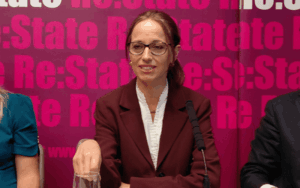
Jenrick (pictured speaking at the event) said this would give a Reform government “a fighting chance to cut taxes for working people and pensioners”.
Just days later, new results from the British Social Attitudes Survey showed the public strongly oppose cuts to spending on disability benefits, and that support for such spending “remains strong across the political spectrum”, including among Reform UK supporters (see separate stories).
Jenrick repeatedly mirrored the disablist rhetoric that was common under the 2010 Conservative-led coalition government, telling the fringe event: “My view is that Reform is the party of workers, we are on the side of working Britain, we put working people first; we are not for people who are on Benefits Street.
“We are not talking about people with genuine disabilities, we are talking about a much smaller subset of people, who maybe in the last few years are claiming benefit for things like mental health.
“It cannot be beyond the wit of man to get this country back to the way it was before Covid.
“To have the same number of people claiming for mental health as there were before the pandemic.
“I can tell you the people who are voting Reform who will get me re-elected at the next election are not scroungers, they are hard-working people, and they are the very people who are most angry and frustrated at the people who are taking the mick, because they are their next-door neighbours.
“You’re talking about somebody in Newark who’s getting up at seven o’clock in the morning to go and work in a distribution centre doing a tough job, earning barely enough to pay the bills at the moment, and maybe there is somebody on their street who the curtains are closed on their house, they’ve got the Motability car on the drive and everybody knows they don’t really need to have those benefits.”
After the event, DNS asked Jenrick for his evidence that disabled people on PIP have been gaming the system when the government’s official rate of PIP fraud was just 1.4 per cent in 2025-26.
DNS also asked Jenrick: “What if you’re wrong, and what if most of those on PIP really do need that support?”
Instead of commenting on the fraud figures, he said his point about the post-Covid increase was just “common sense” although he accepted that it “may seem a simplistic observation”.
He said: “Are we that much sicker as a country? I don’t think we are.
“I appreciate that Covid… I said earlier, lockdown had a profound impact on the country, and on some people in particular.
“I don’t believe the country is twice as sick when it comes to mental health than it was five or 10 years ago.”
When asked again if he accepted the government’s PIP fraud figures, he said: “I haven’t…
“The point I’m making is if people are genuinely unwell then there’s nothing to be afraid of [about] being reassessed, and the reassessments we are proposing are face-to-face assessments by trained clinicians, so people who have genuine disabilities, whether that’s mental health or anything else, will be fine.
“But it will be people who do not have genuine disabilities who I think will have something to be concerned about; I think we can all agree that that’s not right.”
 Conservatives’ £1 billion Motability VAT plan will decimate scheme and raise almost nothing, figures show
 Information Commission orders DWP to release secret report that examined quality of PIP phone assessments
 The Times ignores efforts to draw its attention to years of DWP deaths as it launches its own ‘welfare inquiry’