Disabled children and young people are being placed at risk of abuse because they are missing out on “vital” relationship and sex education at school, according to a new report.
The research found “patchy” provision of relationship and sex education (RSE) for pupils with special educational needs and disabilities (SEND), which has been compulsory in schools in England and Wales since 2020 for those up to the age of 16.
The report’s authors say government guidance on RSE only briefly mentions disability and focuses on safeguarding of disabled pupils while failing to acknowledge that they will “also be looking for intimacy and connection in their lives”.
They say that, by failing to give SEND pupils “the tools to understand the dynamics of good and bad relationships”, schools are placing them at greater risk.
A disabled person is two to three times more likely to experience sexual violence than a non-disabled person, while disabled children are three times more likely to experience sexual abuse, the report points out.
The research report, Yes, We Can Have Sex!, was written by user-led organisation Stay Safe East – which provides advocacy and support to disabled Londoners who have survived domestic and sexual violence, hate crime and other abuse – and the University of East London.
Stay Safe East said yesterday (Wednesday) that good quality RSE was “vital” to disabled children and young people.
The researchers interviewed mostly disabled women, and also some disabled men, about their experiences of RSE and school.
One said: “Often, children don’t get the sex education they deserve, but if you have additional needs or you’re disabled, you’re even less likely to get it.”
Another said: “It’s about equality… people who’ve got disabilities… why should they not have relationships?
“They are just as entitled to having sex and relationships and children and families as everybody else…
“They need to have that information in an accessible way that they understand it.”
A third interviewee said: “Yeah, it was triggering for me. It made me feel that I was a lot different… I felt like I wasn’t a woman.”
The researchers now want the Department for Education to update guidance in consultation with disabled children and young people; to ensure RSE is accessible and that disability “isn’t only viewed through a safeguarding lens”; and RSE to include the perspectives of disabled young people.
They say the RSE curriculum fails to reflect the life experiences of disabled young people, and that RSE is rarely accessible to them and usually fails to include them.
It also calls for SEND students to have access to RSE after they reach the age of 16.
And it says the government should develop and deliver an awareness campaign that challenges ableism within schools and disrupts the “othering” of disabled students that sets them up as victims of abuse, while also providing specialist training to teachers.
The report says education authorities should ensure that all children and young people who are not in school can access RSE.
It also calls for funding to deliver RSE to disabled children and young people in the community, provided by disabled-led specialist services.
And it wants Ofsted to review the RSE curriculum, focusing on how it reflects the experiences of children with SEND.
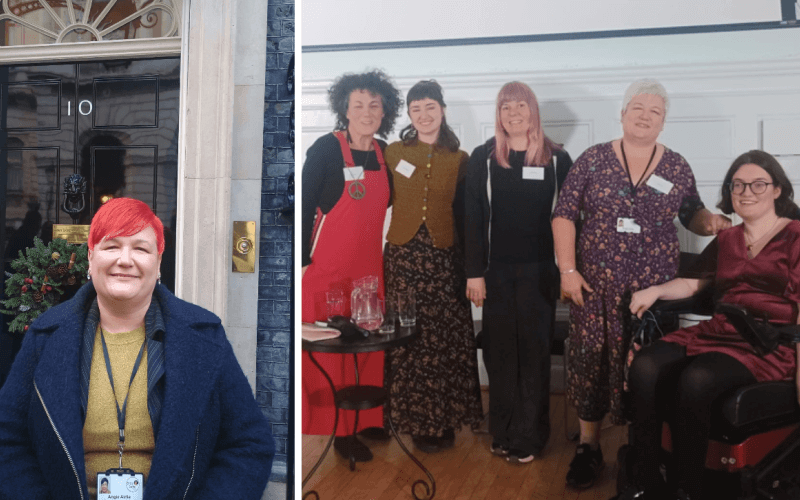
Picture: Angie Airlie (left), Stay Safe East’s chief executive and one of the report’s authors, in front of 10 Downing Street, and Airlie (second from right) at the launch of the report this week at End Violence Against Women’s Prevention Conference
 Shadow minister says parents don’t ‘game’ SEND system… but Kemi says disabled adults do ‘game’ the benefits system
 DWP’s ‘frightening’ failure to protect victim of domestic violence must lead to change, say advocates
 Ministers launch ‘inclusion base’ guidance after research finds concerns over existing units in schools