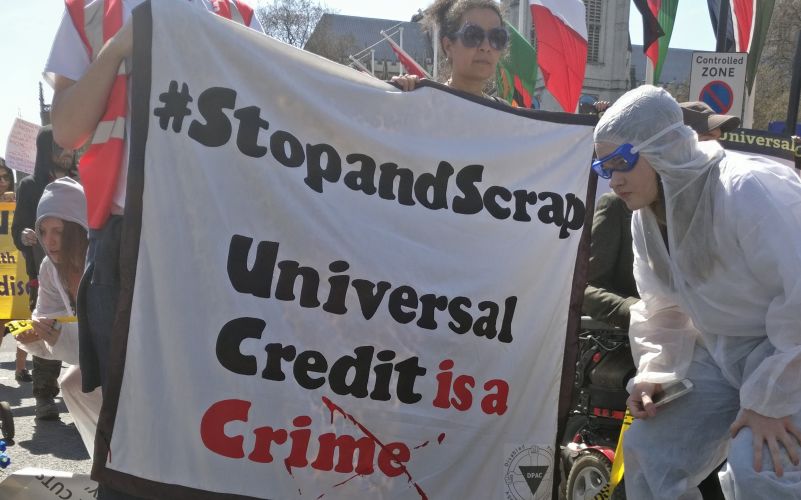
Every one of a sample of about 100 disabled people forced onto universal credit is now receiving less in benefits than when they were transferred from so-called legacy benefits, analysis of their claims by lawyers has revealed.
Many of the sample, who were “migrated” onto universal credit in the years leading to 2019, are struggling with monthly income that no longer covers their essential bills, solicitors responsible for the group legal action have told Disability News Service (DNS).
Law firm Leigh Day has so far looked at about 100 cases as part of the claim against the Department for Work and Pensions (DWP).
Every one of those disabled people is now receiving less in benefits than when they received legacy benefits.
DWP has always insisted that many disabled people would be better off on universal credit and that anyone who would otherwise lose out when transferring from benefits such as employment and support allowance (ESA) would receive “transitional protection”.
In 2016, DWP said that people “moving from the current system to universal credit in the future will receive transitional protection and have their benefit level maintained”.
But the department failed to highlight in that statement how that transitional protection would gradually be eroded over time.
The new analysis from Leigh Day now shows how many disabled people are being forced into poverty by the move to universal credit.
The transitional protection meant that everyone who was moved onto universal credit when their circumstances changed, in the years up to 2019, was initially no worse off than under their previous “legacy” benefits.
But Leigh Day is representing more than 200 disabled people who previously received severe disability payment (SDP), enhanced disability premium (EDP), or both SDP and EDP, in addition to benefits such as ESA.
These claimants were all forced to transfer onto universal credit in 2016, 2017 and 2018, before DWP changed the migration rules in January 2019.
Because SDP and EDP no longer exist under universal credit, many claimants had to rely on transitional protection to prevent their benefits being cut after the migration.
Ryan Bradshaw, a partner at Leigh Day, says he has been through about 100 cases and every one of those claimants is now receiving less in benefits than they were six, seven or eight years ago, after moving across to universal credit.
He said: “All of the ones I have looked at so far are now on less than they were before, when they were on legacy benefits.
“We have seen a decrease in incomes. Some of them have been on universal credit for eight years.”
And, he said, most of those affected are now “running deficit budgets”, which means their income does not cover their monthly bills.
A key reason for their payments being lower is that transitional protection does not take account of “erosion”, which reduces the transitional protection by the amount of any increase in benefit income until – eventually – it is reduced to £0.
One of the reasons for this erosion is that when benefits are increased – uprated – every April to take account of inflation, the transitional protection is reduced by the same amount*.
Bradshaw said the deficit budget issue had become “particularly acute” in the last 12 months, probably because of the impact of soaring inflation.
Another reason for payments being lower for some of the claims Bradshaw has examined is that it is much easier for DWP to automatically reclaim past benefit overpayments and other debts through the universal credit system than it was under ESA and other legacy benefits.
A parliamentary briefing published last year (PDF) found that of 4.96 million households in Britain on universal credit in February 2023, 2.25 million (45 per cent) had a deduction – such as advance repayments to DWP and third-party deductions for money owed for electricity bills, council tax, rent or other debts – with the average deduction of £61 that month.
Leigh Day is taking a group action – which focuses on the same arguments as the long-running series of TP and AR cases against DWP – which involves about 200 disabled people seeking compensation from the department over the loss of their EDP, SDP or both EDP and SDP.
Ken Butler, welfare rights and policy adviser for Disability Rights UK, said: “Transitional protection is a puny fig leaf failing to disguise the fact that many disabled people are worse off under universal credit in the longer term.”
He said transitional protection for the loss of SDP and EDP was only won after the long TP and AR campaign in the courts.
But he added: “While an important legal victory, financially benefiting thousands of disabled claimants, it’s inevitably been a transitory one.”
He called on the next government to add SDP and EDP to the universal credit system, and to provide an “essentials guarantee” that would ensure disabled people “can afford not just the basics but meet too their extra disability-related costs”.
He said: “This is the only way existing and new claimants in the future will not be penalised.”
Finn Keaney, welfare rights manager for Mind in the City, Hackney and Waltham Forest, told DNS: “For a decade, we have been told that universal credit was introduced as a fairer and simpler new replacement to legacy benefits.
“But in the East End of London, our service is still receiving calls almost daily from disabled adults who don’t understand how they are expected to survive on less under universal credit than they were on ESA.
“It is ironic that due to transitional protection being eroded over time, the longer a disabled adult has been on universal credit, the worse off they are likely to be: people are essentially being punished for having been amongst the first to benefit from the new, ‘fairer’ system.”
He also called for the reintroduction of disability premiums under universal credit and for an end to “the confusing and unfair system of erosion”.
Bradshaw stressed to DNS that his figures are based only on the small sample of about 100 cases he has examined.
But he fears that most, if not all, of the estimated 15,000 claimants who were forced onto UC in 2016, 2017 and 2018 because their circumstances had changed will be in similar situations.
He points to a study published last month (PDF) by the Institute for Fiscal Studies, which showed that an out-of-work single disabled adult who also received the daily living component of personal independence payment would, on average, be £2,826 a year worse off – in the long-run, once transitional protection has completely eroded – when transferred onto universal credit.
The rollout of universal credit to the remaining hundreds of thousands of disabled people still receiving income-related ESA will begin in September.
DWP said yesterday (Tuesday) that it was unable to comment on ongoing court cases, but it said that transitional protection was not intended to permanently replicate legacy benefit awards.
It said transitional protection was based instead on the principles of protection at the point of moving from legacy benefits and ensuring equality among those claiming universal credit with no previous legacy entitlement.
But Ayla Ozmen, director of policy and campaigns at anti-poverty charity Z2K, said that ministers had often not been clear that, over time, the move to universal credit would make many people on low incomes worse off.
She said Z2K was also “really concerned” that many claimants were missing out on the transitional protection they were entitled to when moving to universal credit.
She said: “Those who miss their deadline and claim too late risk having their benefits cut off altogether and not receiving any transitional protection.”
She said it was “really critical” that the next government gets the managed migration of people on universal credit right and “stops cutting off vital income”.
She said: “We’re calling for whoever forms the next government to stop putting the responsibility on people to make a new claim for universal credit, even if there’s been no change in their circumstances.
“But until that happens, anyone who gets a migration notice should act on it, to make sure they get what they’re entitled to.”
*Leigh Day provides the following example to highlight the impact of erosion: if transitional protection was £120 in March 2024, and the disabled person was moved onto the universal credit limited capability for work-related activity group, when benefits were uprated by £51.02 in April 2024 the transitional protection would have reduced to £68.98 and the annual uprating would not have increased their benefits. Their total benefit income would not have changed, despite the impact of inflation.
A note from the editor:
Please consider making a voluntary financial contribution to support the work of DNS and allow it to continue producing independent, carefully-researched news stories that focus on the lives and rights of disabled people and their user-led organisations.
Please do not contribute if you cannot afford to do so, and please note that DNS is not a charity. It is run and owned by disabled journalist John Pring and has been from its launch in April 2009.
Thank you for anything you can do to support the work of DNS…
 Budget is ‘miniature sticking plaster’, disabled people warn as they await Timms and Milburn reports
 Alarm bells ringing after minister says all work is good for health, and he wants ‘everyone’ to get a job
 PIP review member delivers powerful rebuttal to research by colleague that called for cuts to child DLA