A new piece of co-produced research will examine the advantages – and risks – of using artificial intelligence (AI) to support disabled people to live independently.
The research, which has secured funding from the British Academy, will see academics work in co-production with disabled people and carers, who will help to design and steer the pilot project.
The project will explore how disabled people are using AI voice-based technologies, such as the Amazon Echo, to deal with the access issues they face in their daily lives and enhance their independence.
But as well as exploring these opportunities, the project will also examine the risks of greater use of AI, such as making it easier for public bodies to make further cuts to health and social care budgets.
Academics at Loughborough University will work on the project with Mark Harrison, formerly chief executive of the disabled people’s organisation Equal Lives and more recently founder of the social enterprise Social Action Solutions.
Because the research is being co-produced, disabled people and carers will act as “co-investigators” and will have a say at every stage of the research project.
Its findings will be shared with disabled people’s organisations and parliamentary groups on AI, disability and social care.
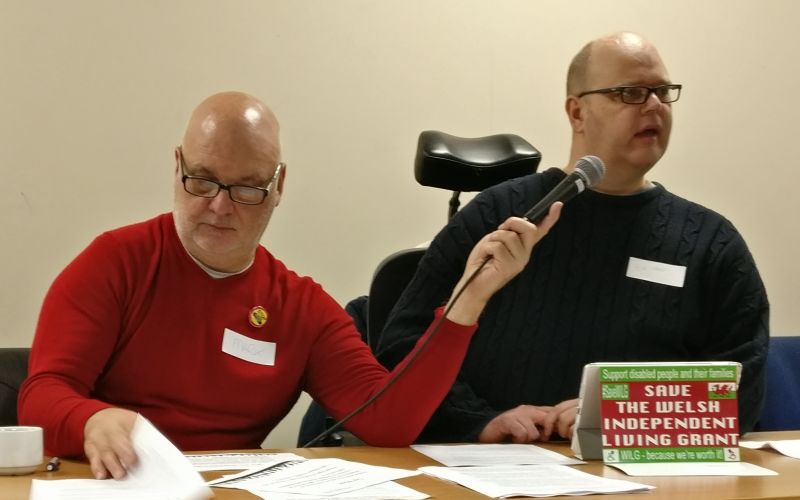
Harrison (pictured, left) said: “The crisis in social care is one of the big political and social policy issues of our time. Unfortunately, the debate often focusses on cost rather than quality of life.
“Our research approach puts disabled and older people at the heart of the enquiry process.
“Because it is rooted in the real lives of people who use care services, we are confident there will be positive outcomes for participants.
“By co-producing the research with experts, one aim is to enable people to empower themselves through the process.
“Another key aspect will be peer-to-peer learning, connecting people who can share experiences and creating a community of AI users.”
Dr Saul Albert, of the university’s School of Social Sciences and Humanities, who is leading the project, said: “Disabled people are very adept at adapting consumer devices to deal with access issues.
“In the next few years, the big tech companies will put voice technologies in every home, so we want to use this opportunity to make sure access needs are considered.”
He said that many of the “wacky” ideas about robot carers “sensationalise” the use of AI and “ignore the more fundamental obstacles that disabled people face in society”.
He added: “Similarly, health and care services often focus on how technology will ‘fix’ individual people’s impairments, rather than looking for relatively cheap and straightforward systemic adaptations to the environment that could provide greater accessibility for everyone.”
Albert said that most of the disabled people he and his colleagues had talked to for previous research believe that these technologies “will be used to drive efficiency, to reduce provision of personal assistants, and to justify further cuts to social care budgets”.
His team has been awarded funding by the British Academy to run the pilot project for one year.
Its findings will be used to develop a four-year project that they hope will run from 2020-2024.
Any disabled users of technology interested in helping to shape the project can email Albert at [email protected]
A note from the editor:
Please consider making a voluntary financial contribution to support the work of DNS and allow it to continue producing independent, carefully-researched news stories that focus on the lives and rights of disabled people and their user-led organisations.
Please do not contribute if you cannot afford to do so, and please note that DNS is not a charity. It is run and owned by disabled journalist John Pring and has been from its launch in April 2009.
Thank you for anything you can do to support the work of DNS…
 Government announces £400 care charges ‘cash boost’, while quietly snatching funds from savings
 Safeguarding probe launched after veteran disabled activist reports ‘terrifying’ care home experience
 New film celebrates 10 years since ‘moment in time’ victory over care charges in London borough