
Disabled activists in the UK have backed a US campaign that will call on actor and film-maker George Clooney to step away from a movie adaptation of a memoir that treats disability as a “fate worse than death”.
In Love is based on US writer Amy Bloom’s In Love: A Memoir of Love and Loss, which describes how she accompanied her husband to end his life by assisted suicide at the Dignitas clinic in Switzerland following his Alzheimer’s diagnosis.
Clooney will star alongside Annette Bening in the movie, which is currently in production.
But the US grassroots organisation Not Dead Yet (NDY) is writing to Clooney to ask him to step away from the project, with support from other US disability rights campaign groups, including Autistic Self Advocacy Network, Deaf Equality, and Disability Rights Education and Defense Fund.
The campaign has already won support from Not Dead Yet’s UK sister organisation, Not Dead Yet UK (NDY UK).
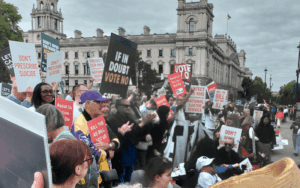
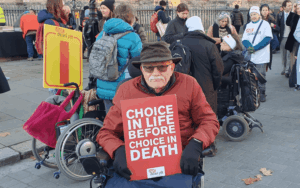
It comes as NDY UK continues to fight attempts in the UK parliament to legalise assisted suicide in England and Wales.
The disabled crossbench peer Baroness [Jane] Campbell, founder of NDY UK, told Disability News Service: “How many more decades must we wait for the film industry to stop portraying disabled people as tragic victims of their diagnosis, who despise their lives so much, they wish to end it all?
“This latest film plays into the age-old stereotype of how society sees disabled people, in this case Alzheimer’s.
“And yet, if you ask people with the condition, they invariably express a strong desire to be treated as individuals who wish to maintain their dignity, autonomy, and social connections like everyone else.
“This continual portrayal of Alzheimer’s as a fate worse than death does nothing for the self-worth of people living with the condition, their families and community.
“It can only help reinforce the view that suicide is not only the preferable course of action but the right course of action for all concerned.
“It’s dangerous, as it plays into the narrative of those campaigning for assisted suicide to become legalised, which disabled people deeply fear.
“There is no place for disabled people to thrive in this kind of culture, and a film starring the Hollywood great George Clooney only serves to perpetuate it.
“Therefore, we have asked him to walk away from it and in doing so, support our right to be portrayed as living, thriving humans with rights.”
NDY’s letter to Clooney also calls on him to abandon the film project.
It tells him: “Like Me Before You and Million Dollar Baby before it, In Love treats disability — in this instance, Alzheimer’s disease — as a fate worse than death, rooted in the eugenic idea that life with a disability is not worth living.”
And, it says, the novel suggests that suicide is “the natural, moral, and rational outcome” to a diagnosis, which is “a dangerous narrative and conclusion that we categorically reject”.
It adds: “Films like In Love and Me Before You help normalize the idea that suicide is rational and even heroic in the presence of disability.
“Worse, they suggest that by killing ourselves we finally free our caregivers, friends, and families from the perceived burden of our continued existence.”
It also points out that, in the US, every national disability rights organisation that has taken a position on assisted suicide legislation opposes it, and not a single national disability organisation supports it.
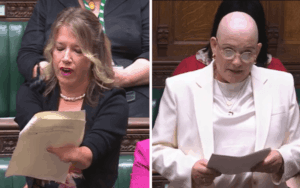
Picture: Baroness Campbell (left) at a Westminster protest in June 2025 against moves to legalise assisted suicide, and George Clooney at the 63rd annual New York Film Festival in 2025 for the film Jay Kelly. Picture of Clooney by Bryan Berlin, CC BY-SA 4.0 https://creativecommons.org/licenses/by-sa/4.0, via Wikimedia Commons
 Relief and tears after MPs reject assisted dying bill, as attention turns to palliative and social care
 Disabled MPs voted against assisted dying bill by two to one, records show
 Government admits disabled people may face ‘subtle pressure’ to choose an assisted death, if bill passes