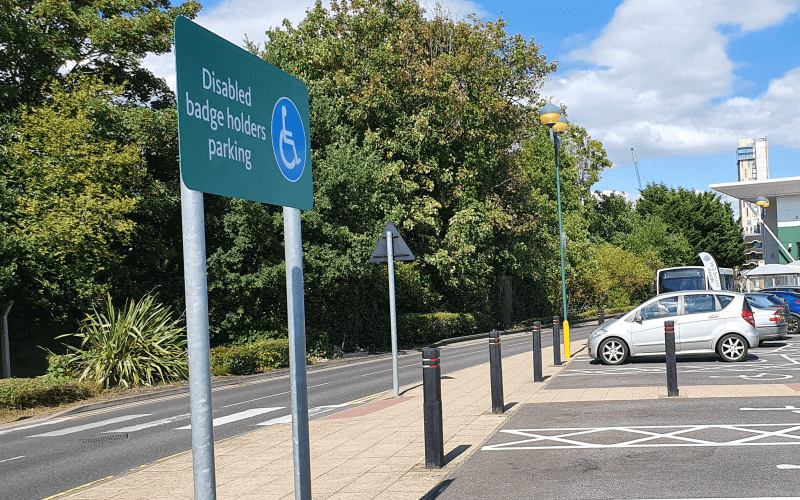
Years of scapegoating rhetoric and politicians casting disabled people as “scroungers” have reinforced prejudices about the blue badge parking scheme and led to “envy and resentment” instead of equal access, according to a four-year research project.
Half-hearted implementation of the scheme has left disabled people who rely on it feeling worried, angry and frustrated, and like “second-class citizens”, because of the encounters they have had while trying to use their badges, the research concludes.
The research was carried out by Vera Kubenz, a disabled postgraduate researcher at the University of Birmingham, and herself a blue badge holder.
She said this week that she feared that recent rhetoric around disabled people receiving “free cars” through the Motability scheme, and the need for cuts to disability benefits, would lead to a fresh wave of such aggressive and hateful encounters.
In a summary report based on her research, Disabled People’s Encounters with Strangers in Accessible Parking Spaces, Kubenz concludes that, as long as there is wider societal prejudice, hostility and suspicion aimed at disabled people, “there can be no such thing as a truly accessible space”.
As part of her research, she surveyed more than 300 disabled people with experience of encounters – good and bad – while using their blue badges.
In the survey, 74 per cent of disabled people said they had been accused of “faking” their impairments while using their blue badges.
These types of encounters were particularly common for younger disabled people, with some told they were “too young” to be disabled.
One of those who took part in the survey, who is 49, said: “A member of the public stopped me as I was parking in a Blue Badge space.
“He knocked on my window, I wound it down and he told me I shouldn’t be parking there, and I had no right to be there.
“I explained I was disabled. He said I was too young and there was nothing wrong with me.
“I proceeded to get into my wheelchair and get out of the car, in fairness, he did look quite embarrassed when I got out of the car.”
The impact of such encounters was clear, with 91 per cent of disabled people who took part in the survey saying they worried about them, with 40 per cent always worrying and 35 per cent worrying a lot, while more than two thirds (68 per cent) said they sometimes did not use their vehicles because of the worry.
Another survey participant said: “A man in his 50s came over trying to take our car keys out of the car (luckily it was a keyless ignition Motability vehicle).
“When he realised he couldn’t get the key he came round to my side trying to grab my Blue Badge.
“We was called every name under the sun. The c word, the n word, lots of f yous.
“All because we had parked in the disabled bay… I was that upset with the whole incident I wanted to just leave and not have my operation.”
Common locations for encounters were supermarket carparks (87 per cent of those surveyed), near shops (70 per cent) and at hospitals or GP surgeries (58 per cent).
Most people (70 per cent) experienced encounters between a few times a year and a few times a month.
People with chronic illness, who were neurodivergent, or who had mental health conditions were particularly likely to be confronted over their use of accessible parking spaces.
Many of those surveyed said that being under constant suspicion meant they always felt on edge and worried that an encounter could happen at any moment.
Two thirds (67 per cent) of disabled people taking part in the survey had experienced hate and harassment in accessible parking spaces.
Negative encounters could involve staring, tutting, or hushed comments, while nearly half (46 per cent) of people had been insulted and a third (32 per cent) had been threatened, while some (six per cent) had been subjected to physical violence.
But most people (69 per cent) had also had at least one positive encounter, often a positive chat with another blue badge holder.
Kubenz says in the report that enforcement of blue badge spaces is often a postcode lottery.
Although some of those surveyed said their councils took action to enforce rules around the use of blue badges, many others said their council took no action.
One said: “I wish that Blue Badge parking was properly policed because what we have now is the worst of both worlds, people making assumptions and not looking at the badge and trying to police it for the benefit of those who do, but in doing so make lots of assumptions.”
Ultimately, says Kubenz, all disabled people who use blue badges risk confrontations because “nobody can live up to the impossible stereotype required for being truly ‘deserving’”.
The survey of 304 blue badge holders was carried out in 2023, while there were 20 follow-up interviews; it was open to holders of blue badges who had had at least one encounter, were over 18, and lived in England.
Kubenz told Disability News Service this week: “I am very concerned that the renewed government and media statements about disabled people’s ‘free cars’ and cuts to both in- and out-of-work benefits will intensify the resentment non-disabled people have against all disabled people, and that this will lead to more encounters because people feel entitled to ‘police’ blue badge bays because they are seen as a perk rather than essential for access.
“These confrontations can range from underhanded comments to intrusive questions, verbal abuse, and even physical violence.
“I fear the current government rhetoric will directly contribute to more aggression and hate towards disabled people.”
She added: “Many of the people interviewed had little faith that the government would change anything about blue badge policy or awareness, precisely because they are responsible for so many of the misconceptions that lead to encounters.
“I conclude in my research that currently the blue badge scheme only provides bare minimum access; it is not about equality, but about keeping disabled people ‘in their place’.”
On Friday 12 December, between 12pm and 1pm, Kubenz is hosting a webinar on the findings of her Politics of Parking project, with guest speakers Anjna Patel, a trustee of Disabled Motoring UK, and accessible transport campaigner Christiane Link
A note from the editor:
Please consider making a voluntary financial contribution to support the work of DNS and allow it to continue producing independent, carefully-researched news stories that focus on the lives and rights of disabled people and their user-led organisations.
Please do not contribute if you cannot afford to do so, and please note that DNS is not a charity. It is run and owned by disabled journalist John Pring and has been from its launch in April 2009.
Thank you for anything you can do to support the work of DNS…
 Slow but steady progress on UK air travel access improvements, says report
 Conservatives’ £1 billion Motability VAT plan will decimate scheme and raise almost nothing, figures show
 National accessibility standards are crucial for addressing transport barriers, Tories hear at conference