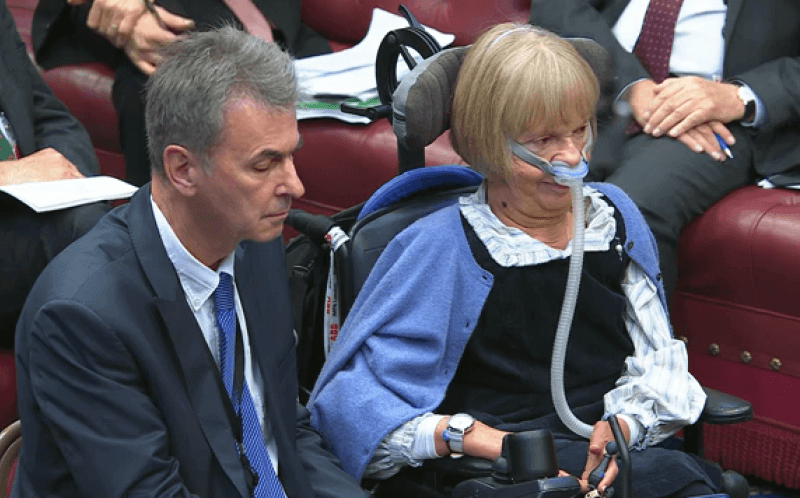
A disabled peer has broken new ground this week by using a version of her own voice – generated by artificial intelligence (AI) – to deliver a speech in the House of Lords.
Baroness [Jane] Campbell used voice cloning technology devised by global AI company ElevenLabs – which was founded in London – to create an AI version of her voice that was based on recordings of her speaking before 2012, when she began using a ventilator full-time.
The crossbench peer hopes the technology will give hope to other disabled people with speech impairments and who struggle to speak in public.
By uploading pre-2012 recordings of her speaking, she created an AI voice that replicates the tone, rhythm, and pitch of her original voice.
She then used ElevenLabs’ text-to-speech generator to create an audio version of her speech, which was played through an assistive device in the Lords.
Since 2012, Baroness Campbell has spoken in the Lords using a combination of her own voice and a personal assistant (PA) reading her words.
She is the only peer allowed to bring a PA into the Lords chamber.
But the Lords procedure and privileges committee has now granted her permission to record speeches in advance using the AI technology, as a reasonable adjustment under the Equality Act.
Tuesday was the first time an MP or peer has used an AI voice generator to deliver a speech in parliament.
Baroness Campbell told Disability News Service before her speech that the new technology left her feeling “very excited and extraordinarily empowered”.
She said: “Even though my PA often reads out parts of my speeches, it has been exhausting trying to read the rest and I realised some of my colleagues simply couldn’t follow what I was able to say a lot of the time.
“So, when I came across this software and tried it out, I was blown away by its accuracy – to the point of it being quite spooky.
“I have already trialled it when giving a lecture on assisted dying legislation for NHS respiratory and neurological consultants, and you couldn’t hear a pin drop – it really drew them in due to its clarity and subject matter.”
She said she now hoped that “other disabled people who struggle with public speaking will know that this does not have to be a barrier to inclusion at the highest level, if they want.
“It offers endless opportunities for those who struggle to be heard, whatever their speech challenges are.
“And the best thing is that nobody will speak for you at that level – super empowering.”
She accepted there were limitations to the technology because the disabled person must prepare their speech in advance, while there must also be a good quality recording of their voice before it was lost or deteriorated.
She was able to use media interviews such as her appearance on BBC Radio 4’s Desert Island Discs in August 2012.
She delivered the speech on Tuesday afternoon (watch from 16.11 onwards) during the second reading of the government’s health bill.
Her speech focused on the importance of ensuring that personal health budgets (PHBs) – something she relies on to fund her own support – remain accessible to disabled people who need them and that the government does “not replace personal control with a one-size-fits-all service”.
She said the government must continue to allow PHBs – which were designed to give disabled people “the right to necessary support to lead ordinary lives, on their own terms, no matter how complex their medical needs” – to be delivered through direct payments, which give users such as herself “greater control over NHS funding”.
She warned that some integrated care boards were “showing creeping rigidity over the use of PHBs”, and she highlighted the case of Lucinda Ritchie, who was “forced into residential care from hospital against her will, rather than be able to return to her adapted bungalow and her experienced PA team”, until Baroness Campbell helped raise the case in the media.
She said she would be scrutinising the bill to ensure that it “does not weaken PHB protections and freedoms”.
And she told fellow peers: “Let us ensure that the medical model does not swallow decades of progress on disability rights and independent living.
“I am not a medical diagnosis but a wife, grandparent and working member of the House of Lords. ICBs would do well to reflect on that.”
Through its Impact Program, ElevenLabs provides free, lifetime access to voice restoration technology for people living with permanent voice loss, and has so far helped more than 11,000 people, with the aim of eventually reaching one million.
Mati Staniszewski, co-founder and chief executive of ElevenLabs, said: “Our voices carry a part of our identity, and losing the ability to use them can mean losing the ability to take part in the conversations that shape our lives.
“Baroness Campbell has spent decades advocating for disabled people, and we are proud that our technology can help her do exactly that in the House of Lords and beyond.”
Picture: Baroness Campbell listening to her speech being delivered by an AI-generated version of her voice
 Defeat of ‘dangerous’ assisted suicide bill is just a pause in our fight, say disabled opponents
 Scottish vote against assisted suicide provides ‘new impetus’ for opponents of Westminster bill
 Peer warns of ‘backward slide to dependency’ after disabled woman’s forced move to nursing home