The rail sector has been accused of a “scandalous” failure to take advantage of the “rich and important” data from a unique mass public consultation that heard from many tens of thousands of disabled rail passengers.
Transport Focus was one of two passenger watchdogs that ran the consultation in 2023 on plans to close nearly 1,000 rail ticket offices across England, which produced more than 750,000 responses.
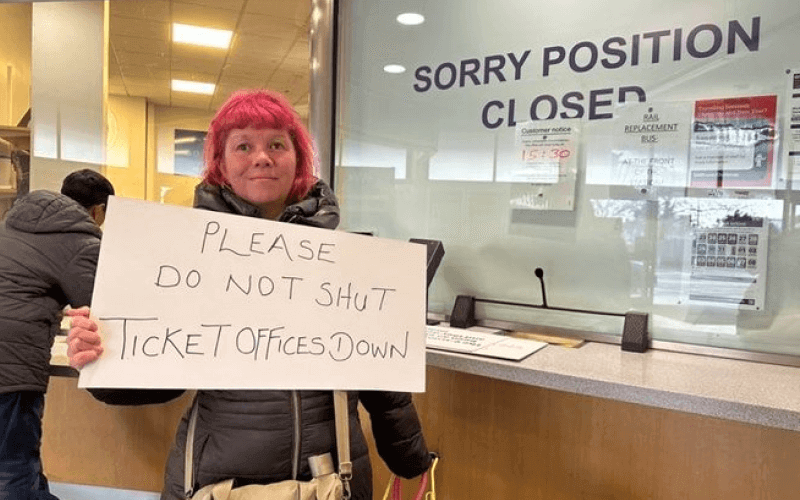
Opposition from disabled rail passengers to the proposed closures played a key part in defeating the plans, with Conservative ministers eventually asking train operators to withdraw their plans.
The consultation is believed to be the largest exercise ever to have mined the views of disabled rail passengers on the accessibility of the rail network in England.
Transport Focus said the following year, in its 2023-24 accounts, that the consultation “generated some excellent insight, particularly relating to the needs of some minority groups”.
This information included the views of disabled passengers on the ease of buying tickets, assistance to travel, availability of ticket information, and safety at stations.
The report added: “The proposals were ultimately dropped, but the data gathered and our analysis are [a] rich and important resource of passengers’ views about ticket offices.
“This data and analysis are now being used by the industry.”
But when the Association of British Commuters (ABC) attempted to find out how this data was being used, Transport Focus said its claim had merely been “aspirational” and “not something that has materialised since it was made”.
It said: “The data gathered as part of the ticket office closure process has not been used in the way we might have wished.”
It added: “No further use is being made of this data, nor has it been shared with other agencies, and it is not in use in any part of the industry.
“To the best of [our] knowledge we haven’t shared the data or even done any further analysis.”
It also admitted that no meetings had taken place which discussed the data and analysis.
And it added: “The industry showed no appetite to continue engaging on this topic following the consultation.”
Emily Sullivan, a disabled researcher in equality and human rights and ABC’s co-founder, said the information that came out of the consultation was “probably the most valuable dataset on disabled people’s experience of travel that has ever been collected”.
She said the data and analysis should have fed into policymaking and the government’s current reforms of the rail industry, and been shared with the wider industry.
She said the rail sector’s failure to take advantage of the information was “scandalous”.
She said: “We are still not getting the full story, and cannot establish whether the data still exists, or if it has been protected, but it is clear from these documents that the government and industry abandoned and ignored the data of 750,000 people.”
When asked about the failure to use its data and analysis, a Transport Focus said this afternoon (Thursday): “The data you refer to was used for the purpose it was gathered, leading to analysis that resulted in Transport Focus objecting to the proposals to close ticket offices and the subsequent withdrawal of those proposals.
“Transport Focus also used the data and analysis to inform its policy positions, but given that the proposals had been withdrawn it judged that further work would not be a good use of resources.
“To understand the extent to which the rail industry has used our analysis following publication of Transport Focus reports in October 2023 – all available here for reference – you would need to approach the relevant train operators.
“We could use the data now if we wished to, however it is two-and-a-half years old and likely to be of limited value, therefore we would be unlikely to do so.”
Asked about the Transport Focus data and analysis, the Department for Transport (DfT) referred to the watchdog’s response to the ticket office consultations, which was published in 2023 and which DfT said had guided several improvements to accessibility and passenger experience.
A DfT spokesperson said: “Making sure everyone can access public transport is a top priority, and we’re working hard to make our railways more accessible for everyone.
“Transport Focus’ important research and publications has already guided several of this government’s improvements to rail accessibility and passengers experience, including progressing Welcome Points and improvements to ticket vending machines.”
The Rail Delivery Group (RDG) – the secretive body that represents the companies and public bodies that run Britain’s railways – also referred to the watchdog’s response to the ticket office consultations, when asked by Disability News Service (DNS) about the data and analysis.
An RDG spokesperson said: “The industry understands the importance of the feedback received through the 2023 ticket office consultation and appreciates the input from the public and stakeholders.
“Since the end of 2023, the rail industry has been working to deliver the improvements based on feedback provided by passenger bodies – for example, trialling Welcome Points at stations to improve customer service and accessibility.
“Improving accessibility remains a priority.
“We continue to work with customers, accessibility groups, frontline staff (including through disability awareness training) and industry partners to deliver meaningful improvements.
“This includes improving services such as Passenger Assist and Turn Up and Go, and working with the government to deliver further improvements set out in the accessibility roadmap.”
Picture: Sarah Leadbetter, from The National Federation of the Blind of the UK, protesting at the threatened ticket office closures in 2023
 Level boarding pledge in government strategy is welcomed, but railways bill amendments are still vital
 Government refuses to say how many rail stations will provide level boarding after major investment
 Ministers condemned for ‘outrageous’ failure to listen to ‘vital’ demands on accessibility in railways bill