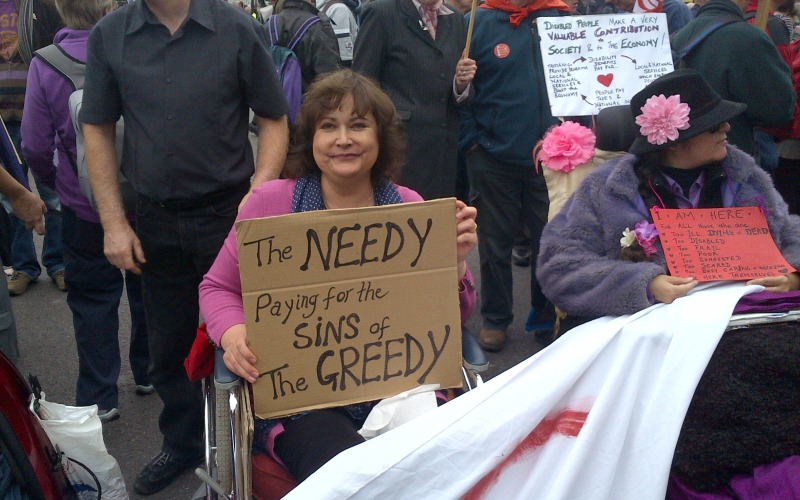
A new book by a campaigning journalist has exposed how disabled people and others were harassed, neglected and abused by the state bodies they were forced to rely on to survive during the years of austerity.
In Abusing Power*, Kate Belgrave particularly focuses on the actions of local authorities and the Department for Work and Pensions (DWP).
Belgrave’s book is based on five years of grassroots journalism in which she joined claimants at their jobcentre meetings, helped them with their claim forms, and confronted council leaders.
The book includes transcripts of covert recordings of interviews and meetings that show exactly how benefit claimants were treated by representatives of public bodies such as jobcentre advisers, local councillors and homelessness officers.
She manages to expose some of the “false statements” made by organisations like DWP, such as its claim that disabled people received “tailored” support from jobcentre advisers, following the decision to cut the number of disability employment advisers (DEAs).
Belgrave recorded jobcentre advisers saying exactly the opposite, “that removing DEAs from jobcentres had been disastrous for people with support needs, and that no ‘tailored’ or replacement service had been introduced”.
She also writes of the “institutional contempt for benefit claimants that permeated public sector organisations in austerity: a feeling that government rhetoric about scrounging claimants had taken hold”.
And she says that it was a “matter of luck” whether claimants found an officer who was decent and helpful.
DWP and local authorities, she said, held all the cards: “housing, benefits and the power to menace”.
She highlights how asking the state for help meant “having to sacrifice privacy and freedom” and being forced to attend repeated assessments where officers and assessors pick through their personal histories.
She writes: “People talked about making a choice and a major sacrifice either way: homelessness and freedom, or help and the grip of the state.”
One chapter examines the experiences of a disabled woman, Linda*, whose benefit claim was closed by her local jobcentre without warning because she had been extremely unwell and had not been given the telephone number to call when she was unable to attend a meeting.
Linda tells Belgrave in the jobcentre: “…they don’t give a shit, these people. They stopped my housing benefit and everything.
“It’s that woman over there – she didn’t give me the phone number…
“When I was ill, I couldn’t get hold of her. They don’t give a shit. Oh. I thought I was going to pass out in the bus… what’s bad is that if you’re ill, you can’t help being ill. But they don’t give a damn.”
Linda was left with no money, and faced eviction, but neither she, nor Belgrave, could find anyone on duty at the jobcentre who was willing to help her.
It was, writes Belgrave, an example of “bloodless bureaucracy” and “public sector dysfunction”, another “hostile” jobcentre where “aggressive sanctions regimes set advisers and claimants against each other”.
Belgrave told Disability News Service (DNS) this week: “I wanted to not only interview people who were experiencing the benefits system but also go through the experience with them – jobcentres and PIP assessments – and talk about how that experience of this brutal state has actually shaped people’s politics and thinking.”
As she spent more time with people, she witnessed how the “constant harassment” of being rung repeatedly by the council “starts influencing how you think” and leads to a “slow deterioration” in people’s wellbeing.
She describes how she spent time with Eddie*, who has learning difficulties and diabetes, and whose life had imploded after his mother died.
The lack of support led to him being stuck for years in a cycle of “filthy flats and jobcentre charades”, until an activist from Kilburn Unemployed Workers’ Group, who had volunteered to support him and spent months helping him try to navigate the system, eventually finds him a sheltered flat.
Belgrave believes that neither those on the right – with their view that those in poverty just need to “pull their finger out” – or those on the left, with their “romanticized views” that paint all those in poverty as a victim, have any understanding “of people’s complex situations”.
She told DNS: “This is how things unfold when people have no money and no recourse against the state that they are forced to rely on to survive.
“Fending off an intrusive, punitive, unaccountable state became the main focus of people’s lives. That relentless pressure started to affect the way that people thought and behaved.”
*Abusing Power: How an aggressive austerity state shaped people’s politics and lives. The book is not for sale, but it is available free for a limited period as a PDF document. Its publication was funded by a grant from the Barry Amiel and Norman Melburn Trust
**Not their real name
A note from the editor:
Please consider making a voluntary financial contribution to support the work of DNS and allow it to continue producing independent, carefully-researched news stories that focus on the lives and rights of disabled people and their user-led organisations.
Please do not contribute if you cannot afford to do so, and please note that DNS is not a charity. It is run and owned by disabled journalist John Pring and has been from its launch in April 2009.
Thank you for anything you can do to support the work of DNS…
 DWP silent after Tory member of PIP review publishes report demanding child disability benefits are slashed
 Timms refuses four times to rule out cuts to PIP, but makes firm promise on cash payments
 No decision from Timms on releasing secret reports on deaths, a year after speaking to DWP civil servants