
Disabled activists have spoken of their relief after MPs voted to reject a bill that would have legalised assisted suicide in England and Wales, but they say the focus must now shift to improving social and palliative care.
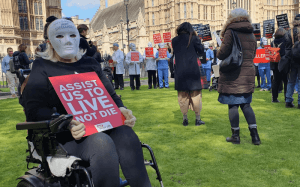
After months of lobbying and activism against the terminally ill adults (end of life) bill, there was a significant turnout of disabled campaigners outside parliament on Friday as MPs took part in the bill’s second reading debate.
The bill was first introduced to parliament in autumn 2024, but it ran out of time to complete its progress through the Lords at the end of the last parliamentary session in April, and it was re-introduced in this session by Labour’s Lauren Edwards.
Almost every disabled activist outside parliament who had been campaigning against the bill spoke of their relief after hearing the result of the vote at 2.43pm on Friday (pictured), with 286 MPs voting against the bill and 270 in favour.
But most also said they hoped attention would now turn to the need to improve social care and palliative care.
Baroness [Jane] Campbell, founder of Not Dead Yet UK (NDY UK), which leads disabled people’s opposition to legalisation, spoke of her relief at the vote, and admitted that she had had to confirm with a Lords doorkeeper that the bill had been defeated.
Baroness Campbell, who has been campaigning on the issue for 22 years, said it was one of the most important parliamentary victories during that time.
She told Disability News Service (DNS): “We knew if it passed that it would be rushed through the Lords and we would not be able to oppose it.”
She said: “I can understand why the other side feel upset.
“Nobody wants people to die intolerable deaths, we all want people to feel as comfortable as they can be during end of life.”
But she said activists should now put all their energy into “ensuring that palliative care becomes a reality and [there is] good social care support so… in the future people will have genuine choices at the end of life.
“I don’t feel satisfaction, there are so many people who we know are having such a difficult time with their health and social care support, and that’s where I am going to turn my attention in the future.”
The disabled crossbench peer Baroness [Tanni] Grey-Thompson, who has also been at the heart of opposition to the bill and attempts to introduce safeguards when it was previously passing through the House of Lords, said it had been “really emotional” when she heard the result of the vote “because of what it means to so many disabled people”.
But she said the battle had left her “just a bit exhausted”.
She was another to point to the importance of focusing on “all the things we are trying to fight for: decent health and social care, palliative care, an NHS that works”.
She said: “My gut feeling is MPs are saying: ‘Not this bill and not right now.’
“I think it gives MPs a little breathing space in terms of having time to look at these other issues.”
Disabled actor and activist Liz Carr, whose BBC1 documentary on the issue has been at the centre of the debate since airing in May 2024, told DNS that she was feeling “overwhelming relief”.
She said: “To contemplate it being legal is so terrifying to so many of us that I don’t think I can in words express my relief that they voted against it today.”
But she said “the message” for the government must now be to improve end-of-life care.
Phil Friend, another key figure in the fight against the bill as NDY UK convener, said: “The turnout today was fantastic. It shows what we can do when we get organised and come together.”
Friend, who has been campaigning on the issue since 2009, said: “When they did vote, my over-empowering emotion was just relief.
“This was putting our lives at so much risk.”
He said NDY UK and other groups opposed to the bill had fought a “David and Goliath” battle against the well-funded organisations campaigning to change the law, although he was among several disabled activists expressing empathy for those pushing for legalisation.
Disabled activist and disability policy researcher Anna Landre, co-founder of the new Assist Us to Live! disability rights collective, also spoke of her relief and pride in the campaigning work of disabled activists who fought against the bill.
She said: “We have a lot of work to do on palliative care and social care and to hold MPs to account on that.”
But she added: “At the same time, my heart goes out to those campaigning for the bill because at the end of the day we are all looking to reduce suffering [but] this is not the way to do that.”
Rick Burgess, co-lead of the Care in Crisis Coalition, who had travelled from Manchester for the demonstration, said the debate had become “very polarised” and “divisive”.
He said the focus now needed to be on social care, palliative care, end-of-life care, campaigning to end non-consensual “Do Not Attempt Resuscitation” orders, and refunding the NHS and other services.
He said: “This can be positive for all sides: making sure everyone has access to those services when we need them.”
Sophia Kleanthous, policy and campaigns officer for Disability Rights UK, who also worked on the NDY UK campaign, said: “It was a massive relief.
“We put everything into it. We have built a community against this bill.
“There was a moment when they announced it, people were so shocked that there was just no sound, and then they all erupted.
“This time last year [when MPs voted in favour of the same bill] we were crying for a very different reason. We will always be here, every time they try this.”
Richard Amm, who has campaigned to raise awareness that the bill was being debated in the context of “relentless attacks” on disabled people, as project manager of the disabled-led Disability Action Research Kollective, said he hoped the victory would free up activists for the many other battles they need to fight.
He said he had been expecting the bill to pass.
He told DNS: “I came here expecting just not to be alone when it passed. I am so glad.”
Dermot Devlin, who travelled from Northern Ireland to demonstrate against the bill, said he “just started to cry” once he had confirmation from two other people that they really had won, after months of lobbying and campaigning.
He said: “I didn’t want to allow myself to believe it. Everybody was just full of emotions.
“The fight doesn’t stop now. Today and tomorrow we can relax, but we have more work to do.”
Simone Aspis, Free Our People Now campaign manager for Inclusion London, said she was “delighted that parliament has seen sense”, although disabled people needed to “keep vigilant” for the next attempt at legalisation.
She said: “I feel the bill has distracted MPs’ energy and disabled people’s energy.
“The focus should now be on what do we need to live good lives: Access to Work, welfare reform, social care, [disabled] people coming out of institutions, more focusing on what do we need to do to support people to have good lives, which includes resourcing our education system and our public services that help us have good lives.”
 Disabled MPs voted against assisted dying bill by two to one, records show
 Government admits disabled people may face ‘subtle pressure’ to choose an assisted death, if bill passes
 Burnham delivers significant blow to assisted dying bill as he launches attempt to ‘fix’ social care funding