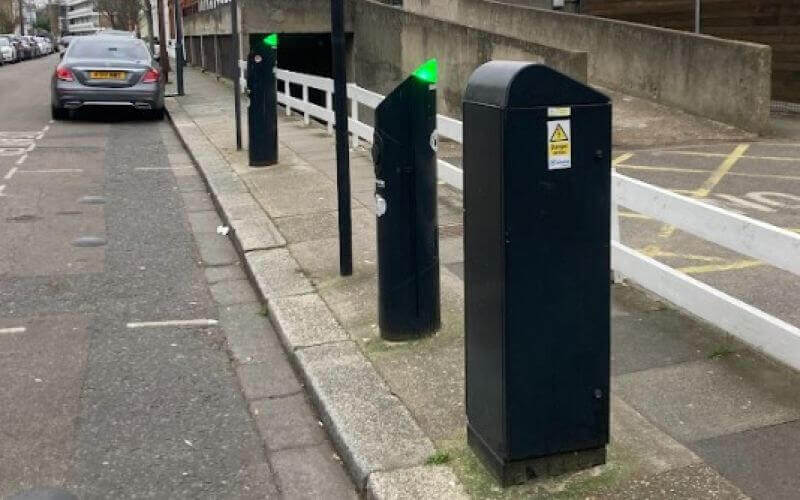
Disabled campaigners are calling on the government to do more to ensure that public charging-points for electric vehicles are accessible to drivers with access needs.
Last week, a House of Lords committee produced a report that recommended that only a small proportion of new charging-points for electric vehicles (EVs) should be accessible.
The report referenced 2022 guidance from the British Standards Institution (BSI), which highlights the environment around charging-points, their location, design and spacing, and the information provided to users.
Among access concerns raised by disabled people are that there is often not enough room between parking spaces, instructions and sockets are being placed too high on the charging-units, while there is frequently not enough lighting, and connectors cannot be used with one hand.
The Lords environment and climate change committee says in its report that it received “significant evidence in support of ensuring that chargepoints and chargepoint bays are accessible for disabled drivers”.
Disabled Motoring UK told the committee that most charging-points that have been installed so far are not accessible, with many being installed on plinths or kerbs and surrounded by bollards.
The report says the “limited number” of accessible charging-points presents a “major barrier” for disabled motorists “in transitioning to EVs”.
But although the report says the government is “encouraging” adoption of BSI’s PAS1899 guidance and is urging councils to “incorporate accessibility” into procurement processes and applications for grants from the government’s Office for Zero Emission Vehicles (OZEV), ministers are not seeking to make the guidance mandatory for all new charging-points.
The report says it is “crucial” that disabled people can use public charging-points, but it also says it “may not be practicable for all chargepoints at every site to meet these standards, and imposing this would risk jeopardising the rollout”.
It recommends instead that “chargepoint hubs over a certain size should be required to have a proportion of accessible chargers available that meet these standards”.
But Dick Fowler, a wheelchair-user and retired auditor who has previously advised the Department for Transport, has written to the Lords committee asking it to strengthen its recommendations.
He told the committee in his letter: “Accessibility should have been designed in from the outset, but as usual is an inconvenient afterthought.”
He wants to push OZEV to make the guidance mandatory because he fears that “only a tiny fraction of the mass charge point rollout will be accessible”, which will lead to “real and severe” anxiety among disabled drivers about how far they will be able to travel in their EVs and whether they will be left “stranded”.
Fowler said that accessible charging-points need to include those provided commercially, and not just those receiving public funds, and he warned that where a charging-point hub has both accessible and inaccessible bays, non-disabled drivers, including those who drive vans and minibuses, often choose the accessible bays for convenience.
Graham Footer, chief executive of Disabled Motoring UK (DMUK), said DMUK shared Fowler’s concerns about accessible EV charging provision.
He said: “There simply aren’t enough accessible public EV charge points being installed and disabled motorists are being left behind in the transition to electric vehicles as a result.
“As an organisation, we are not suggesting that every EV charge point should be PAS1899 compliant, but that a reasonable percentage of charge points should be at any given site.”
Motability Foundation*, which co-sponsored the BSI guidance with the government, said it supports the standard becoming mandatory, but favours a “phased approach” that could ensure a certain percentage of EV chargers are compliant by 2030, with that proportion increasing in future years.
A Motability Foundation spokesperson said: “Since the launch of PAS1899 in October 2022, we have focussed on raising awareness of the standard amongst chargepoint manufacturers, providers, designers and procurers (including local authorities), with the aim of promoting compliance.”
Because of “issues around interpretation” with some parts of the guidance, Motability has co-sponsored a working group with OZEV that will allow the industry to provide feedback on achieving compliance and will also engage with disabled people on their experiences with public charging.
A Department for Transport spokesperson said: “We encourage all chargepoint designs to incorporate accessibility guidance from the British Standards Institution and advise local authorities to consider accessibility as part of all grant scheme applications.
“We are monitoring implementation over a two-year period and will consider whether further intervention is required.”
Last year, Disability News Service reported how the rollout of new charging-points was stripping vital pavement space away from pedestrians and wheelchair-users, and that almost none of the charging points being installed were accessible to disabled drivers.
Research across London by two campaigning organisations found that only four of London’s 32 boroughs had so far installed more charging-points on roads than on pavements.
And only nine of the councils had clear planning policies that matched best practice guidance that charging-points should be built on “kerb buildouts” in the road, and not take up vital space on pavements.
*The Motability charity is a DNS subscriber
Picture: Photograph taken by climate action charity Possible during its investigation into charging-points being installed on pavements in London
A note from the editor:
Please consider making a voluntary financial contribution to support the work of DNS and allow it to continue producing independent, carefully-researched news stories that focus on the lives and rights of disabled people and their user-led organisations.
Please do not contribute if you cannot afford to do so, and please note that DNS is not a charity. It is run and owned by disabled journalist John Pring and has been from its launch in April 2009.
Thank you for anything you can do to support the work of DNS…
 Regulator is asked to probe conduct of Motability Operations and its insurer over Drive Smart distress
 PIP review: Disability minister leading review warns there ‘may well be reductions’ in spending