There must be “meaningful participation” of disabled people in the initial stages of developing new digital assistive technology, if its potential for supporting their independence is to be realised, according to a new report.
The Royal Society concluded that tech companies, researchers and governments should do more to remove barriers and engage disabled people in the design of digital assistive tools and services.
Among the recommendations made by the Disability Technology report*, launched this week, is that governments should not consider smartphones as any less a form of assistive technology than hearing aids, manual wheelchairs, or white canes.
But it also warns that many disabled people globally experience lower levels of income compared with non-disabled people, so digital assistive technology needs to be affordable if it is to be useful.
It calls on governments, technology companies and research funders to explore ways to ensure affordability.
As part of the research, the Royal Society – the UK’s national academy of sciences – commissioned the Research Institute for Disabled Consumers to survey a panel of 850 disabled people.
Three-fifths (62 per cent) of them said they used digital assistive technology, with more than half of this group doing so throughout the day.
The survey found that more than half of users of digital assistive technology (53 per cent) said they could not live the way they did without it.
The report defines digital assistive technology as “any technology that processes information to help make people’s lives easier”, such as audio-to-text apps, wayfinding and navigation apps, wearable health devices, smart home devices, sight assistance apps, and screen-reading software.
The report also calls for statistics bodies to collect more data on the daily barriers many disabled people experience with their sight, mobility, and memory, rather than solely focusing on their self-reported disability identity.
Sir Bernard Silverman, emeritus professor of statistics at the University of Oxford and chair of the report’s steering committee, said: “As a statistician, I would particularly stress that the data we record, and how we categorise it, affects everything and everyone.
“Data on the functional challenges experienced by disabled people would help researchers and providers to ensure that digital products and services, especially in the AI age, are genuinely responsive to their needs.”
The report was developed by a committee of international researchers and technology experts, several of whom are themselves disabled.
Dr Hamied Haroon, a research fellow at the University of Manchester and a member of the Royal Society’s diversity and inclusion committee’s disabled scientists subgroup, said: “We shouldn’t be developing assistive technologies or policies without disabled people being front and centre of the process.
“How do you capture the day-to-day challenges faced by disabled people, or ensure you’re offering solutions that actually work, unless you talk to disabled people?”
Dr Haroon, a member of the report’s steering committee, added: “These assistive technologies are fundamental to the workplace and our daily tasks – but they can be prohibitively expensive or unusable in some settings.
“We need to look at removing these barriers, whether that’s costs, additional training, or infrastructure improvements – like addressing patchy mobile data services that can cut off disabled people in rural and deprived areas.”
*Disability Technology: How data and digital assistive technologies can support independent, fulfilled lives
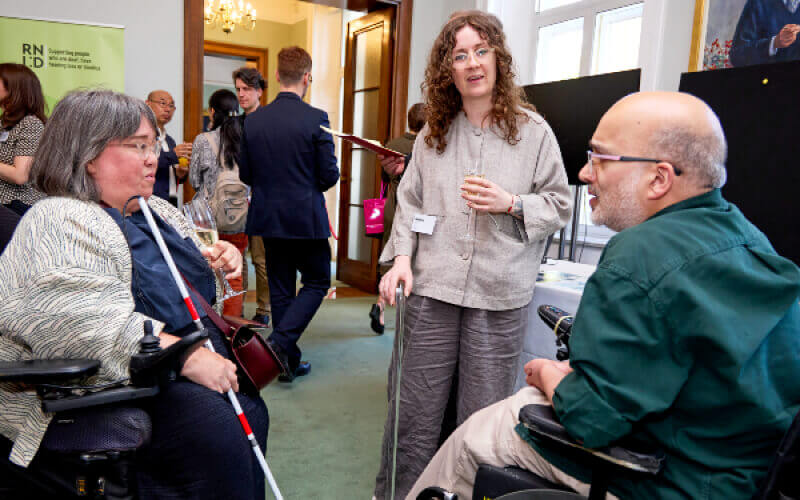
Picture: Dr Hamied Haroon (right) at the report’s Royal Society launch. Photo by The Royal Society
A note from the editor:
Please consider making a voluntary financial contribution to support the work of DNS and allow it to continue producing independent, carefully-researched news stories that focus on the lives and rights of disabled people and their user-led organisations.
Please do not contribute if you cannot afford to do so, and please note that DNS is not a charity. It is run and owned by disabled journalist John Pring and has been from its launch in April 2009.
Thank you for anything you can do to support the work of DNS…
 Free social care is coming… but only if you’re over 65, government confirms after Burnham speech
 Casey refuses to apologise after ‘harmful’ comments stir up more hostility towards disabled benefit claimants
 Burnham wins praise from disabled people’s organisations after pledge to fix ‘broken’ social care