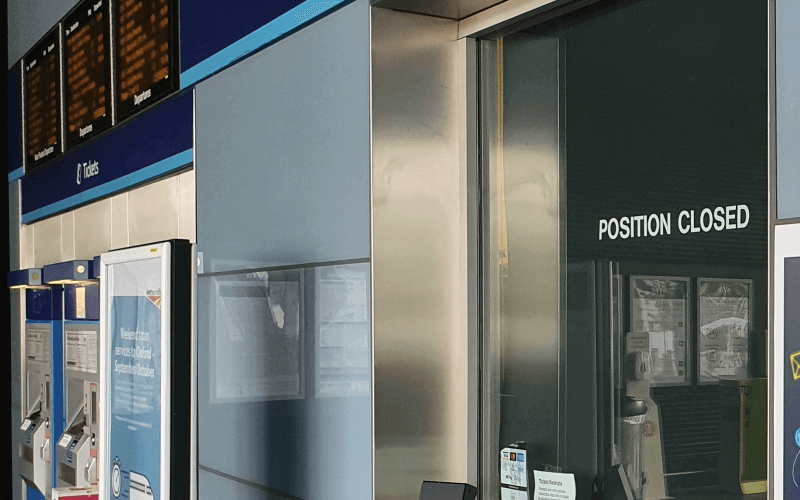
Documents published by train companies show how their plans to close hundreds of ticket offices across England will risk the safety of disabled passengers and make it harder for them to obtain assistance and buy tickets.
Information contained in equality impact assessments (EIAs) released by the 13 companies shows scores of concerns about the impact of the closures on disabled people and other groups protected by the Equality Act.
The assessments were released as part of a major consultation into the proposed closures, which ended on Friday (1 September).
All 13 companies have now released EIAs and while some have provided a detailed and thorough description of the potential impact of the proposals, others – such as LNER (PDF) and Southeastern (PDF) – appear to have dismissed or ignored many of the potential impacts.
Among the companies that have provided detailed EIAs was Northern (PDF), which warned that the lack of staff presence could “increase personal security and safety concerns” for disabled passengers.
Figures produced by the RMT union have previously shown that more than 2,200 jobs across the country will be cut due to the closures.
Northern’s EIA also highlighted that nearly half of train stations in Britain have either no or only partial tactile surfaces on their platforms, which means that a reduction in staff available to assist visually-impaired and blind passengers could “adversely affect them”.
Last year, an inquest jury found that the lack of tactile paving caused or contributed to the death of 53-year-old Cleveland Gervais, at a station in south-east London in February 2020.
Northern also warned that a reduction in staff available to provide “turn up and go” assistance for disabled passengers who do not want to book assistance in advance has the potential to “negatively impact” their “travel experience”.
Another train company to raise concerns about the safety of disabled passengers was Greater Anglia (PDF), which warned in its EIA: “Crime, anti-social behaviour and fear of crime (including hate crime) may increase as ticket offices are closed and static colleague presence reduced.”
Greater Anglia also warned that delays in members of mobile staff teams getting to stations could prevent disabled passengers from securing the assistance they need, and it could lead to them “attempting to self-board, putting themselves at great risk”.
East Midlands Railway was one of several train companies that raised concerns in its EIA (PDF) that visually-impaired or deaf passengers may not be able to navigate a station or access help points.
It also warned that neurodiverse passengers “may decide not to travel by rail or feel more anxious travelling through stations with reduced/no staff”, while it raised concerns of “an increased risk of anti-social behaviour as there will not be staff at the station”.
Many of the companies highlighted concerns with the accessibility of ticket vending machines (TVMs), as the industry expects more customers will have to use them when ticket offices close.
Avanti West Coast warned that (PDF) “TVMs may not be accessible for some disabled customers, including those with visual impairments”, while C2C (PDF) said that TVMs “are not accessible to all”.
TransPennine (PDF) said in its EIA that disabled passengers may even “potentially be victims of financial extortion if they need to give their bank card to others to assist them with purchasing tickets”.
Chiltern Railways (PDF) was another to raise concerns about inaccessible ticket purchasing, stating in its assessment: “With the removal of the ticket office, some customers may be unable to understand, be familiar with, or find it difficult to use technology.”
South Western Railway (PDF) was among those to highlight concerns about passengers who rely on hearing loops, which are usually only available in ticket offices and not around the station.
It pointed out in its EIA that a ticket office “is a focal point of a station where customers can get assistance in buying a ticket and journey information” and without a ticket office “the focal point of the station is lost”.
It also warned that people with learning difficulties might struggle to buy tickets without a ticket office, and that with fewer staffing hours available at some stations they “may become a place for targeted intimidating behaviour from perpetrators”.
West Midlands Trains said in its assessment (PDF) that a “reduced staff presence” could result in “less support for people through the station environment”, while it also raised concerns over reduced access to toilet facilities and waiting-rooms.
All the companies stressed in their EIAs that they would take “mitigating” measures to reduce the possible harmful effects of the closures.
In its EIA mitigation (PDF), Great Western Railway argued that there would be a transition period “designed to help make the changes more gradual”, while it said the industry was investing in simplifying fares “to make it even easier for customers to self-serve” and was “training staff to help support customers purchase tickets”.
Greater Anglia argued that a strong communications strategy would “help to reassure customers”, while staff presence may even improve so stations “may appear busier and feel more secure”, with its staff “trained to proactively look out for and help any customer who may need assistance”.
But some of the EIAs talked of how the company would seek advice from groups representing disabled passengers to “find and implement suitable mitigations”.
In response to concerns about blind, visually-impaired or deaf passengers not being able to navigate stations, East Midlands said it was “reviewing” its “current wayfinding offer” and would be consulting its accessibility and inclusion panel, while staff “will still be available to support with the purchasing of tickets and navigating the stations during certain hours”.
Govia Thameslink, which operates Gatwick Express, Great Northern, Southern and Thameslink, said in its EIA (PDF) that it would be “consulting with organisations representing customers with lived experience” to find a solution to the hearing loop issue.
It also said it was “working at an industry level” to find a solution for discounted tickets that are available to wheelchair-users and blind and visually-impaired passengers but can only be obtained at ticket offices.
There were more than 680,000 responses to the consultation by the time it closed on Friday (1 September).
Transport Focus and London TravelWatch will now examine these responses and the closure proposals before responding to the train operators by 31 October.
The train companies can then refer their proposals to transport secretary Mark Harper if they disagree with the conclusions of the two watchdogs.
A note from the editor:
Please consider making a voluntary financial contribution to support the work of DNS and allow it to continue producing independent, carefully-researched news stories that focus on the lives and rights of disabled people and their user-led organisations.
Please do not contribute if you cannot afford to do so, and please note that DNS is not a charity. It is run and owned by disabled journalist John Pring and has been from its launch in April 2009.
Thank you for anything you can do to support the work of DNS…
 National accessibility standards are crucial for addressing transport barriers, Tories hear at conference
 Government refuses to say how many rail stations will provide level boarding after major investment
 Lack of knowledge on ‘reasonable adjustments’ affects significant minority of disabled workers, says study