Major insurance companies – including one that spent years lobbying the government to tighten eligibility for out-of-work disability benefits – have refused to say if they pushed the government to introduce controversial cuts to one of those benefits.
Not one of the seven companies approached by Disability News Service (DNS) agreed to answer questions over the last month on whether they welcomed planned reforms to contributory benefits, including to new-style employment and support allowance (NS ESA).
One of the companies, Unum, spent years pushing reforms that would later be closely linked to the deaths of many ESA claimants and to harming the health of countless others.
Disabled researchers and activists showed in the early 2010s how Unum spent years undermining the social security system to try to boost the market for its own income protection insurance policies.
The government’s Pathways to Work green paper proposes replacing new-style jobseeker’s allowance (NS JSA) and NS ESA – benefits that are only open to those with a certain period of national insurance credits – with a new unemployment insurance, paid at the current ESA rate.
But unemployment insurance will be time-limited, which will mean that disabled people who would currently receive contributory ESA indefinitely – if assessed as having limited capability for work and work-related activity – will only be able to receive the new benefit for a limited period.
After that period has ended – the green paper suggests this could be after six months – they will have to claim universal credit, which is itself being reformed to make the disability-related top-up less generous (although details have yet to be confirmed), and where nearly all disabled recipients are set to face conditions and potential sanctions.
The government says these reforms will make the contributory system “simpler and significantly more pro-work” by removing the difference in treatment between jobseekers and those considered unable to work for health or disability reasons, but also removing the “financial incentive to be considered unable to work”.
It will also mean that “almost all disabled people and people with long-term health conditions” who receive the new unemployment insurance would have to take part in “tailored employment support”, although it claims there will be “appropriate exemptions”.
But the introduction of these reforms, and the greater pressure on newly-disabled people to engage with the Department for Work and Pensions (DWP), are likely to increase demand for disability insurance (otherwise known as income protection) policies sold by some of the country’s biggest insurance companies.
These policies provide a regular income if someone is unable to work due to disability, illness or injury.
It is likely that at least some insurance companies will have pushed Labour and previous governments to introduce these reforms, something DWP failed to deny this week.
But when DNS approached seven prominent insurance companies selling these policies in the UK, none of them would discuss the government’s reforms or say whether they had lobbied DWP ministers or civil servants to introduce such policies.
Unum said that it “won’t be able to provide commentary for your article” as its communications team was “pretty swamped at the moment”.
Aviva said it was “not something that we would comment on”.
Royal London said it had “not been able to find someone to cover these questions for you”.
A Zurich spokesperson said: “As far as I’m aware we haven’t engaged with any lobbying.”
When asked to check this with senior people in the organisation, and to comment on the reforms, she did not respond further.
Legal & General did not respond to repeated requests to comment.
Vitality said that it would “not be able to share any comments this time”.
And LV= Life and Pensions did not respond to repeated requests to comment.
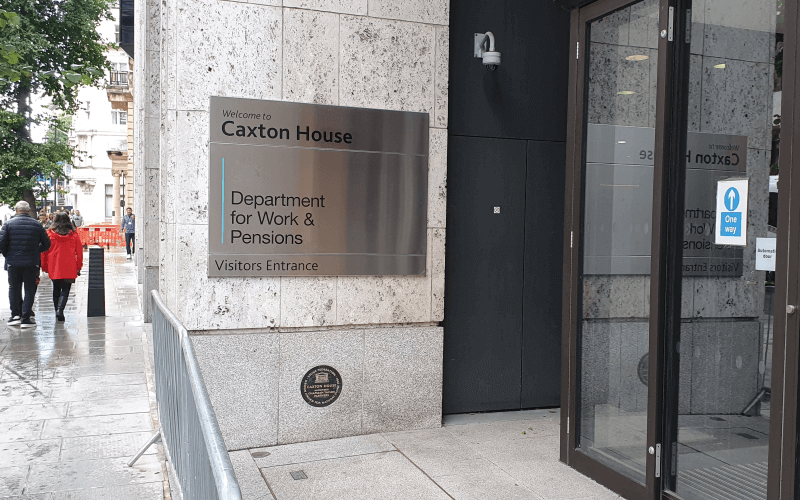
This week, DWP refused to say if it was lobbied by the insurance industry to introduce the changes, or if it believed the industry would benefit from its cuts and reforms to contributory benefits.
But the department did insist that it had not been influenced by insurance companies.
It is also unclear what will happen to existing claimants of NS ESA and NS JSA.
Asked in a written question by SDLP MP Claire Hanna how many current recipients of contributory ESA ministers expected to transfer to the new unemployment insurance, Sir Stephen Timms, the minister for social security and disability, said this week: “No decisions have yet been made about transitioning existing claimants of NS ESA and NS JSA to the proposed Unemployment Insurance and therefore an estimate cannot be provided at this stage.”
Edward, a wheelchair-user who took part in Fight4Life’s anti-cuts “die-in” protest outside Tate Modern in London this week (see separate story), and who relies on NS ESA, said the idea that it was going to be replaced was “really scary” and would be “toxic and painful” for a lot of disabled people.
He said it made “perfect sense” that the insurance industry would have been pushing for such changes to contributory ESA.
Disabled researcher Mo Stewart, who did most to raise concerns about Unum’s influence on welfare reform in the early 2010s, said the green paper would “cause a great deal of preventable harm for the chronically ill and disabled community who are unable to work”.
Stewart, who has continued her work through her Preventable Harm Project, following the publication of her book Cash Not Care in 2016, said she believed the consequences of the green paper would be “an increase in the purchase of private income replacement health insurance policies now that the past psychological security of the welfare state has been demolished by successive UK governments”.
She said: “Given that Unum insurance was instrumental in guiding previous social policy reforms… it can’t be much of a surprise to learn that Unum and other corporate health insurance giants refuse to comment on the DWP green paper which guarantees an increase in their profit margins.
“I suspect they will never admit to lobbying for government reforms to line their pockets, but it’s hard to imagine that they would resist the opportunity to influence more social policy reforms which are guaranteed to continue the government-induced public health crisis negatively impacting on those in greatest need.”
Stewart is now working on a new book, Social Policy Abused: The Creation of Preventable Harm, a collection of articles, research papers and reports she says will demonstrate “the government-induced public health crisis generated to move the UK to welfare funded by insurance”.
Ellen Clifford, a member of the national steering group of Disabled People Against Cuts, and award-winning author of The War on Disabled People, said: “Important research by John Pring, Mo Stewart and others has meant we have clear evidence of the role the insurance industry has played in the welfare reform agenda.
“It seems unthinkable that they would have stopped now given the effort put in over the decades and now that the UK government is taking such dramatic steps to destroy the social security system for out-of-work disability benefits, which can only be to their advantage.
“The lack of transparency is an indictment on our so-called democracy and refusal to comment can only fuel fears that big business is pulling the strings and doing their best to ensure politicians put profit before people.”
Unum’s links with the UK government date back to the 1990s, when Peter Lilley, social security secretary in John Major’s Conservative government, hired senior Unum executive John LoCascio to offer advice on how to cut the number of claimants of long-term sickness benefits*.
A submission to the Commons work and pensions committee in 2002 by a director of Unum – then known as UnumProvident – called on the Labour government to “ensure both that work always pays more than benefits, and more importantly that it is clearly seen to do so”.
In 2011, Unum launched a major UK marketing campaign to promote the need for income protection insurance policies, just as the Conservative-led coalition began its three-year programme to reassess about 1.5 million existing claimants of old-style incapacity benefit through the new work capability assessment (WCA).
Research by public health experts from the Universities of Liverpool and Oxford later linked that reassessment programme with about 600 suicides in just three years.
Unum has previously dismissed claims that it pushed the government to introduce the WCA system.
*The Department: How a Violent Government Bureaucracy Killed Hundreds and Hid the Evidence, DNS editor John Pring’s book on the years of deaths linked to DWP, is published by Pluto Press
A note from the editor:
Please consider making a voluntary financial contribution to support the work of DNS and allow it to continue producing independent, carefully-researched news stories that focus on the lives and rights of disabled people and their user-led organisations.
Please do not contribute if you cannot afford to do so, and please note that DNS is not a charity. It is run and owned by disabled journalist John Pring and has been from its launch in April 2009.
Thank you for anything you can do to support the work of DNS…
 Whately appears to agree social security spending is not spiralling after all… as Tories plan £36 billion-a-year cuts
 Shadow minister says parents don’t ‘game’ SEND system… but Kemi says disabled adults do ‘game’ the benefits system
 DWP silent after Tory member of PIP review publishes report demanding child disability benefits are slashed