The disability minister has performed a rapid U-turn and agreed to do more to involve disabled people in producing his cross-government disability strategy, but his efforts have still been described as “back to front and feeble”.
Sir Stephen Timms, the minister for social security and disability, announced last year that the government would “develop and publish” a cross-departmental Plan for Disability.
The press release described how this would set out “a clear vision to break down barriers to opportunity for Deaf and disabled people” and would support government departments in ensuring that disabled people’s voices were “at the heart of everything we do”.
But Disability News Service (DNS) revealed in August that the summary of a meeting on 19 May between Sir Stephen and the chairs of the Disability Unit’s Regional Stakeholder Network showed how the government would dodge this pledge.
During that meeting, Sir Stephen said government departments would instead develop the Plan for Disability themselves using “quantitative and qualitative data and evidence on the lived experience of disabled people”.
They would then consult on their plan later this year “to gather insights” from “disabled people and organisations”.
Asked about this failure of co-production in an interview with DNS at Labour’s annual conference in Liverpool this week, Sir Stephen said he had now decided that key disabled people’s organisations (DPOs) and other disability organisations would be involved in drawing up the plan.
He said he had just written to the six key disability groups the government consults with regularly to ask them to be involved.
Each will be asked to nominate two people to “sit on a strategic group to look at what should be in the Plan for Disability”.
The draft plan will then be put out for consultation early next year.
Asked if this change was a response to the criticism of his failure to coproduce the plan with disabled people, he said: “It’s a response to discussions.
“I talk to all those groups regularly and came to the conclusion that this was the right way to approach it.
“We’ve discussed how this should be done and this was the conclusion that we reached.
“It’s a bit different to what we first said, but that’s why I talk to people.”
Asked if this meant he was learning lessons on coproduction, he said: “I think we are learning lessons on coproduction.
“Coproduction will have been proved to be a very fruitful approach to my review [of personal independence payment], and I hope you will feel that when you see [that] report at the end of November.”
The six groups he will be talking to are DPO Forum England, the government’s Independent Disability Advisory Panel, its British Sign Language Advisory Board, the chairs of the government’s regional stakeholder network, its disability and access ambassadors, and the Disability Charities Consortium.
But Mark Harrison, a member of the steering group of the Reclaiming Our Futures Alliance (ROFA), said Sir Stephen’s U-turn was “all back to front and a feeble attempt to avoid challenge”.
He said: “It is not compliant with the relevant articles in the UN Convention on the Rights of Persons with Disabilities.
“Involving the non-disabled people’s organisations and including us as an afterthought is not coproduction.
“The government approach needs a complete reset so that ‘Nothing about us without us’ is real and not tokenism.
“This applies to the Casey Commission [on adult social care] which has refused to coproduce with DPOs and has excluded us.” (See separate story.)
Fazilet Hadi, head of policy for Disability Rights UK (DR UK), was slightly more upbeat about Sir Stephen’s change of heart.
She said: “It’s positive that the government has introduced a degree of engagement with disabled people, in advance of consulting on a disability plan next spring.
“The hope would be that early involvement by disabled people would make the plan more meaningful by addressing deep-rooted systemic inequalities that would improve the lives of disabled people, rather than tinkering around the edges.”
But she also pointed out that the National Disability Strategy and Disability Action Plan produced by the last Conservative government were “essentially shopping lists of departmental actions, without strategic direction or prioritisation”, and had omitted major areas of government activity such as social security and social care.
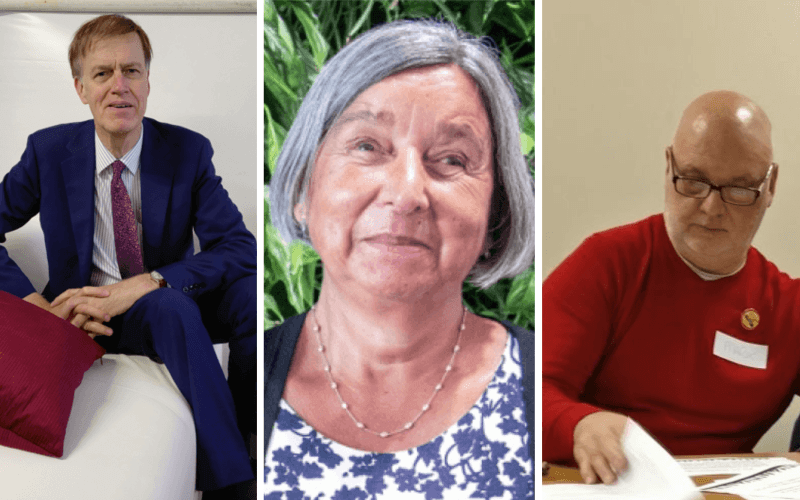
Picture: (From left to right) Sir Stephen Timms; Fazilet Hadi; and Mark Harrison
 DWP silent after Tory member of PIP review publishes report demanding child disability benefits are slashed
 Ministers’ decision to slash accessible housing targets was ‘unprincipled’, but Timms says they were right
 Free social care is coming… but only if you’re over 65, government confirms after Burnham speech