What is known publicly about the harm caused by the benefits system – including deaths by suicide linked to the actions of the Department for Work and Pensions (DWP) – is just “the tip of the iceberg”, MPs have been told.
Experts were giving evidence yesterday (Wednesday) to the Commons work and pensions committee in the first session of its inquiry into safeguarding “vulnerable” benefit claimants.
Labour’s Debbie Abrahams, who has led parliamentary efforts to highlight deaths caused by DWP’s safeguarding failures, had asked whether the number of suicides examined by the department through its internal review process was “the tip of the iceberg”.
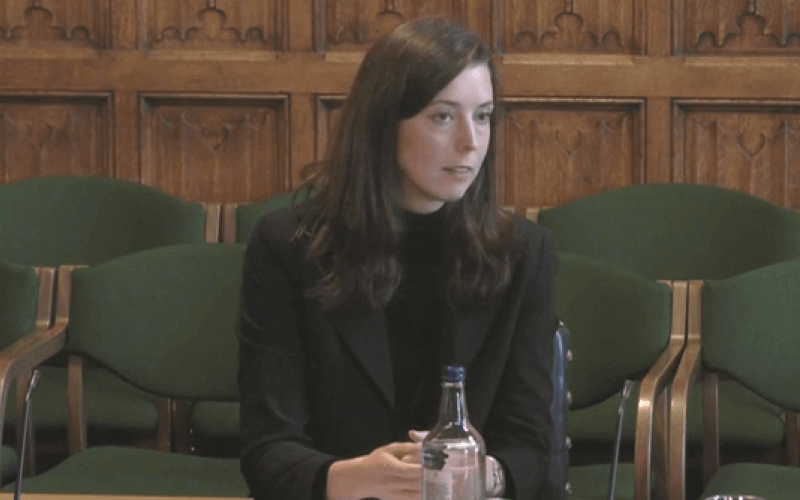
Chloe Schendel-Wilson (pictured), co-founder and director of The Disability Policy Centre, a thinktank linked closely to the Conservative party, agreed with Abrahams.
She said it “feels like we’re still playing catch up” and that there appeared to be “a huge systemic problem where things are just not being picked up”.
Nikki Bond, interim head of research and policy at the Money and Mental Health Policy Institute (MMHPI), said it was “absolutely the tip of the iceberg”.
She said that people were self-harming or contemplating suicide every day because they feel “trapped” and “think it’s their only way out”.
She said MMHPI had “reams of evidence” that the disability assessment and sanctions systems were “a significant source of harm”.
Henry Parkes, principal economist and head of quantitative research at the Institute for Public Policy Research, said “the reason why we don’t know the full size of the iceberg is because our processes to understand how this is failing are flawed at the moment”.
Schendel-Wilson, Bond and Parkes all agreed with Abrahams’ suggestion that there should be an independent organisation to examine deaths linked to DWP’s failures.
Schendel-Wilson said: “If there was any other area of the public sector where these sorts of failings were going on, people would rightly expect a lot more transparency and a lot more accountability, and there would be a lot more public outrage, I think, if this was going on in the health system.”
In a second evidence session yesterday, Professor Ben Baumberg Geiger, professor in social science and health at King’s College London, told the committee how one of the architects of universal credit, Devon Ghelani, had admitted to him that they were not thinking about “health problems and caring responsibilities at all” when they created it.
He said Ghelani told him: “We just weren’t thinking about that. We sort of assumed that this was going to be an operational problem that other people could deal with down the line.”
Baumberg Geiger said this was not a helpful approach and under a benefits system like universal credit that has “really strong requirements” and “makes a lot of assumptions about what people can deal with”, many people will be made “vulnerable”.
Asked by Conservative MP Siobhan Baillie about the “urgency” of the government’s efforts to reform the work capability assessment as a way of reducing the “sheer numbers of people” with mental ill-health on out-of-work benefits, he said there was a need to “stop talking about things as if there’s something cheap that’s going to magically solve the problems”.
He said there were ways to help some people with mental distress into work, by providing significant levels of support, removing sanctions and “not threatening people”, as well as doing much more to provide inclusive, flexible workplaces, and allowing people to work from home, as disabled campaigner Catherine Hale has suggested for people with energy-limiting impairments.
But pressed by Baillie on whether that could be done at scale, he said: “Avoiding magical thinking, I think, is really important in this area because I’ve only been working on these issues for 15 years or so, which is long enough, but I know people have worked on it for longer, and [there has been] so much magical thinking from people saying ‘these people don’t have many barriers to work and we can fix it magically like this’.”
Baumberg Geiger, who has previously spent time on secondment in DWP, said the department’s current consultation on plans to restrict eligibility by tightening the work capability assessment was “very bad”.
He said there was “a lack of evidence base” for its proposal to remove the “substantial risk” clause that currently protects many disabled people at risk of harm if found fit for work or work-related activity.
Abrahams told the committee that she had visited the Museum of Austerity mixed-reality installation* in Manchester earlier this month.
She accompanied Gill Thompson, whose brother David Clapson is featured in the installation and died due to diabetic ketoacidosis after he had been sanctioned.
The production uses the verbal testimony of family members and state-of-the-art technology to recreate the circumstances that led to some of the countless deaths of disabled claimants in the post-2010 decade of austerity.
Professor Lisa Scullion, professor of social policy at the University of Salford, said her research with veterans within the social security system and her earlier work on the five-year The Impacts of Welfare Conditionality project had shown that “conditionality is ineffective in moving people towards the paid labour market, particularly in relation to people with more complex needs and mental health issues”.
She said: “The research has shown that over many years.
“People feel trapped, dominated, powerless, and particularly where they are being pushed towards precarious, low paid work, or work that isn’t appropriate for them, or courses that aren’t appropriate to supporting them into meaningful work.”
*John Pring, editor of Disability News Service, is co-editor and specialist advisor on Museum of Austerity
A note from the editor:
Please consider making a voluntary financial contribution to support the work of DNS and allow it to continue producing independent, carefully-researched news stories that focus on the lives and rights of disabled people and their user-led organisations.
Please do not contribute if you cannot afford to do so, and please note that DNS is not a charity. It is run and owned by disabled journalist John Pring and has been from its launch in April 2009.
Thank you for anything you can do to support the work of DNS…
 DWP silent after Tory member of PIP review publishes report demanding child disability benefits are slashed
 Timms refuses four times to rule out cuts to PIP, but makes firm promise on cash payments
 No decision from Timms on releasing secret reports on deaths, a year after speaking to DWP civil servants