New government figures that show an increase of 1.3 million in the number of disabled people in work since 2017 are “meaningless” when it comes to the inequality disabled people face in the jobs market, ministers have been warned.
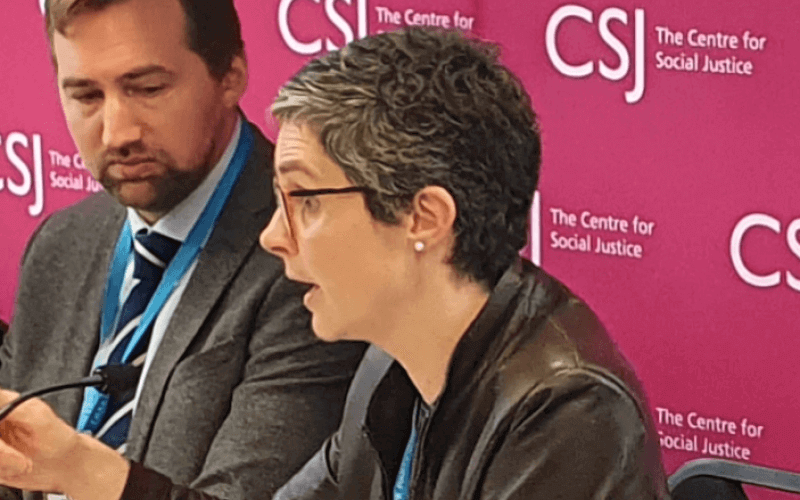
The minister for disabled people, Chloe Smith (pictured), had described the figure as an “important milestone” which showed the government’s “commitment to supporting disabled people to lead independent lives and reach their full potential”.
She said this delivered on a Conservative manifesto commitment to see one million more disabled people in work between 2017 and 2027.
The Office for National Statistics figures do show there were about 4.8 million disabled people in employment in the UK in the first quarter of 2022, compared with about 3.5 million in the first quarter of 2017.
But analysis of the new figures by Professor Vicki Wass, from Cardiff Business School, a member of the Disability@Work group of researchers, has shown that the disadvantage faced by disabled people in the jobs market has not reduced since 2017.
She said that what has driven the increase in disabled people in employment since 2017 has been the level of overall employment – which is determined by the economic cycle – and the number of people describing themselves as disabled.
Both of these have risen since 2017, with the proportion of the working-age population reporting to ONS that they are disabled rising from 17 per cent to 22 per cent in just five years.
She said the 1.3 million increase “looks less impressive” in the context of the 1.9 million rise in the number of working-age people who report that they are disabled.
Before the pandemic, she said, this rise of 1.9 million people would have been mostly people with lower support needs.
This meant that employment and employment rates for disabled people naturally increased.
In a briefing document published this week, Wass said: “This obviously makes the ‘one-million’ target a meaningless indicator as far as disability employment disadvantage is concerned.”
Wass pointed out that, in 2017, the government had abandoned the “more ambitious” target of halving the disability employment gap in five years, and instead used a new target of one million more disabled people in jobs.
She said: “Without any real policy initiative or investment in support for employers and disabled individuals, this first commitment was unachievable.”
She pointed out that the National Audit Office and the Commons work and pensions committee – in both 2017 and 2021 – had raised concerns about the one million target, and recommended that ministers also select a target which would show disabled people’s employment compared with the employment of non-disabled people.
Her calculations show that, once account is taken of the increasing disability prevalence rate, there has been no improvement in the disadvantage faced by disabled people in the employment market since 2013.
She concluded that Smith was “justified in celebrating the employment expansion and the increase in disability reporting, to the extent that the latter reflects greater social awareness and acceptance that has occurred since disability targets were set in 2015 and 2017”.
But she added: “The evidence suggests that there is much less to celebrate if the aim of either commitment was to address disability employment disadvantage.
“Disability prevalence has increased during the pandemic, including for ‘functional’ reasons – meaning an increase in the number of people with higher support needs – and the message from looking at the trends in disability employment is that real effort and investment on disability employment disadvantage is increasingly urgent.”
DWP refused to comment on Professor Wass’s analysis, instead pointing to a DWP press release about the figures.
Fazilet Hadi, head of policy for Disability Rights UK, said: “Having more disabled people in the workforce is extremely positive; however, the government is well aware that the gap between the employment of disabled people and non-disabled people has been unchanging at around 30 percentage points for many years.
“The figures show an increase in the number of disabled people at work, as more people already in work are identifying as disabled.
“Closing the disability employment gap would be a much better indicator of progress, as it would track whether more disabled people are entering employment.”
She added: “Over the last decade, the government has slashed the money spent on targeted support to get disabled people into work and to help people who become disabled, stay in work.
“New job schemes introduced during the pandemic included no specific measures to support disabled people.
“The National Disability Strategy was extremely thin in relation to supporting disabled people into work.
“We need the government to come forward with a plan to halve the disability employment gap, which is a previous commitment that it scrapped.”
Meanwhile, new figures show a significant increase in the number of complaints about DWP received by the Independent Case Examiner (ICE).
In 2021-22, ICE received 4,740 complaints about DWP, compared with 4,205 in 2020-21, an increase of 13 per cent in just one year.
In 2019-20, the last year before the pandemic, ICE received 3,835 complaints.
The number of complaints accepted by ICE for investigation has also risen sharply, from 1,132 in 2019-20 to 1,642 in 2021-22.
The number of complaints recorded by DWP – the earlier stage of the complaints process –dropped slightly in the last year, from 20,167 in 2020-21 to 19,186 in 2021-22.
A note from the editor:
Please consider making a voluntary financial contribution to support the work of DNS and allow it to continue producing independent, carefully-researched news stories that focus on the lives and rights of disabled people and their user-led organisations.
Please do not contribute if you cannot afford to do so, and please note that DNS is not a charity. It is run and owned by disabled journalist John Pring and has been from its launch in April 2009.
Thank you for anything you can do to support the work of DNS…
 DWP silent after Tory member of PIP review publishes report demanding child disability benefits are slashed
 Ministers’ decision to slash accessible housing targets was ‘unprincipled’, but Timms says they were right
 Free social care is coming… but only if you’re over 65, government confirms after Burnham speech