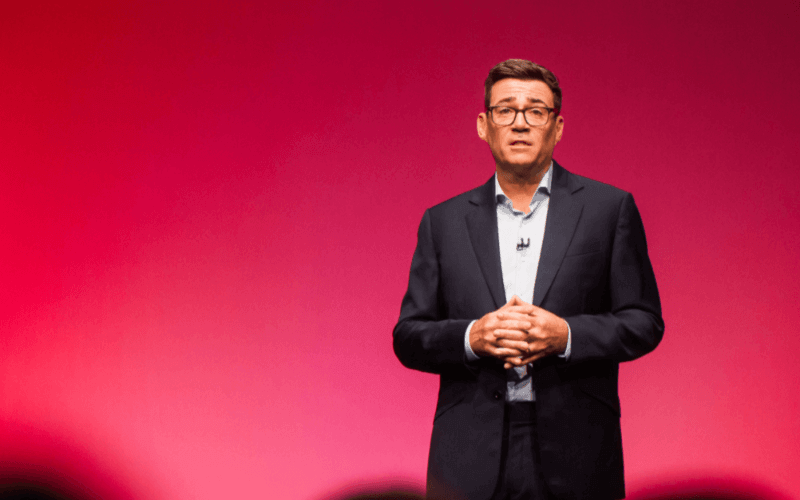
Andy Burnham’s announcement of free personal care as part of a new National Care Service will only apply to those over 65, and not to working-age disabled people, No 10 has confirmed, sparking shock and concern among disabled people’s organisations.
The prime minister (pictured) spoke to Labour’s annual conference in Liverpool on Tuesday of the need for a “person-centred, high-quality care service that starts in the home” and which was “free at the point of use”.
But there was disquiet among disabled people’s organisations (DPOs) after the speech at his repeated emphasis on older people and the failure to mention working-age disabled people, as he spoke of the need to provide “peace of mind over care needs in later life”.
He pledged to “start laying the ground now for the National Care Service and introduce it in the next parliament”.
The move, he said, would be funded by changes to the state pension “triple lock” to make it less generous, a move confirmed by the government later that day.
He said he was “going to go out and argue” for his plan, which would provide a “good deal for our pensioners and for older people in the 21st century”.
But after concern among DPOs at the emphasis in his speech on older people, Disability News Service (DNS) asked for clarity from Downing Street.
And the government later confirmed that his announcement of free personal care applied only to those over the age of 65.
Any changes aimed at fixing the care crisis and charges faced by tens of thousands of working-age disabled people will only be announced after next year’s final report of Baroness Casey’s social care commission.
A government spokesperson told DNS yesterday (Wednesday): “We have set out a new settlement for older people which will deliver free personal care and a state pension that rises every year, giving peace of mind in later life.
“This is a core part of our vision for the National Care Service and will draw a line under decades of drift so that people can receive the dignity and security they need.
“Baroness Casey’s commission continues to work on wider recommendations for fixing the social care system for all those who need it, including working age adults.”
Yesterday’s statement caused alarm and frustration among DPOs.
Svetlana Kotova, director of campaigns and justice for Inclusion London, said: “We welcome the prime minister’s vision of a person-centred, high-quality, free-at-the-point-of-use care service that starts in people’s homes.
“However, we are shocked and disappointed that the vision of a National Care Service does not include disabled people of working age, who make up one third of social care users and who are facing much harsher charges compared to older people.
“There is no justification for limiting support just to older people.
“Everyone who needs care and support should have a right to live independently in the community, regardless of their age, as outlined in the UNCRPD [the UN Convention on the Rights of Persons with Disabilities].
“We call on the prime minister and Baroness Casey to urgently and meaningfully engage with disabled people and our organisations, ensuring our experiences and expertise are at the heart of designing and running a joined-up National Care Service that is available to all, going well beyond basic personal care and enabling everyone to enjoy their right to live independently and be included in the community.”
Fazilet Hadi, head of policy for Disability Rights UK (DR UK), also welcomed Burnham’s commitment to developing a National Care Service but said the announcement “raises real questions and concerns”.
She said: “Why is the spotlight solely on older disabled people, which he refers to as older people?
“Why is there a rightful concern about older disabled people paying for care from their state pension but no similar concern relating to disabled people of working-age having ever-increasing charges for care, taken from benefit payments?”
She also criticised Burnham for talking about care and support in “paternalistic ways”.
She said: “Don’t disabled people, young and old, have a right to more than receiving personal care?
“Don’t we have the right to live with dignity, independence, choice and control?
“Don’t we have a right to be supported to be socially engaged and connected with family and community?”
She said there was a “wholly unacceptable” exclusion of disabled people’s organisations from the decision-making process on social care reform, with the Casey Commission’s “big conversation” failing to bring disabled people “to the heart of shaping a new service”.
Earlier this week, Sophia Kleanthous, DR UK’s policy and campaigns officer, had told a fringe meeting hosted by the New Statesman and the new Free Home Care campaign at Labour’s conference: “We really need a system-level approach to making sure that choice, control and independence is at the heart of our care system… it needs to be co-produced with and by disabled people.”
She said that Baroness Casey had sidelined disabled people’s organisations from her commission, and she called for a National Independent Living Service (NILS) that was “free at the point of need and delivery and alongside the NHS to solve the current crisis in social care.
“And at the heart of it, it should be built with and by and for disabled people.”
Meanwhile, Disabled People Against Cuts (DPAC) has announced that a protest outside No 10 North in Manchester will take place later this year and call for a NILS designed in co-production with disabled people.
The protest will take place on 4 December, almost 20 years after UNCRPD was adopted by the United Nations (PDF) in December 2006, and the day after the international day of disabled people.
DPAC said it wanted to “celebrate the convention and expand the scope of our campaign against regression of our rights by this Labour government and the coalition and Tory regimes that went before them”.
The protest will argue that “social care is broken beyond repair” and that there must be “meaningful coproduction with representative DPOs” in moving towards NILS, rather than the “tokenism” of the Casey Commission.
It will also call for Baroness Casey’s commission to be scrapped and for UNCRPD’s article 19 – which recognises disabled people’s right to independent living – to be implemented in UK law.
DPAC has launched a crowdfunder to fund the demonstration and other campaigning and protest that would show how “since signing and ratifying the convention, successive governments have taken away our rights and attacked our benefits, independence and living standards”.
DPAC co-founder Linda Burnip said: “It is shocking that a Labour government continues to slash our rights, putting us at risk of destitution, imprisonment in our own homes or care homes, and even of more unnecessary deaths.”
 Ministers’ decision to slash accessible housing targets was ‘unprincipled’, but Timms says they were right
 Labour’s inactivity adviser swears at DNS editor after being challenged on safety of young claimants
 Timms refuses four times to rule out cuts to PIP, but makes firm promise on cash payments