
Young disabled people are often “dismissed”, devalued and “minimised” by the disability movement in the UK and across Europe simply because of their age, according to a new book by a disabled academic.
Dr Miro Griffiths (pictured) says veteran activists often implement a form of “gatekeeping” which insists that new entrants must know about their “historical victories” and have a “comprehensive” knowledge about the disabled people’s movement before they can “legitimately” take part.
His book is based on a survey of more than 200 young disabled people in the UK and across Europe, as well as in-depth interviews.
Those he spoke to told him they were “expected to know everything about disability activism”, that they confront “ageism and elitism about knowledge”, and that young disabled people are “not taken seriously compared to experienced activists”.
They are, he writes, “expected to be grateful beneficiaries of past gains” rather than activists confronting new forms of exclusion, although they “repeatedly acknowledge that their work builds on what earlier activists made possible”.
Without action to address the “hostility, aggression and toxicity” they face, he writes, the movement will be weakened, and young activists will continue to be ignored or placed into “tokenising and restrictive youth groups”.
His book, Youth, Disability, and Resistance*, examines the many barriers young disabled activists face, such as inaccessible venues for meetings, a lack of personal assistance, financial pressures, fatigue, and the hostility they can face within the movement.
A vast majority (90 per cent) of the young disabled people Dr Griffiths surveyed said it was vital that the movement took an intersectional approach to activism.
One 21-year-old UK activist said: “It is not possible to talk about oppression without understanding the multiple and different ways it comes together.
“So, what, do I talk about injustice because of disability today and abuse because I am in queer community the next day?
“It is not possible… Disability activism needs to recognise this.”
The young activists he heard from repeatedly describe activism as “a process of unsettling taken-for‐granted ways of life, while also putting forward new ideas grounded in support, consideration, accessibility, and kindness”.
They describe their activism as “necessary” rather than optional, often because “the worlds they inhabit remain arranged through inaccessible infrastructures, hostile engagements, insufficient support, and narratives that render disabled people’s lives lesser, burdensome, or disposable”.
Griffiths also says in the book that it is vital that the movement builds a hopeful vision of the future by campaigning for an accessible and inclusive society as a way of stimulating the participation of young disabled people.
And he says it is crucial to support young disabled activists to develop the skills they need to carry out research that will substantiate their claims and drive “both incremental and radical social change” and challenge injustice.
He concludes that young disabled activists are “indispensable to the renewal, sustainability, and liberatory force of disabled people’s social movements”.
He adds: “If disability activism is to remain meaningful, durable, and transformative, it must recognise young disabled people as among its most important theorists, strategists, and world‐makers.”
Griffiths is associate professor of social policy and disability studies, and director of the Centre for Disability Studies, at the University of Leeds, with his work focusing on disability studies, political sociology, social policy and disability activism.
He said: “Young disabled people are frequently discussed as a group whose participation needs to be encouraged or facilitated.
“This book begins from a different position: young disabled people are already theorising, organising and resisting.
“They are producing political ideas and practices that should change how we understand both disability activism and social movements more broadly.”
The crossbench peer Baroness [Jane] Campbell, a key figure in the UK disabled people’s movement since the 1990s, said his book was “a clarion call for disability youth activism, social movement studies, resistance practices, and the kind of vital social disruption our times demand”.
She said the book “reminds us that movements grow through courage, collective learning, and the refusal to accept exclusion as inevitable”.
A documentary linked to the research, which focuses on young disabled people’s activism across Europe, will be released later this year.
*Youth, Disability, and Resistance: Producing Change through Activism and Social Movements, will be published by Routledge on 27 August. As an academic book, it is priced £155, but may be available through your local library, while disabled people who cannot obtain a copy but want to discuss the issues it covers can contact Dr Griffiths at the University of Leeds
 Six DWP reports show exactly why so many young disabled people are not in work, education or training
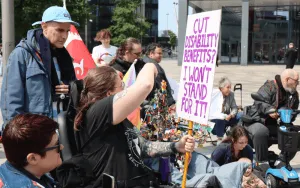 Government’s focus is on ‘punishing’ young disabled people rather than supporting them, activists fear
 Forgotten and abandoned, young disabled people are fighting back against cuts through a new collective