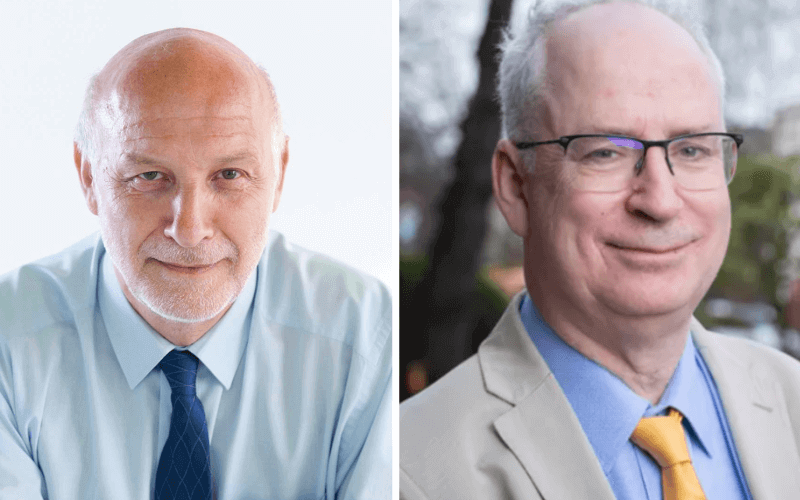
The government’s decision to commission a review of alleged “over-diagnosis” of mental health conditions and neurodivergence has caused alarm among many disabled people, with fears that it will allow ministers to justify further sweeping cuts to disability benefits.
There is also concern that health and social care secretary Wes Streeting has commissioned two high-profile mental health figures with controversial backgrounds to lead the review.
Although the government has not yet confirmed the review will take place, it will reportedly examine the prevalence of mental illness and neurodivergence, “with a particular focus on whether some conditions are being overdiagnosed”.
But disabled activists believe its authors have been chosen because they will “help to slash the social security bill”.
The review will apparently be chaired by Professor Peter Fonagy, while the vice-chair will be Professor Sir Simon Wessely.
Fonagy is a highly-decorated clinical psychologist and psychoanalyst but he has also been closely associated with the Serenity Integrated Mentoring (SIM) programme, which was described as unethical, unlawful and unsafe and “a national scandal” that had put people in severe mental distress at risk of being denied vital support.
He was lead author of an article (PDF) whose co-authors included Paul Jennings, the former police officer who founded SIM, and which examined how SIM was working in London and concluded six years ago that it was “promising”.
Jennings described Fonagy in one presentation as a “senior supporter” of the programme.
Campaigning by the StopSIM Coalition later exposed SIM as discriminatory, coercive and punitive, and eventually persuaded NHS England to admit it was wrong to endorse SIM without applying “sufficient scrutiny” and to accept that this had harmed service-users.
Wessely’s appointment is likely to prove even more divisive.
He helped recruit patients onto the notorious, and later discredited, PACE trial – part-funded by the Department for Work and Pensions – and he was hugely supportive of the PACE research (PDF) into the use of controversial treatments such as cognitive behaviour therapy and graded exercise therapy for those with ME.
In 1993 (PDF, page 17)*, Wessely had written to the then Department of Social Security to argue that the only difference between “chronic fatigue syndrome, or ME as it is sometimes known” and “the major psychiatric disorders” was “the existence of a powerful lobby group that dislikes any association with psychiatry”.
Wessely argued in his letter that any suggestion that ME was a neurological condition would “discourage any sensible efforts at rehabilitation” and lead to an “ever increasing stream of claims for permanent benefits in people who might otherwise have had a chance of recovery”.
The view – shared by Wessely – that it was the attitudes of people with ME that were preventing their recovery, and the impact of this belief among many doctors and scientists on the treatment of many thousands of people with ME, was described by the Guardian’s George Monbiot last year as “the greatest medical scandal of the 21st century”.
Wessely also led a review of the Mental Health Act, which was criticised for falling “significantly short” of recommending full human rights for people in mental distress, but was a blueprint for Labour’s much-criticised mental health bill.
Although the Fonagy review has yet to be officially confirmed by the Department of Health and Social Care (DHSC), its existence was revealed by the well-connected Health Service Journal (HSJ).
Linda Burnip, co-founder of Disabled People Against Cuts (DPAC), said: “I think the choice of these two people shows how little regard the government, and Streeting and Timms** in particular, have for the fears of disabled people.
“It seems likely that they have deliberately been chosen to help to slash the social security bill.”
The grassroots, user-led mental health group Recovery in the Bin (RiTB) said both appointments were “safe establishment” figures with troubling backgrounds, such as Wessely’s links to the ME “forced exercise programmes” and Fonagy’s links to SIM, which suggested “a very low probability that this will be an open and fair investigation”.
RiTB said: “We expect it will return findings the government will find useful to deny people benefits.
“The issue that should be investigated is the thousands of deaths covered up by the DWP.
“Instead, they want to cause more death.”
A spokesperson for DPAC Cymru said it was “alarmed” at the decision to appoint Fonagy and Wessely, whose backgrounds were “a clear signal” of a “politically-motivated review that has had its outcome decided in advance.
“In the context of an NHS starved of funding, disability welfare cuts, and the UK government’s demonisation of disabled people, it is obvious why these two men have been selected.”
A DPAC Cymru member added: “Normalising mental health and neurodiversity normalises seeking help and clarity which makes diagnosis more accessible.
“We’ve always existed, we’ve always been different, we just didn’t have the ability to seek help or diagnosis.
“This whole ‘autism is new’ and ‘over-diagnosed’ argument is just another load of rubbish to demonise young people, make disability a taboo, exclude disabled communities, and save rich people pennies on providing help to people who really need it, and it frustrates me so incredibly much.”
Bethan Edwards, co-founder of the Stop SIM Coalition, which has now been disbanded, told Disability News Service (DNS) this week: “Professor Fonagy led an evaluation of SIM during its implementation in London in 2018 and 2019.
“SIM involved withholding care from people in extreme mental distress and involved the threat of criminalisation for attempting to use statutory services to meet significant mental health needs.
“It should not have taken a group of service-users to bring this to the public and professional bodies’ attention in 2021, leading to SIM’s demise.
“The alarm could and should have been raised sooner, including by Professor Fonagy himself.
“I, therefore, have very little confidence that the DHSC’s review will put the well-being and safety of people with mental health needs ahead of the Labour governments agenda – to cut welfare spending and to continue underfunding mental health services.”
And Kate Skinner, a neurodivergent campaigner, psychology student and academic research assistant, told DNS: “In my mind, the government’s potential reasons behind this review are straightforward: if fewer people qualify for diagnostic labels (such as ADHD), then fewer people will qualify for benefits, accommodations, and specialist services, as so many places lock the provision of support behind these labels.
“Reviews like this one feel like their real purpose is redefining who counts as being ‘deserving’ of support, as evidenced by the wider media, which has been chipping away at the ‘validity’ and ‘deservingness’ of neurodivergence for a while now.”
She said: “I understand why many disabled people, particularly those who are neurodivergent, are deeply concerned about this review.
“Psychology and psychiatry have a long history of researchers deciding what is ‘best’ for others, while ignoring the lived experiences of the people they study.
“This history of exclusion and paternalism already makes it difficult to trust that this new review, commissioned in such a negative light, will be conducted with genuine openness or ethical integrity.”
Skinner added: “One of the professionals leading this review [Wessely] has previously argued that greater awareness of mental health conditions may not be ‘beneficial’, and has warned against ‘over-professionalising’ or ‘medicalising’ certain conditions.
“Therefore, it is difficult not to feel that the government is seeking to use ‘experts’ to push through a harmful, ideologically-driven agenda.
“Until reviews like this are shaped and conducted by those they claim to represent, any talk of ‘overdiagnosis’ will continue to sound less like healthy, scientific investigation and more like deep, cynical suspicion.”
DHSC declined to comment on the HSJ article.
*This document was obtained from the National Archives through the efforts of disabled barrister Valerie Eliot Smith, who has ME
**Sir Stephen Timms, minister for social security and disability
Picture: Peter Fonagy (left) and Simon Wessely
A note from the editor:
Please consider making a voluntary financial contribution to support the work of DNS and allow it to continue producing independent, carefully-researched news stories that focus on the lives and rights of disabled people and their user-led organisations.
Please do not contribute if you cannot afford to do so, and please note that DNS is not a charity. It is run and owned by disabled journalist John Pring and has been from its launch in April 2009.
Thank you for anything you can do to support the work of DNS…
 Whately appears to agree social security spending is not spiralling after all… as Tories plan £36 billion-a-year cuts
 Shadow minister says parents don’t ‘game’ SEND system… but Kemi says disabled adults do ‘game’ the benefits system
 Free social care is coming… but only if you’re over 65, government confirms after Burnham speech