Disabled campaigners have welcomed a government strategy that says new passenger trains should aim to allow level boarding wherever possible, but they say key amendments to the railways bill will be needed to make the plan a reality.
They have also called for a plan and timescale for a rolling programme of work to ensure the necessary changes to platforms across Britain are carried out to allow level boarding, with “genuine” involvement of disabled people in the plans.
The pledge on level boarding is part of a policy paper on rolling stock and infrastructure, published by the government last week, which describes how the new Great British Railways (GBR) will plan spending on passenger trains, infrastructure, depots and maintenance.
The government says that level boarding will be a “baseline expectation” for new fleets of trains, and it pledges to use “engagement with passengers and their representatives to shape more accessible, consistent and attractive trains”.
It says improving accessibility is a “priority” for rail reform and promises a “progressive transition” towards unassisted level boarding, mostly through designing replacement rolling stock “where practicable and cost-effective”.
And it says that “the most practical route to faster progress” is by gradually replacing the current fleets of trains with low-floor versions, as shown with the recent order announced by state-owned TransPennine Express.
Exceptions will only be allowed if this is “impracticable or disproportionately expensive”.
It points out that the current system for assisting passengers with mobility impairments on and off trains, which usually relies on staff and ramps, limits passengers’ independence and reduces the railway’s “attractiveness and usability”.
It adds: “It is entirely right, therefore, that unassisted level boarding and alighting between the platform and the train will become GBR’s baseline expectation wherever practicable, with the ambition over time of removing the need for passengers with mobility impairments to have to seek help from a member of staff across most of the network.”
But it warns that it would be “extremely challenging” to deliver level boarding at every platform across the country because of how the railway has gradually evolved over 200 years.
As reported last month by Disability News Service, the government is already carrying out a study of platforms “which will identify what would be needed to achieve level boarding”, which will inform the “specifications” of trains ordered in the future.
Tony Jennings, co-founder of the disabled-led Campaign for Level Boarding, said the announcement was “excellent news and a very good long-term commitment to level boarding”.
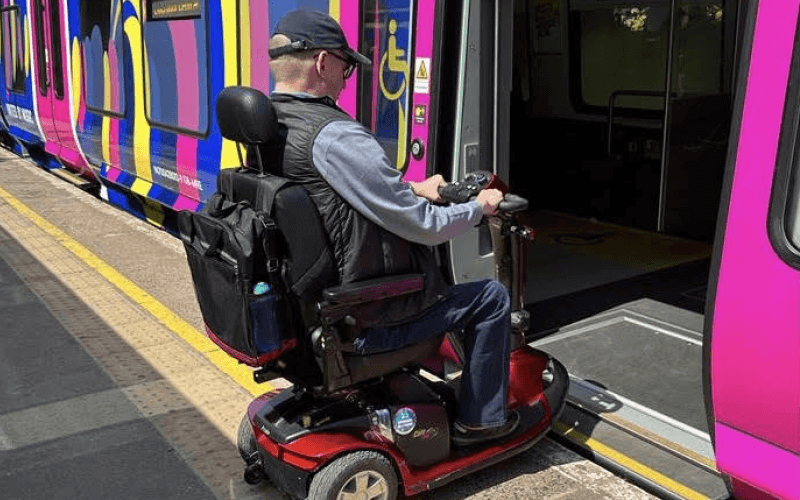
And he said his experiences of level boarding as a mobility scooter-user on Merseyrail – with its level boarding trains with retractable sliding step and the train door at the same level as the platform – had been “transformative”.
But he warned that the new strategy does not include a plan and timescale for a rolling programme of work to ensure platforms across the UK are standardised to the correct height to allow level boarding.
Jennings said: “The government’s own accessibility roadmap gives an indication of the scale of the problem: only about 56 per cent of stations currently have step-free access to platforms, and genuine street-to-seat level boarding was reported at only about four per cent of stations.”
He said there must also be “genuine co-design” in delivering the level boarding programme, with disabled people given “decision-making power over the national programme” with involvement at the stage where specification of train design is decided.
And he warned that level boarding trains, and changes to platforms, needed to be accompanied by step-free access from the street to every platform at both the departure and destination stations, while train designs must also ensure access for powered wheelchairs and mobility scooters.
He also pointed out that a “substantial” number of trains without capacity for level boarding have been ordered in the last 10 years, including across Northern and West Midlands Trains, and these may remain in service for another 20 or 30 years.
Jennings said this means there is likely to be a “substantial period in which Britain will have two railways operating alongside each other”, one that allows level boarding and a shadow version that does not.
He added: “The real test will be whether GBR moves from a situation where level boarding is the expectation for new trains, to a funded and dated programme, with a legislative timescale in the railways bill, which says which trains, which platforms, which routes and by what year a wheelchair- or mobility scooter-user will actually be able to turn up and travel without assistance.”
Deborah Persaud, co-chair of the disabled-led charity Transport for All, said: “Making level boarding an expectation for new trains on Great British Railways is a welcome step.
“We hope it is a sign that a public railway, run in the interests of its passengers, will be serious about tackling accessibility failures that have shut disabled people out for too long.”
But she added: “We’re urging the government to go further.
“Aims don’t tell us when we can expect to see step-free access and independent boarding across the network. We need a clear commitment to delivery.
“Baroness Grey-Thompson’s amendments to the railways bill – including a 10-year railway accessibility strategy, a requirement for co-production, and a funded programme for permanent step-free access – writes access into law.
“We want to see them pass so Great British Railways is a network where everyone can simply turn up, get on a train and go.”
Emily Sullivan, a disabled researcher in human rights law and co-founder of the Association of British Commuters (ABC), also pointed to the railways bill, which has passed through the House of Commons, but will resume its committee stage in the Lords on Monday.
She said: “This is a welcome policy statement, but it is not a binding statutory commitment.
“That distinction is crucial because the most important rail legislation in decades is going through parliament right now, yet level boarding is not even mentioned and there is no duty to deliver a long-term programme of accessible infrastructure investment.
“Level boarding will require complex, coordinated investment in trains and platforms over decades.
“That makes it especially important to put the commitment into law now, rather than leave it to promises that may disappear with a change of government.”
Doug Paulley, another co-founder of the Campaign for Level Boarding, welcomed the reference to level boarding in the new strategy, and said the campaign had likely played a “significant” part in the success.
But he said there now needed to be a rolling programme of upgrades to infrastructure to allow level boarding at stations, and the apparent failure to promise new funding or improvements to platforms was “a significant problem because for level boarding to happen, there has to be both compatible trains and compatible platforms.
“One without the other is pretty pointless; and the current level of investment in accessibility of stations is so low that achieving level boarding on any substantial range of stations would take centuries, if it happened at all.”
He also called for GBR to ensure “genuine” involvement of disabled people in its plans, in contrast to Network Rail’s “very negative approach towards accessibility and inclusion”.
He said: “I do think that level boarding does lead to spontaneous and unassisted travel for many people with mobility impairments, particularly wheelchair- and scooter-users, and I have found it emancipatory where I have encountered it (which is sadly far too infrequent).”
He added: “Level boarding cannot be achieved unless compatible stock is commissioned; so this is genuinely a significant milestone, for which we should be proud.”
The government strategy also says GBR will use its size to encourage the market to include features such as improved accessibility, wi-fi and reliable passenger information into future train designs, although it says this will still have to be “appropriate, affordable and supported by passenger need”.
As well as promising to engage with passengers, the government says it will develop “detailed inclusive design guidance” with organisations representing disabled passengers, accessibility panels and disabled travellers.
And it says GBR will continue to engage with the Disabled Persons Transport Advisory Committee (DPTAC), disabled passengers and other accessibility stakeholders as it develops “standards, train specifications and implementation plans”.
Picture: Tony Jennings boards a Merseyrail level boarding train
 Government refuses to say how many rail stations will provide level boarding after major investment
 Nationalised rail firm ‘was desperate’ to settle trio of discrimination cases, as calls mount for stronger laws