
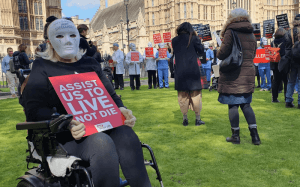
 Disabled activists have criticised “aggressive” campaigners for the legalisation of assisted suicide who they say intimidated and harassed them during a protest outside the House of Lords.
One disabled protester was allegedly hit with a fist, others were intimidated and verbally abused, while some pro-euthanasia campaigners encouraged drivers to run over disabled activists who were blocking the road in a peaceful direct action.
Similar protests in July had seen campaigners for and against Lord Falconer’s assisted dying bill separated by metal fencing, but this time there was nothing to keep the two sides apart.
On one side were supporters of the bill, who were wearing pink tee-shirts provided by the pro-assisted suicide organisation Dignity in Dying (DiD), while next to them were the bill’s opponents, wearing white tee-shirts from the disabled people’s organisation Not Dead Yet UK (NDY UK).
Lord Falconer’s bill would make it legal for doctors to help end the lives of those they judged to be terminally-ill, if the individual requested such help.
Dennis Queen, who helped organise the NDY UK protest on 7 November, and took part in the direct action, said they had been surprised that the pro-assisted suicide campaigners were so aggressive.
After she and the other five activists left the road, after blocking traffic outside the House of Lords for about 20 minutes, they found themselves surrounded by hostile DiD campaigners.
Queen said: “They followed us off the road, a whole crowd of them, until we were in a corner. We had to ask the police to move them back. Each one of us had to be escorted out by the police.
“I have not been treated by other protesters like that since I was on a protest against the far right. They behaved like EDL [English Defence League] protesters. They should be ashamed.”
She added: “They were already being annoying but when we went on the road you could feel an anger growing from them.
“They were shouting at a truck to ‘run them over’ and the truck was inching forwards and the police had to talk to the driver.”
Simone Aspis, another NDY UK campaigner who blocked traffic, said the supporters of the bill had been “aggressive”.
She said: “The tone had changed immensely since the last protest.”
One DiD campaigner was constantly hovering behind the NDY UK group and at one point placed his placard over the head of a wheelchair-user.
Queen said: “You cannot be going over a wheelchair-user’s head with a massive piece of wood. If he had dropped it, he would have injured him.”
Aspis said: “He was standing right behind us. We asked him to move a few times
“I said I wanted to have a look at his placard. I touched his placard. Before I knew it he walloped me one with his fist. I did feel assaulted.”
Queen said: “We are going to have to talk to police before the next protest to tell them that we are concerned about the other protesters.”
Another NDY UK campaigner, Paula Peters, described how she was approached from behind by a Metropolitan police officer during the direct action.
The officer took hold of her mobility aid and started to drag her backwards.
Peters, from Disabled People Against Cuts (DPAC), said: “He didn’t tell me to get out of the way, or tell me what my rights were.
“He leaned over and grabbed the handles of my tri-rollator [three-wheeled walking aid] and he hauled me backwards really fast.
“If he had asked me to move I would have done. But he pushed me into the ‘pro’ campaigners, who were aggressive and abusive.”
She added: “I was surrounded by aggressive ‘pro’ campaigners. They just turned round and told the car drivers to ’run them all over’.”
She is now considering lodging a complaint with the Metropolitan police about how she was dealt with by the officer.
Peters said: “I think the police put our safety at risk. They don’t know what our impairments are, what are access needs are.”
She said one officer told her afterwards that disabled activists could “expect treatment like that” if they took part in another protest near parliament, because of the heightened state of security.
But Queen said: “If she had fallen off she could have got a bad injury. She was perched on it and they were pulling her backwards.”
She said they had decided to carry out a direct action because disabled people were “afraid and angry” about the proposals to legalise assisted suicide.
The force has since approached DPAC, asking for a meeting to discuss how disabled people taking part in peaceful direct actions should be treated by police.
A DiD spokesman said: “The whole day there were demonstrations on both sides, both were interviewed by the BBC and we respected each other’s protests.
“There was no violence on either side. We had 200 demonstrators. I saw no aggressive comments from our side or from the NDY UK side.
“I have not been alerted until now that there was any aggression on either side.”
So far, no-one from the Metropolitan police has been able to comment on how the protest was policed.
But it is just the latest in a series of criticisms of how the force has treated disabled activists taking part in protests and direct action in London.
13 November 2014
 Review dismisses claims of widespread over-diagnosis across mental health, ADHD and autism
 Burnham delivers significant blow to assisted dying bill as he launches attempt to ‘fix’ social care funding
 Disabled MP stays silent over key concerns as she says she will co-sponsor assisted dying bill