
Conservative leader Kemi Badenoch has ignored analysis that showed how her “catastrophic” plans to save £1 billion from the Motability scheme would decimate the programme and put it beyond the reach of hundreds of thousands of disabled people.
Badenoch’s party was warned last month that plans to remove VAT relief on Motability lease payments and the resale of its fleet of second-hand vehicles would in fact raise just a few million pounds.
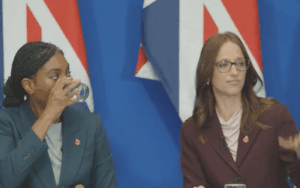
But Badenoch (pictured) has ignored concerns raised by the charity that oversees the scheme about the social and economic consequences of the policy.
Instead, this week she and her shadow work and pensions secretary Helen Whately included the £1 billion savings as part of their launch of plans to cut £36 billion a year from social security spending if their party wins the next general election.
Whately produced a string of unevidenced claims about disabled people who use the scheme.
She claimed some Motability users were “making a mockery of the system, bragging about their free Motability cars, flaunting their new keys on TikTok” and that they believed this was “a victimless crime”.
She said some were “exploiting the system” and claimed that every pound that funded Motability comes from “someone who gets up, goes to work, and pays their taxes, and most likely will never afford a brand-new car”.
Despite her claims, there is no evidence of widespread personal independence payment (PIP) fraud, with the latest government figures showing that only 1.4 per cent per cent of PIP spending was fraudulent in 2025-26, although that was a sharp increase on the previous year when it was just 0.4 per cent.
In response to the party’s claims this week, a spokesperson for Motability Foundation*, the charity which oversees the car scheme, told Disability News Service: “To date we have had some engagement with members of the Conservative party, and we would welcome the opportunity to engage with the senior leadership following yesterday’s announcements.
“The party’s proposal to remove tax reliefs from the scheme would be catastrophic for disabled people.
“We remain optimistic that we will be able to meaningfully engage with the party in the coming months, to ensure they are equipped with the information they need to make a decision on potential future policy regarding the scheme.”
The Conservative party is not currently engaging with Disability News Service, and it refuses to explain why.
It had not responded by noon today (Thursday) to questions about the Motability measure, and wider concerns about the report.
Motability Foundation has previously described repeated claims by Whately that people can sign up to Motability with “acne” or “tennis elbow” as “extraordinary”, although only DWP can confirm that Whately’s claims are not correct, and it has so far refused to do so
Despite this, Whately claims in the foreword to the new report, Welfare that Works: The Conservatives’ plan for Welfare Savings: “A safety net designed for a country emerging from war now funds free cars for people claiming for acne and tennis elbow.”
Motability has previously explained that the party’s £1 billion savings would add thousands of pounds to the cost of a Motability vehicle, jeopardise the scheme’s sustainability and have “serious knock-on effects” on the economy and the automotive industry.
The Motability scheme works by buying cars, leasing them to disabled customers, and selling them after three years, with the resale value helping to keep the cost of the lease affordable.
But because the scheme operates on a low profit margin to make those leases affordable, Motability Foundation has said that any new taxes would have to be added to the advance payments customers must pay every three years when they lease a new vehicle.
Removing VAT relief on reselling its vehicles would be likely on average to add an extra £3,320 to the advance payment a disabled person needs to find every three years, and it would reduce new applications by an estimated 74 per cent.
Applying VAT at 20 per cent to new leases would likely add an extra £6,000 on average to the advance payment, and at that level, Motability Foundation’s modelling suggests, “almost all demand for the scheme would disappear”.
The combined Tory measures could “theoretically” raise £1.7 billion a year, but once nearly all disabled people stopped using the scheme, the modelling suggests, tax revenues could fall to just £20 million by the fourth year, while wrecking the scheme, the market for wheelchair-accessible vehicles, and the wider UK car industry.
VAT changes introduced by Labour chancellor Rachel Reeves last November are already costing disabled people who lease a Motability car more than £400 each on average.
She imposed VAT at 20 per cent on most advance payments for cars leased through the Motability scheme and removed the 12 per cent insurance premium tax exemption.
Only vehicles with substantial adaptations for wheelchair- and stretcher-users were exempt from the new taxes, which were introduced in July (and in September in Scotland) on new Motability leases.
Motability Operations, the company which runs the scheme, has absorbed some of the extra costs itself.
It has estimated that the tax changes would have added an average of £1,100 per new Motability lease if it had not introduced hugely unpopular changes to the scheme, such as lower mileage allowances – cut from 20,000 to 10,000 miles a year – increasing excess mileage charges from 5p per mile to 25p**, tightening its tyre replacement policy, and imposing a fee to take vehicles abroad.
Motability was also pressured by the government into removing all “premium” brands – such as BMW, Jaguar and Mercedes – from the scheme.
*Motability Foundation is a Disability News Service subscriber
**21p for customers who do not pay VAT on additional payments, such as those with a wheelchair-accessible vehicle
 DWP forced to release report that includes ‘outrageous’ revelation about sub-standard assessment reports
 Tories announce seven ways they will attack disability benefits if they win the next election
 Tory plans for billions of pounds in disability benefit cuts ignore echoes of reforms that led to hundreds of deaths