Conservative plans to cut £36 billion a year from social security spending if they win the next election include seven separate measures that target disabled people’s support, analysis of the proposals has shown.
On Tuesday, party leader Kemi Badenoch spoke of the need for “some tough decisions and some tough love” as she announced the publication of Welfare that Works: The Conservatives’ plan for Welfare Savings.
Helen Whately, the party’s shadow work and pensions secretary – although she calls herself the “shadow welfare secretary” – told the invited audience of journalists and Tory supporters that it was “morally the right thing to do” to cut £36 billion a year from the social security system from 2029-30.
Half of these cuts would come from targeted attacks on disability support, with another £10 billion through ending access to the working-age benefits system for all foreign nationals who do not have EU settled status.
But the true scale of how the cuts would impact disabled people is only revealed within the pages of the new document.
Disability News Service has found seven measures that would drastically cut spending to disabled people’s support, in addition to others that will affect disabled people as well as other claimants.
One of the disability measures has already been completely discredited (see separate story).
The first measure would ensure all new claimants of personal independence payment (PIP) would only receive the less generous attendance allowance once they reach state pension age, which means their daily living payment would stay at the same rate but they would no longer receive any payment to cover their mobility needs.
The second measure would introduce “tighter eligibility criteria” for “back and joint conditions”, saving £5.2 billion a year across both PIP and the universal credit health element.
The third would see every claimant forced to undergo a face-to-face assessment, despite many disabled people needing more accessible and less harmful versions of the assessment process.
It is not clear if this means a Conservative government would scrap all video and telephone assessments, but it would certainly mean the end of paper-based assessments, which have been in place for decades and allow some disabled people with high support needs to avoid the potential harm and difficulties of a face-to-face assessment.
The party’s fourth proposal would remove cash support from claimants with what the party calls “milder mental health issues and neurodiversity conditions such as anxiety, depression and ADHD”, again across both PIP and the universal credit health element, saving nine billion pounds a year.
The fifth measure would introduce nearly £3 billion in cuts to child disability living allowance (DLA), focusing on disabled children with lower-level needs relating to “behavioural disorder”, learning difficulties or ADHD, who would no longer be eligible for cash payments for new claims and after reassessments.
The sixth would end VAT exemptions on Motability lease payments – for cars with no adaptations – and on the resale of Motability’s fleet of second-hand vehicles.
The party claims this measure would save £1 billion a year but Motability Foundation has made it clear that it would put the scheme beyond the reach of hundreds of thousands of disabled people and would raise just a few million pounds in revenue (see separate story).
The final measure targeting disabled people would see a Conservative government extend the “targeted case review” programme run by the Department for Work and Pensions (DWP) – which currently looks for potential fraud and error in universal credit – to PIP and DLA.
The report says the party would invest £1 billion of the savings from its reforms in child mental health services and family hubs, and another £1 billion in health support for mental health conditions and joint and back pain.
Other measures do not focus on disability benefits but would still impact hundreds of thousands of disabled people.
These include ending access to working-age benefits for any foreign nationals without EU settled status; cutting local housing allowance rates; and reinstating the two-child benefit cap.
Another proposal would tighten the rules around the household benefit cap, impacting households that include someone receiving child DLA or PIP – and those on some other benefits – and costing many disabled households thousands of pounds a year.
A Conservative government would also reduce the universal credit standard allowance for some claimants by 30 per cent – after six months of unemployment – to a new “subsistence allowance”, paid onto a card that cannot be used for alcohol, cigarettes, gambling or cash withdrawals.
Some claimants who have previously made national insurance contributions would be able to stay at the standard rate for longer than six months, while some disabled claimants would be exempt from this policy.
The Welfare that Works report says that failing to make the cuts would be an “unacceptable moral failure”, while Whately says in the document: “A safety net designed for a country emerging from war now funds free cars for people claiming for acne and tennis elbow.”
She continued this attack at Tuesday’s launch event, talking of people “making a mockery of the system, bragging about their free Motability cars, flaunting their new keys on TikTok” and believing that “it’s a victimless crime”, although it was not clear who exactly she was referring to.
She also spoke of “exploiting the system” and claimed that every pound that funded Motability comes from “someone who gets up, goes to work, and pays their taxes, and most likely will never afford a brand-new car”.
But there is no evidence of widespread PIP fraud, with the latest government figures showing that only 1.4 per cent per cent of PIP spending was fraudulent in 2025-26, although that had increased sharply on the previous year when it was just 0.4 per cent.
Motability Foundation*, the charity which oversees the Motability car scheme, has previously described repeated claims by Whately that people can sign up to Motability with “acne” or “tennis elbow” as “extraordinary”, although only DWP can confirm that Whately’s claims are not correct, and it has so far refused to do so.
The party is also carrying out what it calls a Disability and Sickness Benefit Review, which it says will “propose a fundamentally reshaped disability and sickness benefit system” that will allow “those with serious disabilities to be more able to get the support they need while bringing the growth in demand for cash benefits under control”.
It says the review – whose advisory board members have so far not been named by Whately – is examining eligibility, assessment, and how to “provide better support that fixes broken incentives by moving away from a cash benefit model”, while “helping those who can into fulfilling work that builds resilience and independence”.
*Motability Foundation is a Disability News Service subscriber
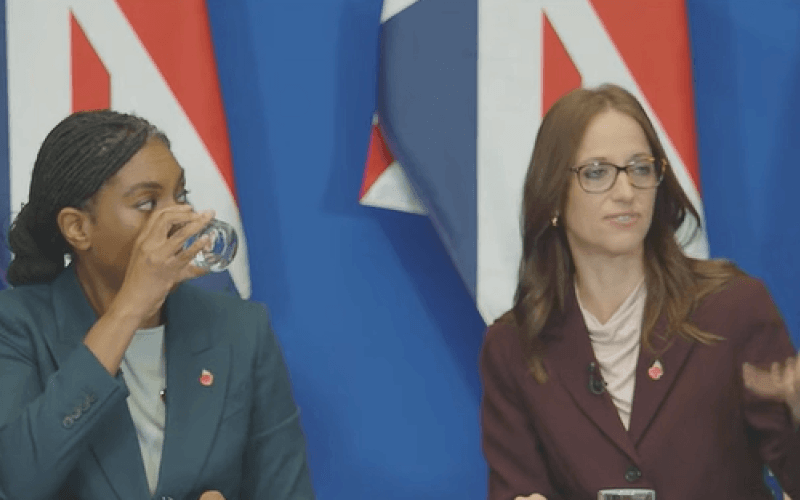
Picture: Kemi Badenoch (left) and Helen Whately
 DWP forced to release report that includes ‘outrageous’ revelation about sub-standard assessment reports
 Badenoch ignores analysis that shows her ‘catastrophic’ £1 billion plans would decimate the Motability scheme
 Tory plans for billions of pounds in disability benefit cuts ignore echoes of reforms that led to hundreds of deaths