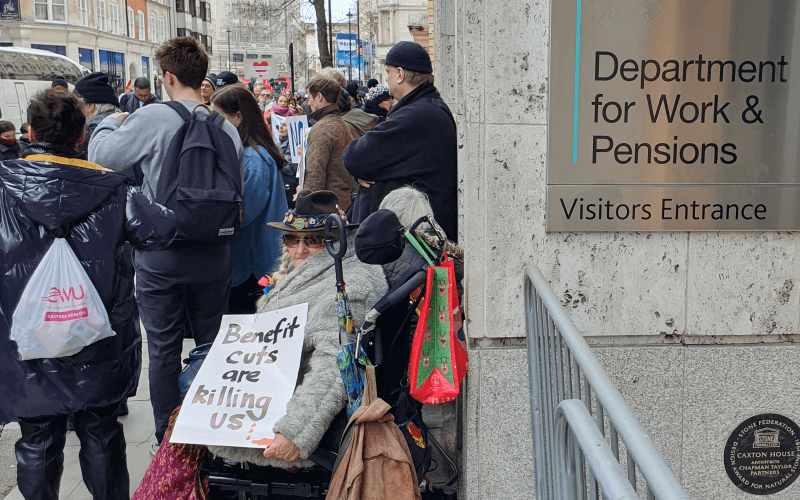
Andy Burnham has edged further towards clarifying his policy on work and pensions reform, taking a step away from blaming disabled claimants but still failing to acknowledge the safeguarding risks of the sanction-heavy approach he appears to favour.
In his first media interview since becoming prime minister, Burnham refused to accept the suggestion of the BBC’s Laura Kuenssberg that there were people claiming “sickness and disability benefits” who do not need them.
Instead of targeting benefit claimants, he said, he blamed the failure of support provided to young disabled people, particularly in the education system, and told her: “… so I don’t blame them.
“I don’t think the support has been there for them in the way it should have been.”
But when asked if his plans included “removing benefits from anyone or reducing benefits for anyone”, he said the new system would be about “changing the nature of the support and making some of the support conditional upon people taking opportunities that are presented in front of them”.
This suggests he will support the findings of former New Labour health secretary Alan Milburn’s inquiry into young people who are not in education, employment or training.
The final report of his inquiry, which focuses on young disabled people, is due later this year.
Milburn repeatedly stressed in his interim report that there should be a “participation-first welfare system” which should be asking “what can they do and how can it enable that to happen”.
The concerns about the possible introduction of stricter conditions and sanctions were emphasised when work and pensions secretary Pat McFadden told the Guardian this week that any support would – in the Guardian’s words – “be conditional on young people properly participating in the support that would be provided”.
McFadden said: “We have an obligation to put good support in place. And then there is an expectation that people engage with the support.”
It is not yet clear what level of conditionality and sanctions Burnham will approve, and there is still no clue on how he would prevent a repeat of the hundreds – and probably thousands – of deaths that followed the last major government push to cut spending and force disabled people off benefits and into work, in the early 2010s*.
Earlier this month, Disability News Service (DNS) reported how the number of deaths of benefit claimants investigated by the Department for Work and Pensions through its system of secret reviews nearly doubled to 110 in 2025-26, according to figures hidden in its annual report.
Although Burnham accepts the need to bring down the “welfare” bill, he told Kuenssberg that one of the key ways to do this would be by building new council and social homes, which would “help get that benefit bill down in a fair and sustainable way”.
He added: “I think the thing I am just pushing back on is this idea that we go to a kind of crude approach, crude cuts to benefits to get the welfare bill down.
“Often that just pushes people into even more crisis and then even more public spending in another part of the system.
“We need a system that sets people up for success, rather than pays for failure.”
Meanwhile, No 10 has stressed that Burnham’s launch of “prestigious” new technical educational routes for students from the age of 14 will run alongside the government’s wider reforms to the special educational needs and disabilities (SEND) system in England.
Burnham said he wanted to see “parity between academic and technical” education to ensure there are “no dead ends” for young people coming out of the education system.
No 10 said that strategic authorities – combined authorities and the Greater London Authority – along with schools, colleges and employers, will all be expected to make these new routes accessible, so that young people with SEND will be able to develop the skills, confidence and experience they need for further study, training or work.
Ministers have also announced a new bursary, possibly worth up to £4,500 per year per household, that will target a small number of families receiving universal credit who currently lose out financially if a disabled child takes up an apprenticeship.
A social security advisory committee report found single parents with a disabled child could lose up to £340 per week in benefits, which is greater than the apprenticeship minimum wage salary of £258 per week.
The bursary aims to address much or all of this shortfall, to ensure the loss of benefits is not a barrier to taking up an apprenticeship.
The final amount of the bursary has not yet been confirmed.
*The Department: How a Violent Government Bureaucracy Killed Hundreds and Hid the Evidence, DNS editor John Pring’s book on the years of deaths linked to DWP’s actions and failings, is published by Pluto Press
 Budget extends the agony, as disabled people face further wait for Labour’s decisions on benefit cuts
 Alarm bells ringing after minister says all work is good for health, and he wants ‘everyone’ to get a job
 PIP review member delivers powerful rebuttal to research by colleague that called for cuts to child DLA