The Conservative party are refusing to say which vital protections they would scrap if they win the election and abolish the Human Rights Act (HRA).
The party’s manifesto says a Conservative government would replace the act – introduced by a Labour government in 1998 – with a British bill of rights, which it claims would “restore common sense to the application of human rights in the UK”.
But although the manifesto promises that such a bill of rights would “protect basic rights”, such as the right to a fair trial, and the right to life, which are “an essential part of a modern democratic society”, it does not say which other existing rights might be at risk.
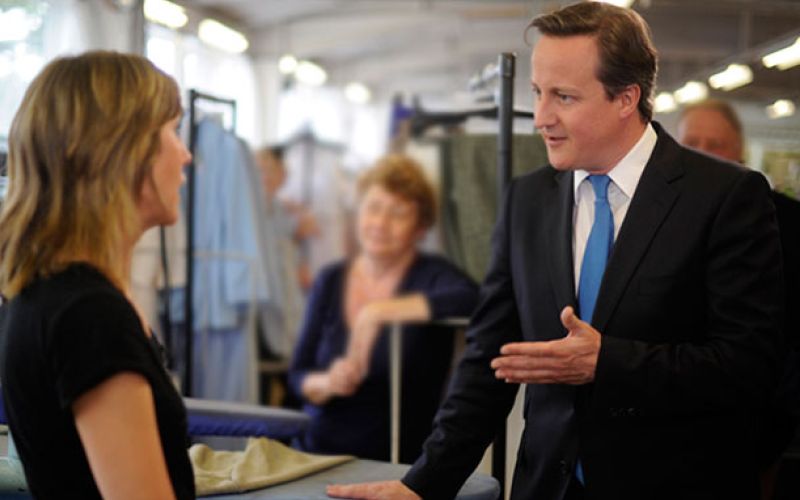
And this week the party (led by prime minister David Cameron, pictured) has made it clear to Disability News Service that it will provide no information about what rights might be scrapped until after the election.
A party spokesman said: “You are going to have to find that out when we publish our draft UK bill of rights.”
But he confirmed that the bill of rights would not provide “an exact replica” of the rights included in the HRA.
Among the articles included in the Human Rights Act, many of which have been used to secure vital improvements to the lives of disabled people, are the rights to: freedom from torture and inhuman or degrading treatment; freedom from slavery and forced labour; respect for private and family life; the right to marry and start a family; the right to education; and the right to participate in free elections.
Last July, the government was forced to back down in a legal dispute with the disabled owners of two small businesses, over whether they had to file their VAT returns online.
A judge had found that mandatory online filing was a breach of the right to privacy, the right to be free from discrimination, and the right to peaceful enjoyment of possessions.
The British Institute of Human Rights (BIHR) has compiled a series of cases in which the HRA has helped people in practice.
It tells of Balbir, a disabled woman who, with the help of an advocate, persuaded her local council to build her an accessible downstairs bathroom after she was no longer able to access her upstairs bathroom.
The advocate had warned the council that, under the HRA, it was in danger of breaching Balbir’s right to be free from degrading treatment.
BIHR also describes the case of Peter, whose advocate used the right to liberty, under article five of the act, to persuade the mental health hospital where he was an informal patient to back down after staff refused him permission to visit his sister and friends.
In another series of case studies, BIHR describes how the parents of a man with mental health problems, who had been placed in short-term residential care, noticed unexplained bruising on his body.
After the home’s managers dismissed the couple’s concerns and banned them from visiting, they took part in a BIHR training session and used their son’s right not to be treated in an inhuman and degrading way, and their right to respect for family life, to force the home to revoke the ban and investigate the bruising.
Meanwhile, an audit of the effect of the main political parties’ manifesto policies* has concluded that neither the Conservatives nor Labour are offering a “robust strategy to address poverty”.
The Greens score consistently the highest (with an average of 3.9 out of five) across 12 policy areas, followed by the Liberal Democrats, with 3.2, and Labour with 2.6. The Tories score just 1.7, while UKIP trail in last with 1.4 out of five.
On disability, the Greens and Lib Dems both score five, Labour four, UKIP three and the Conservatives two out of five.
The report by Academics Stand Against Poverty UK was put together by academics from 21 UK universities, as well as peer reviewers, students, and communications and policy experts, and provides “an audit of the main political parties’ manifestos, measuring their policies’ impact on UK and global poverty”.
It concludes that a common theme of the Green manifesto was that “unlike other parties – their policies were more far-sighted, addressed the structural causes of problems (like housing) and looked systematically at the impact on different parts of UK society”.
On disability, the Lib Dems and Greens score very highly “because of their comprehensive response to disability and explicit commitment to disability rights, followed closely by Labour”, while UKIP “scores moderately”, followed by the Conservatives, who score poorly.
The authors of the report include two prominent disabled academics, Tom Shakespeare, of the University of East Anglia, and Nick Watson, of the University of Glasgow, who co-wrote the chapter on disability.
They conclude that “overall, the Liberal Democrats have the most comprehensive response to disability of all the parties”.
*The SNP manifesto was published too late to allow it to be analysed
 Equality watchdog must investigate ‘urgent threat’ posed by Labour policies, say DPOs
 Disabled tribunal member takes step towards legal action against DWP over years of ‘persecution’
 Labour manifesto drops key disability rights pledges