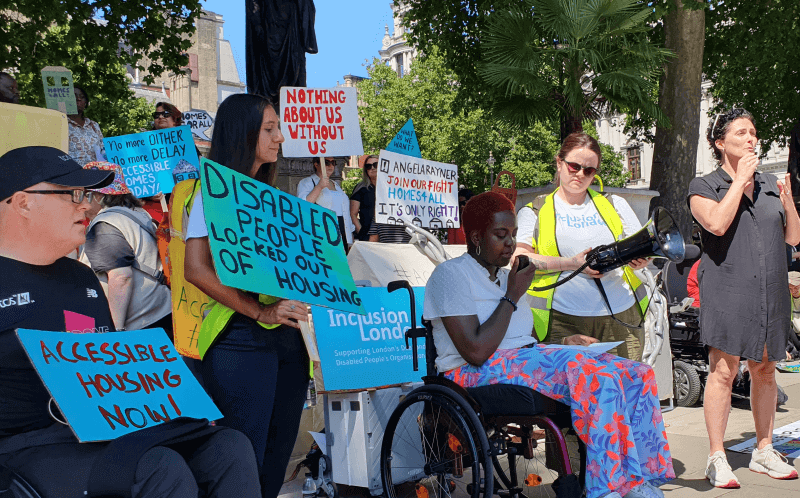
The government is freezing the budget of a scheme that funds “life-changing” adaptations to disabled people’s homes, despite a minister claiming he was “putting more money” into the programme.
Care minister Stephen Kinnock said last week that the extra funding for Disabled Facilities Grants (DFGs) in England was part of the government’s “wider plans to build a national care service rooted in quality, fairness and dignity for all that use it”.
He said the government would spend £723 million in 2026-27 on the scheme.
But calculations by Disability News Service (DNS) show this will be a fall of five per cent in the DFG budget.
The government had allocated £711 million for the scheme for 2025-26 but the County Councils Network said in January that the government had allocated an extra £50 million to DFGs, taking it to £761 million.
This means the government will be cutting the DFG budget by £38 million in 2026-27, a drop of five per cent.
But even without the extra £50 million the government added in January, a budget of £723 million would still have been a real terms cut, increasing spending by just 1.7 per cent, lower than the current CPI* rate of inflation, which is currently about three per cent and was predicted by the Office for Budget Responsibility (OBR) in November to fall to about 2.5 per cent in 2026.
This follows a significant increase to the DFG budget from £220 million in 2015-16 to £623 million in 2023-24 under the last government.
The Department of Health and Social Care (DHSC) told DNS that the £12 million increase (1.7 per cent) in the DFG budget (excluding the £50 million top-up in January) was based on the OBR inflation forecast that was made in March 2025, at the time of the government spending review.
It said it was still broadly in line with OBR inflation forecasts from November 2025.
This is because it uses OBR’s estimates of the “GDP deflator” to judge expected inflation, rather than the CPI measure, because it said this tends to better reflect government spending.
OBR estimated last March that the GDP deflator – which only measures the price of domestically-produced goods and services – would slow down to 1.7 per cent in 2026.
But OBR’s latest forecast, in November 2025, predicted a GDP deflator of 2.2 per cent for 2026, which is set to mean a real terms cut in the DFG budget**.
Although the complexity of the various figures and comparisons means the government can argue that it did not intend a real terms cut, it is hard for it to argue that the DFG budget for 2026-27 is, at best, anything but a real terms freeze.
Asked how the government justified this level of funding at a time when there was an accessible housing crisis, a DHSC spokesperson said in a statement: “We increased the Disabled Facilities Grant (DFG) financial package by £12 million for 2026-27 compared to the original allocation for 2025-26.
“The allocation for next year is £723 million.
“Due to exceptional circumstances, we were also able to announce an additional in-year uplift of £50 million for the DFG for 2025-26, which was welcomed by the sector.
“This did not form part of the original allocation from the spending review/budget.
“Each year, the DFG supports tens of thousands of people to adapt their homes so they can live safely and independently.”
The funding freeze comes just months after the government was accused of a “truly horrifying” betrayal of disabled people, after it slashed an accessible housing target proposed by the last government.
Shortly before the last general election, Tory housing minister Felicity Buchan finally promised to introduce new rules that would ensure all new homes were built to the strict M4(2)*** standard of accessibility, except for cases where this was “impractical and unachievable”.
Conservative ministers had been considering and consulting on the measure – a long-standing demand of the disabled people’s movement – for at least five years, but the general election came before any further action was taken.
But just before Christmas, Labour housing secretary Steve Reed – after more than a year of government delays and false promises – finally published plans for accessible housing in a consultation on changes to the National Planning Policy Framework.
The consultation showed Reed wanted to cut the percentage of new homes that should be built to the M4(2) standard from 100 per cent – under the Tory plans – to just 40 per cent.
It also failed to propose a minimum level for the proportion of M4(3) new homes that are suitable for wheelchair-users, which disabled housing campaigners believe should be set to at least 10 per cent.
*Consumer prices index. This is the measure of inflation targeted by the Bank of England
**These cannot be precise comparisons as OBR’s estimates are for the 2026 calendar year, whereas the government budget is for the financial year 2026-27
***Homes built to the M4(2) standard have 16 accessible or adaptable features, similar to the Lifetime Homes standard developed in the early 1990s to make homes more easily adaptable for lifetime use, while M4(3) homes are those that are supposed to be fully wheelchair-accessible
 Ministers’ decision to slash accessible housing targets was ‘unprincipled’, but Timms says they were right
 Government ‘encourages discrimination by design’ by deciding to slash Tory accessible housing targets
 BBC and Sky News fail to explain why presenters do not push back on claims of ‘spiralling welfare spending’