Labour appears set to plough ahead with billions of pounds of cuts a year to disability benefits, after this week’s spending review failed to offer any suggestion of a U-turn.
The government had already given two other major signs that it was not intending to reverse the cuts, even before yesterday’s spending review.
In her statement to MPs, chancellor Rachel Reeves confirmed the government’s U-turn on cuts to winter fuel payments for older people, but she made no mention of disability benefits, and did not mention disabled people or disability.
The Treasury’s spending review document – which sets out the budgets for government departments for day‑to‑day spending until 2028‑29, and until 2029‑30 for capital investment – mentions disabled people or disability just six times in about 43,000 words, and only in connection with planned reforms to the special educational needs and disabilities (SEND) system and in confirming increases in employment support for disabled people.
Asked by Disability News Service whether the chancellor’s failure to mention disability benefits meant there would be no U-turn on the cuts, the Treasury had not commented by noon today (Thursday).
Even before Reeves delivered her statement, the prime minister had misled MPs about the planned cuts to personal independence payment (PIP).
He had been asked in prime minister’s questions by Labour MP Richard Burgon why a Labour government was planning to “balance the books on the backs of disabled people”.
Burgon said that “people who need assistance to cut up their food, to wash themselves, to dress themselves and to go to the toilet will lose the personal independence payments that they currently receive”, and he asked Sir Keir Starmer to “drop these disability benefit cuts”.
But instead of responding to the concerns about cuts to PIP, the prime minister said Labour’s cuts and reforms would be based on the principle that “those who can work should work, that those who want to work should be supported so that they can do so, and that we must protect those with the most severe disabilities who will never be able to work”.
PIP is not an out-of-work benefit, and it can be claimed by disabled people who are in or out of work.
Only last month, work and pensions secretary Liz Kendall misled MPs four times in just 23 minutes by suggesting that the cuts to PIP were linked to supporting disabled people into work.
And in a third sign that the government has no intention of making a U-turn on the cuts laid out in the Pathways to Work green paper, Kendall wrote to the work and pensions select committee this week to confirm that she believes she was right to cut billions from disabled people’s support.
In Monday’s letter to the committee’s Labour chair, Debbie Abrahams – which was published on the day of the chancellor’s statement – Kendall defended the cuts to PIP and said again that the increase in the number of claimants was “not sustainable if we want our welfare safety net to exist for those who need it in future”.
She also referred to the “urgently needed changes to the PIP eligibility criteria”.
Kendall also made it clear that her position had not changed on the planned cuts to the universal credit disability payment, because of the “perverse incentives” in the system.
She said at the end of the letter: “We will not avoid or delay the decisive action needed to transform the system, so it helps people in the best way possible and ensures our welfare state is sustainable for the future.”
Meanwhile, the spending review document says the Department for Education will set out the government’s “intended approach to SEND reform” in a schools white paper in the autumn.
It says this will “make the system more inclusive and improve outcomes for all children and young people”.
It is looking increasingly likely that these will be major reforms, with The Law Society Gazette reporting yesterday that SEND tribunal judges “have been told their services will not be needed in future”.
Although not mentioned in the chancellor’s speech, the spending review document also mentions an increase of more than £4 billion a year in funding for adult social care by 2028-29, compared with this year, with further details to be announced “shortly”.
But the Liberal Democrats said the spending review document had revealed “a potential black hole for social care”.
Daisy Cooper, the party’s Treasury spokesperson and deputy leader, said: “This spending review was a missed opportunity to repair the damage done by the Conservatives and finally deliver on the promise of change.
“Behind the smoke and mirrors is a potential black hole for social care as local government budgets remain at breaking point.
“Putting more money into the NHS without fixing social care is like pouring water into a leaky bucket.”
Her party said the spending review document showed that, while local government has a statutory responsibility to provide social care, the Ministry of Housing, Communities and Local Government was facing a 1.4 per cent real terms cut over the course of the spending review.
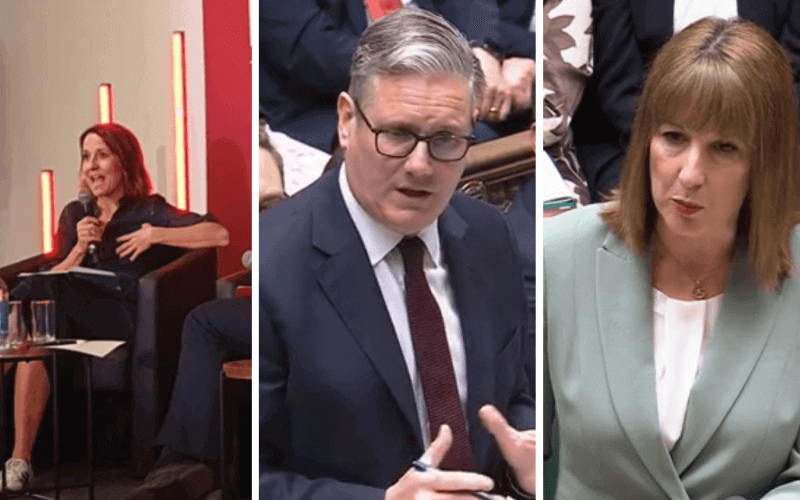
Picture: (From left to right) Liz Kendall, Sir Keir Starmer and Rachel Reeves
A note from the editor:
Please consider making a voluntary financial contribution to support the work of DNS and allow it to continue producing independent, carefully-researched news stories that focus on the lives and rights of disabled people and their user-led organisations.
Please do not contribute if you cannot afford to do so, and please note that DNS is not a charity. It is run and owned by disabled journalist John Pring and has been from its launch in April 2009.
Thank you for anything you can do to support the work of DNS…
 New official figures disprove claims that social security spending is ‘spiralling out of control’
 Secrecy of DWP’s board of experts set up to examine ‘economic inactivity’ and long-term sickness
 DWP refuses to say who will lose out in £2 billion cuts to disability benefits, six weeks after budget