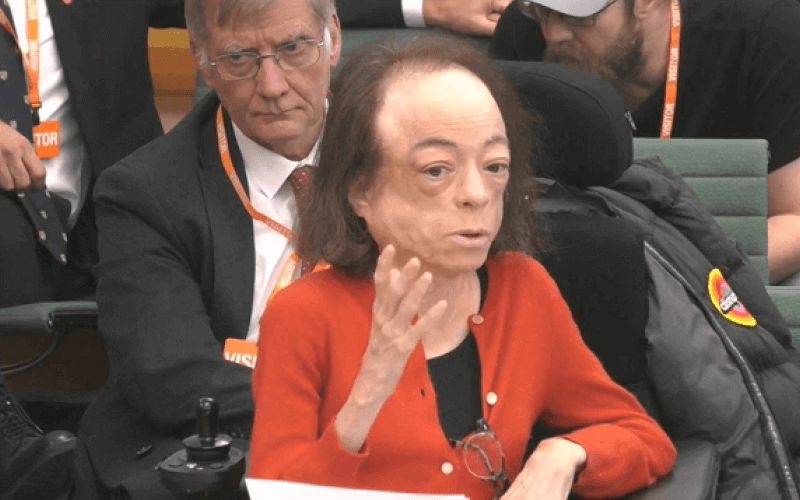
Many terminally-ill people would feel “duress” and “pressure” to choose an assisted suicide if it is legalised, because of the lack of funding for the NHS, palliative care and social care services, a disabled activist has told MPs and peers.
Liz Carr (pictured) was giving evidence to the joint committee on human rights yesterday (Wednesday) just two days before the House of Lords begins the latest parliamentary stage in examining the terminally ill adults (end of life) bill.
The bill, which applies to England and Wales, has not been introduced by the government – although it is believed to be heavily-supported by the prime minister – but has instead been sponsored as a private members’ bill by Labour MP Kim Leadbeater and Labour peer Lord Falconer.
Carr, a disabled actor, writer and activist, told the committee that some terminally-ill people, faced with a lack of support, would feel they had no alternative but to choose an assisted suicide, if it was legalised.
She said they would feel “duress” and “pressure” because they were not able to secure the support package they needed, and because they felt they were a “burden on their loved ones”.
She told the committee there should be more focus on “providing support and a good death for people at the end of their lives rather than focusing on this one option for a small group of people, when there’s a much bigger group of people who are suffering at the end of life now.
“They’re dying in corridors, they’re dying because they don’t get the drugs because NICE is not approving them, they are dying because there is not the right support and funding into palliative care.
“That is suffering.”
Carr, who opposes legalisation, said the need for the evidence session was “testimony to the absence of the disability voice in the progress of the bill so far”.
She said that disabled people and disabled people’s organisations had “struggled to get heard” during the bill’s passage through the House of Commons.
She also told the committee that most disabled people had experienced “devaluation at the hands of the health professionals, and that is terrifying.
“The one safeguard that there currently is that I feel safe with… is that assisted suicide remains a criminal act.
“Once it becomes a medical treatment, then that’s when it terrifies me, because it happens behind closed doors and is based on medical subjectivity.
“And those doctors and whoever are making those decisions have the same biases and the same prejudices and pressures every single day that view disabled people often as better off dead and their lives as having less value.”
Jean Eveleigh, a patron of the pro-legalisation campaign group My Death, My Decision, who has a long-term health condition, said it was parliament’s job to provide the necessary funding to deal with the “very real pressures and very real problems” with the NHS and advocacy programmes, rather than using them as reasons not to introduce the legislation.
She told the committee: “And you not doing anything about it is your fault, not ours.”
Eveleigh said there were some people for whom “no matter how great palliative care is, no matter how loving their family is, no matter how much medication they’re given, they just cannot have what they would decide is a good death and they should be given the choice to decide how they want to die”.
Eveleigh said there were currently no safeguards to protect terminally-ill people who are considering taking their own lives, and no figures on how many of them are being coerced to take their own lives or refuse treatment.
She said: “This law is actually going to be improving things from the zero state we have now.
“Whether it’s a bad law or not is for other people to decide, but having nothing is causing problems.”
She said that data should be collected after assisted dying was legalised to see how the law was being implemented by doctors.
She said: “You’ve got the data, you can then see where the flaws of it are, you can then make improvements.”
The crossbench peer Baroness Hollins, a former president of the Royal College of Psychiatrists, who opposes legalisation, spoke about her husband, who died from motor neurone disease earlier this year.
She said he had still been waiting for a wheelchair when he died, because of an NHS waiting list.
She said: “You can imagine that you are there needing something and not getting it, and that is not going to help your mental state, it’s not going to help you to manage your everyday life.”
She said the much higher rate of suicide for disabled people compared with non-disabled people made her worry that some disabled people might choose an assisted death rather than wait for the care and support they needed.
She also spoke to the committee about her daughter, who was treated 20 years ago for a high-level spinal injury, and who is now “scared of what this bill could bring”.
When her daughter was injured, a neurosurgeon “did not want her to be resuscitated because he said the quality of her life would be so poor”.
Baroness Hollins told the committee: “Her life would not be worth living, he said, and he did not want to admit her.
“It’s only because I was there as an advocate, essentially, it’s only because I actually understood what he was talking about, that I said, please, please admit her, and 20 years on she’s got three children and she’s living a wonderful life.
“Yes, her life is different. But do you know what? She’s scared of this bill.”
Dr Henry Marsh, a neurosurgeon and supporter of legalisation, who was diagnosed four years ago with advanced prostate cancer, told the committee: “I see assisted dying as a form of treatment, a treatment for suffering, and it should be subject to the same analysis of cost and benefit on the basis of evidence as you do with any other treatment.”
He confirmed that he believed that if there were some cases of coercion, the greater public good would still be served by legalising assisted suicide.
He said: “In principle, yes. I know I made a very crass comment about sacrificing grannies*. I greatly regret it. I wish I hadn’t said it. It was very stupid of me.
“I didn’t realize it was going to get into the public domain, but the principle is there is always a cost.”
He said the “reality of normal medical practice” was that there was always a risk that a medical procedure “could make things worse”, but that risk was justified because “more people benefit”, even if “it sounds rather inhumane and utilitarian”.
He said later: “There are always risks. Nothing is perfect.
“A lot of people are suffering bad deaths in this country, I’m afraid.”
He said such a bad death could happen to him.
He told the committee: “The state of the NHS is abysmal and palliative care is not properly funded, but I think it’s highly unlikely there’ll be better funding of palliative care in the future.”
*He told The Times eight years ago in an interview that, if assisted suicide was legalised: “Even if a few grannies get bullied into it, isn’t that a price worth paying for all the people who could die with dignity?”
A note from the editor:
Please consider making a voluntary financial contribution to support the work of DNS and allow it to continue producing independent, carefully-researched news stories that focus on the lives and rights of disabled people and their user-led organisations.
Please do not contribute if you cannot afford to do so, and please note that DNS is not a charity. It is run and owned by disabled journalist John Pring and has been from its launch in April 2009.
Thank you for anything you can do to support the work of DNS…
 Disabled peer hits back at claims of ‘filibustering’ over ‘vague’ and ‘poorly drafted’ assisted suicide bill
 Disabled activists call on Clooney to abandon movie that is set to paint Alzheimer’s as ‘fate worse than death’
 People with learning difficulties ‘could be collateral damage’ if assisted dying bill becomes law