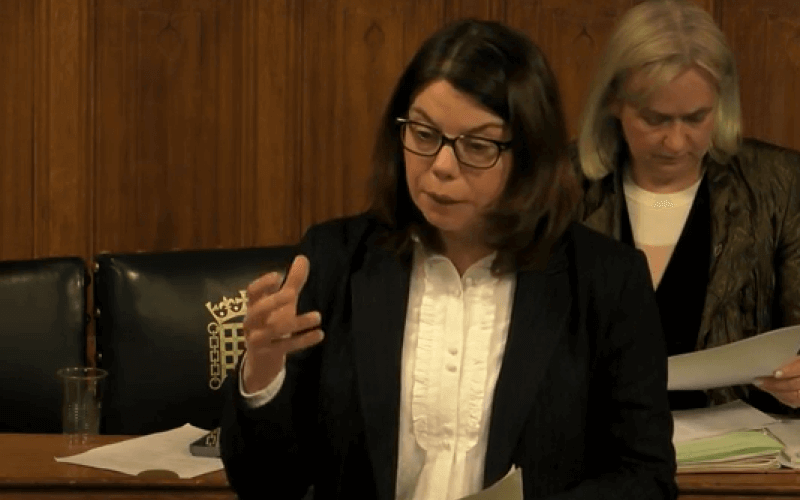
A Liberal Democrat MP has warned that a bill that aims to legalise assisted suicide would take England and Wales into “tiger country” and let “tigers out into the wild”.
Sarah Olney (pictured) was speaking as she attempted to persuade members of the committee examining the terminally ill adults (end of life) bill that they needed to toughen its safeguards.
It came as pressure mounts on the Labour MP behind the private members’ bill, Kim Leadbeater, over her decision to replace a system in which the high court would have to approve applications for assisted suicide with a panel of “experts”.
Reports suggest the move could see support for the bill among MPs drop off ahead of its report stage, with Conservative MP Danny Kruger warning on Tuesday that more than 60 MPs had voted for the bill on second reading in November “because of that safeguard”.
The bill passed in November with a majority of just 55, so it could take less than 30 MPs to change their minds for it to be defeated.
Olney’s amendments would particularly have strengthened the safeguards around how the capacity of someone to choose an assisted suicide would be decided.
She suggested that, rather than using the Mental Capacity Act 2005 to decide if someone had the capacity to make a decision to end their own life, they should be assessed on whether they were “fully able to understand, fully able to weigh and use the relevant information” to make a decision to ask for an assisted suicide.
This would mean a terminally-ill patient with a co-occurring mental health impairment which affected their judgement “would not be eligible for assisted dying”.
The “tiger country” phrase had been used earlier in the day by Dr Neil Shastri-Hurst – a Conservative MP and supporter of the bill – when he warned against abandoning the bill’s reliance on the Mental Capacity Act 2005.
But Olney, who does not support the bill, said: “It’s the bill itself that takes us into tiger country. This is unprecedented. This is very much new territory for legislation in this country.
“That’s the tiger country right there.
“And if we are going to let these tigers out into the wild, we need to make sure that the British public, and particularly the most vulnerable members of it, have the right protections.”
She said there had not been agreement among the experts who gave oral evidence to the committee last month on whether the use of the Mental Capacity Act in the bill was “a sufficient safeguard”.
Danny Kruger, another opponent of the bill, said the Voluntary Euthanasia Society, which later changed its name to Dignity in Dying and which has led the campaign to legalise assisted suicide, had lobbied behind the scenes for the Mental Capacity Act to be framed in the way that it had.
He said it had done that “because they were very conscious that when the time came to pass the law for assisted suicide, it would be very helpful to have a capacity act on statute that had this very low bar, so they were delighted when the act was passed in the way it was, and they boasted at the time of the influence they had had on the act”.
Opposing the amendment, the disabled Labour MP Dr Marie Tidball, a supporter of the bill, said the term “ability” was “not an existing concept in law” and replacing it “would create more problems than it seeks to solve”.
She said that to “unleash the tiger of an unknown and untested concept of ability into a bill that would benefit better from the well-understood, measured and principled approach of the Mental Capacity Act 2005” would not “best serve the patients” they were discussing.
She said: “The presumption of capacity in the Mental Capacity Act exists because it is considered a fundamental principle of respecting individual autonomy, meaning that every adult is assumed to have the ability to make their own decisions unless there is clear evidence proving otherwise.”
Olney’s proposed amendment was defeated by 15 votes to eight. The committee is heavily weighted in favour of supporters of the bill.
After the debate, the coalition of disabled people’s organisations that monitors implementation of the UN disability convention in the UK said: “The UK coalition supports Sarah Olney’s amendment and thanks her for putting it in.
“The amendment is aimed at providing a much tighter safeguard than the bill’s proposed use of the Mental Capacity Act as a tool for assessing whether a person is making a clear, settled and informed decision to end their life.
“Our concern is that terminally-ill people with depression will easily pass the capacity assessment but will nevertheless be making their decision to end their lives based on depressed thinking, and internalised assumptions about the hopelessness of their situation.
“Psychological and, crucially, peer support could change their thinking and enable them to enjoy more special moments of life.”
A note from the editor:
Please consider making a voluntary financial contribution to support the work of DNS and allow it to continue producing independent, carefully-researched news stories that focus on the lives and rights of disabled people and their user-led organisations.
Please do not contribute if you cannot afford to do so, and please note that DNS is not a charity. It is run and owned by disabled journalist John Pring and has been from its launch in April 2009.
Thank you for anything you can do to support the work of DNS…
 Disabled peer hits back at claims of ‘filibustering’ over ‘vague’ and ‘poorly drafted’ assisted suicide bill
 Disabled activists call on Clooney to abandon movie that is set to paint Alzheimer’s as ‘fate worse than death’
 People with learning difficulties ‘could be collateral damage’ if assisted dying bill becomes law