
Disabled people’s organisations (DPOs) have raised ongoing concerns about the government’s failure to comply with basic principles of the UN disability convention at a long-awaited meeting with the minister for disabled people.
Representatives of six of the UK’s leading DPOs met with minister for disabled people Sarah Newton and senior civil servants last week to discuss the government’s track record on engaging with disabled people and their user-led organisations.
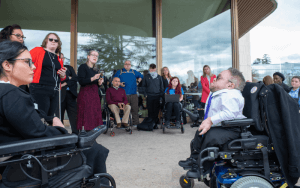
It was the first time that Newton (pictured) had met with the group of DPOs – members of the UK CRPD Monitoring Coalition of Disabled People’s Organisations – since she took up her post in late 2017.
Representatives from coalition members Inclusion London (which was also there on behalf of the Reclaiming Our Futures Alliance), Disability Wales, Inclusion Scotland, Disability Action (Northern Ireland), the National Survivor User Network and Equalities National Council attended the meeting.
The coalition also used the meeting to share its ideas for monitoring the UK’s implementation of the UN Convention on the Rights of Persons with Disabilities (UNCRPD).
The meeting follows a series of failings by the government which appear to demonstrate its reluctance to accept key rights and principles laid out in the convention.
They include plans to allow non-disabled people and organisations not led and controlled by disabled people to be part of Newton’s new Regional Stakeholder Network – which aims to “provide a channel for disabled people and their organisations to share their views and experiences about policies and services that affect them” – and Newton’s reluctance to pay those people taking on roles in the network for their time.
There was also frustration at the decision of the Cabinet Office to host a workshop on the barriers facing disabled people without inviting any DPOs to take part.
And in November, the Department of Health and Social Care wrongly insisted that it had been complying with the UN convention by only consulting on its mental capacity (amendment) bill with non-user-led charities like Mencap and Sense.
Last week’s meeting came after the coalition was forced to write to Newton last August after she refused to meet them to discuss the UK’s failure to implement the UN convention.
But the long-awaited meeting ended last week without easing concerns among DPOs at the apparent ongoing confusion among senior civil servants in the Office for Disability Issues (ODI), and Newton herself, about the convention’s principles around engagement.
A meeting earlier in the day between three members of the Reclaiming Our Futures Alliance (RoFA) – which is part of the coalition – and two senior civil servants from the Office for Disability Issues was also marked by frustration at the government’s apparent ignorance of the UN convention.
Mark Harrison, from RoFA, said they had hoped to come out of their meeting with a strategy for how the government would engage with DPOs and resource them in that work, but left disappointed.
He said Newton’s regional network was set to be a “disability free-for-all”, with disability charities and other organisations “all in the tent on an equal footing” with disabled people and DPOs.
He said he had asked the civil servants why they did not understand the principles on engaging with disabled people and DPOs that had been clearly laid out by the UN.
He said the core of the issue was the failure by repeated governments – including the last Labour government – to provide infrastructure funding for DPOs to do this work, which he said was “absolutely shameful”.
Tara Flood, director of The Alliance for Inclusive Education, who was also at this meeting, said the civil servants became “very, very uncomfortable” when she and her two colleagues made it clear they thought the new regional network was “a joke”.
She said there was “no understanding of the difference between DPOs and disability charities. Shame on the ODI for not understanding that.”
It is now hoped Newton will agree to three key requests: for both the regional network and any similar UK-wide engagement to be restricted to representatives of DPOs; for there to be funding for DPOs to take part in that engagement; and for those networks to work with the government on implementing the recommendations made 18 months ago by the UN’s committee on the rights of persons with disabilities.
Tracey Lazard, chief executive of Inclusion London, who was present at both meetings, said there appeared to be ongoing confusion within the government about the difference between DPOs and non-user-led charities.
She said: “We put forward what we think are key minimum asks in order to have meaningful engagement going forward.
“We will now see whether the government has listened to us and taken the opportunity to clarify, improve and extend engagement with us so it reflects and promotes the principles and practice of the UNCRPD and general comment number seven*.”
She added: “It is slightly dismaying having to reiterate principles of engagement with disabled people and DPOs that were recognised and acted upon 10 years ago, and having to re-argue them as if they were radical new ideas descended from another planet.”
*The UNCRPD makes it clear that, when developing laws and policies relating to disabled people, governments “must closely consult with and actively involve persons with disabilities, including children with disabilities, through their representative organizations”.
It defines “representative organizations” as those that are “led, directed and governed by persons with disabilities”, a definition which the UN committee on the rights of persons with disabilities included in its general comment number seven, which was adopted in September.
A note from the editor:
Please consider making a voluntary financial contribution to support the work of DNS and allow it to continue producing independent, carefully-researched news stories that focus on the lives and rights of disabled people and their user-led organisations.
Please do not contribute if you cannot afford to do so, and please note that DNS is not a charity. It is run and owned by disabled journalist John Pring and has been from its launch in April 2009.
Thank you for anything you can do to support the work of DNS…
 Seven years on and no progress on disability rights by UK government, says UN
 UN’s ‘damning verdict’ is ‘vindication’ of fightback against government’s rights violations
 Black disabled pupils face systemic barriers and injustice at school, says new report