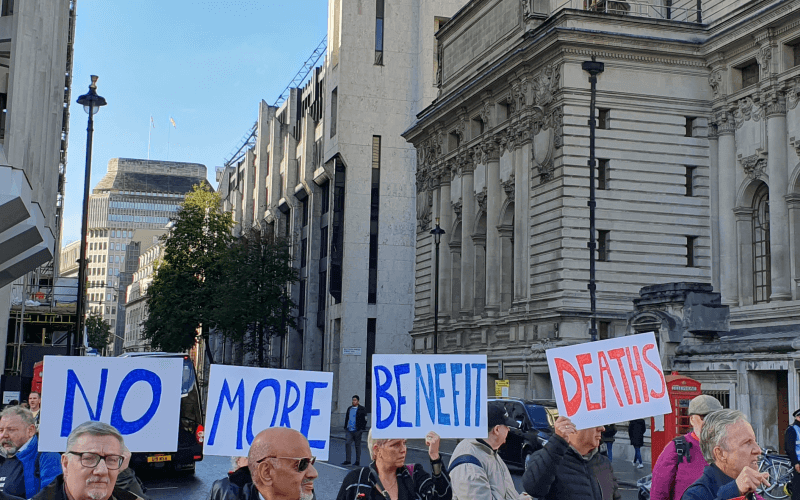
A minister has asked the Department for Work and Pensions (DWP) whether it could release secret reports to families whose relatives’ deaths have been linked to DWP’s actions and failings.
Ever since Disability News Service (DNS) first revealed the existence of the secret reviews in October 2014, DWP has repeatedly refused to even alert the families of those who have died that an investigation has been carried out.
The department has insisted – as it did last week when it again refused to tell lawyers for the family of Jodey Whiting whether it carried out a probe into her case – that such reviews are “internal retrospective investigations focused on organisational learning, not public accountability”.
The probes were previously known as peer reviews but are now called internal process reviews (IPRs).
The only IPRs ever to be released to grieving relatives have come after orders made by a coroner or a judge.
DNS is aware of only two such cases, including the IPR ordered to be released by the coroner who heard the 2021 inquest into the death of Philippa Day.
But DNS told the social security and disability minister Sir Stephen Timms this week that safeguarding adults reviews and domestic homicide reviews are released to families and are published, although the identities of the subjects of the reviews are disguised.
DNS also pointed to the eight-year campaign for justice and accountability led by Jodey Whiting’s mother, Joy Dove, and her struggle to secure the IPR she believes was carried out into the circumstances surrounding her daughter’s death.
Speaking during an interview with DNS at Labour’s annual conference in Liverpool, Sir Stephen said: “Internal process reviews are what the name implies, they are for internal consumption within the DWP to look at where we got things wrong and how are we going to put them right.
“So that is kind of the nature of them, so I don’t think it’s surprising inherently that they are not shared more widely.”
But he then said that DNS was “raising a very reasonable issue here, and particularly asking whether families should, in certain circumstances, be able to see them”.
He said he had asked DWP civil servants “to take a look at this, and I am going to be receiving some advice on that subject”, although he said it was “difficult and there is a duty of confidentiality that the department owes to people”, even after they have died.
He added: “There might be a need to change the law here.
“Anyway, I’ve asked officials to have a look at this and to come back to me.”
His comments came after Steve Darling, the Liberal Democrat work and pensions spokesperson, told DNS last week that he was hoping to use the government’s new Hillsborough Law to force DWP to release IPRs to relatives.
During Sunday’s interview, Sir Stephen admitted that it was only because of a DNS news story that he became aware that a report – commissioned by Conservative work and pensions secretary Therese Coffey in 2020 – had called for DWP to reduce suicides of benefit claimants and other “very bad cases”.
The Complaints, Suicides and Other Matters report was written by Tory peer Baroness [Lucy] Neville-Rolfe, but DWP has told DNS that it would be too expensive to find out what happened in response to the 11 recommendations she made five years ago.
Among her recommendations was for DWP to set up a new register of “very bad cases”; to review its safeguarding system, including an analysis of its effectiveness in reducing suicides; and to review the IPR system.
Sir Stephen said on Sunday: “I actually did not know that Baroness Neville-Rolfe had done a report for the DWP until my office told me that you were likely to ask me about it.
“That’s the first time I was aware of this report having been done.”
DNS has been writing news stories about the report since May this year, but it appears that no-one in DWP briefed him on the report or those stories until the lead-up to the conference.
Sir Stephen said he would now ask civil servants what happened in response to the 11 recommendations made in the report.
He said: “I will find out about it.”
He said Labour ministers were now “very substantially changing the culture of the department in a pro-transparency direction.
“I’m not claiming that we’ve entirely got there yet, but we’ve made a lot of headway.”
Sir Stephen also confirmed that the disabled members of his new independent disability advisory panel would no longer be expected to sign non-disclosure agreements, following a backlash over the “completely unacceptable” measure.
Instead of an NDA, DWP said it would “collaboratively agree the confidentiality arrangements as part of the terms of engagement with the panel once the membership is confirmed”.
The deadline for applications has now been extended by two weeks to 13 October.
*The Department: How a Violent Government Bureaucracy Killed Hundreds and Hid the Evidence, DNS editor John Pring’s book on the years of deaths linked to DWP, is published by Pluto Press
A note from the editor:
Please consider making a voluntary financial contribution to support the work of DNS and allow it to continue producing independent, carefully-researched news stories that focus on the lives and rights of disabled people and their user-led organisations.
Please do not contribute if you cannot afford to do so, and please note that DNS is not a charity. It is run and owned by disabled journalist John Pring and has been from its launch in April 2009.
Thank you for anything you can do to support the work of DNS…
 Leaked DWP ‘corner-cutting’ plans reveal changes to checks on assessments that will cause ‘even more risk’
 Information Commission orders DWP to release secret report that examined quality of PIP phone assessments
 DWP silent after Tory member of PIP review publishes report demanding child disability benefits are slashed