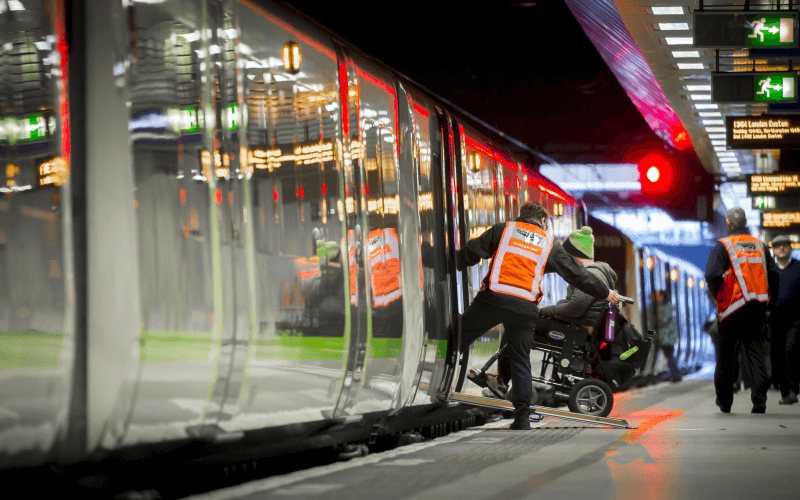
The government has been accused of an “outrageous” failure to listen to disabled campaigners and allies who have been calling for ministers to include far stronger measures on accessibility and disability rights in their railways bill.
The bill finished its passage through the Commons last week without key amendments on disability rights even being debated by MPs.
Despite the setback, these amendments are almost certain to be re-introduced by allies in the House of Lords when the bill continues its progress through parliament.
Both the Association of British Commuters (ABC) and Transport for All (TfA) were heavily critical this week of the government’s repeated failure to embed accessibility into the bill.
The main purpose of the bill is to create Great British Railways (GBR), a new publicly-owned company that will bring together management of passenger services and rail infrastructure.
Emily Sullivan, a disabled researcher in equality and human rights and ABC’s co-founder, said it was “outrageous” that the government had done nothing to strengthen accessibility in the bill.
She said: “It leaves GBR and ministers with a weak duty to ‘promote the needs’ of disabled people and no duty whatsoever on accessibility investment.
“This is in contrast to the much stronger amendments we co-drafted with Chris Hinchliff MP, to ‘protect and promote the rights and interests’ of disabled people and ‘secure targets towards the full accessibility of the rail network’.”
She said these amendments would have established the principle of rights regulation across the bill – for example by regulating a right to so-called “turn up and go” travel for disabled passengers – and would have ensured “proper integrated investment plans with deadlines” as a replacement for the “fragmented approach” of the long-standing Access For All programme.
Sullivan said the government had also failed to adopt the “groundbreaking” demand for a democratic passenger organisation, fully integrated with a system of regional and national accessibility panels.
She said these amendments were “by far the strongest on disability rights, had more MPs co-sponsoring than any others, and had the support of a wide civil society coalition of 20 passenger groups, disabled people’s organisations and experts”.
She said: “It is deeply disappointing that they were not discussed in the Commons debate.
“The duties set down in the railways bill will be the core principles for all decisions on rail accessibility for decades into the future.
“It is therefore vital that strong disability duties are established in the three main areas we’ve covered in our proposals so far: rights, investment and representation.”
This three-part approach is the only one consistent with the UK’s obligations under article four of the UN Convention on the Rights of Persons with Disabilities, she said, and “needs to be the minimum expectation as the bill moves on to the Lords”.
James Barber, TfA’s interim chief executive, was also highly critical of the government’s approach.
He said: “The government promised once-in-a-generation reform to embed accessibility when they announced the railways bill.
“It presented an opportunity to put disabled people at the heart of our railways so that everyone has the freedom to travel by train and make onward connections.
“But, once again, disabled passengers are being left at the station.
“When you listen to the debate, it’s clear many MPs recognise some of the barriers we face. Unfortunately, that’s where it ended.
“We need more than warm words and vague, unenforceable measures if we’re going to change a rail system that already excludes disabled people, and where the expectation we will continue to be excluded is solidly entrenched.
“We need our freedom to travel to work, education, appointments and leisure activities, guaranteed by law.
“We will continue to work with partners, including We Own It and the Association of British Commuters, to ask the House of Lords to act where the Commons failed.”
Some MPs did make it clear last week that the bill would need significant improvements if it was to transform the accessibility of the network.
A string of MPs from Labour, the Conservatives and the Liberal Democrats told ministers of the accessibility issues that still plague the railways, as the bill received its report stage and third reading.
Among those with suggested amendments was Labour’s Ruth Cadbury, who chairs the transport select committee and has played a role in pushing for the government to “close the gap between rights and reality” when it comes to accessible public transport.
She told MPs that the rights of disabled passengers needed to be “embedded in the culture” of GBR and spoke of the “sheer number of amendments tabled today that cover accessibility”.
Cadbury said disabled people needed to see “enforceable, statutory responsibilities that require progress”.
Disabled Labour MP Jen Craft told MPs that she supported two of Cadbury’s proposed amendments, which would have required a commitment from GBR and a proposed passenger council “not simply to consider the interests of disabled users, but to carry out their responsibilities in a way that actively promotes their interests”.
Craft said that if these two amendments were approved, there could be “a turning point in how disabled people who regularly use the rail network are viewed”.
She told MPs: “We have to consistently get the basics right.
“We need lifts that work, ramps with railings and staff on hand to help people on and off the trains. We also need these things to be reliably available.”
She added: “Accessibility must not be viewed through the same lens as customer service, where minor delays or engineering faults are considered irritating but, unfortunately, normal.
“Accessibility failures should be incredible rare, and failures to meet standards should be regarded as a serious infraction of people’s rights.”
Picture by Office of Rail and Road
 Slow but steady progress on UK air travel access improvements, says report
 Level boarding pledge in government strategy is welcomed, but railways bill amendments are still vital
 National accessibility standards are crucial for addressing transport barriers, Tories hear at conference