
Peers opposed to the assisted dying bill strongly outnumbered those who were in favour, during the first of two days of debate that will be spread over consecutive Fridays.
Of about 90 peers who spoke last Friday (12 September), nearly two-thirds were opposed to the bill being passed in its current form, with most of them opposed to the principle of legalisation.
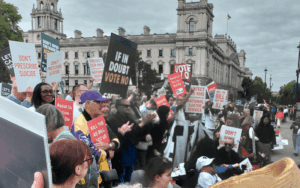
Conservative peers were the most likely of those representing UK-wide parties to express opposition to the bill – which is strongly opposed by the disabled people’s movement (pictured) – with 29 of 37 who spoke in the debate opposing the terminally ill adults (end of life) bill*.
Labour peers were more evenly split, with nine in favour of the bill and seven against, while crossbenchers were also evenly split, with 11 expressing opposition and 10 suggesting they were in favour of the bill as it stands, which would apply to England and Wales.
Of Liberal Democrats, four supported the bill, and one peer said they were opposed.
Many more peers will contribute to the debate tomorrow (Friday), before voting on whether to grant the bill a second reading, which would allow it to be scrutinised clause-by-clause in the Lords.
On the day of the debate, the Equality and Human Rights Commission (EHRC) released the advice it has sent peers.
It warned that a private members’ bill was “an unsuitable vehicle for such significant legislation, because it is not subject to the same pre-legislative scrutiny that a government-sponsored draft bill would have undergone, with expert evidence considered earlier in the process”.
It also called on the government to provide more detailed information on the potential impacts of the bill on those with characteristics protected under the Equality Act, “particularly age, pregnancy and maternity, religion or belief, race and disability”.
And it called on peers to work on “a clear and unambiguous definition of terminal illness” in the bill.
EHRC also warned that because of “continued constraints” on its resources, it might be limited in its ability to scrutinise vital regulations, if the bill became law.
Baroness [Tanni] Grey-Thompson was one of the few disabled peers to speak in Friday’s debate.
The crossbench peer raised concerns about the drugs that would be used if assisted dying was legalised.
She said: “Over 27 years, half the patients in Oregon [where assisted suicide has been legalised] took between 53 minutes and 137 hours to die.
“If the bill is to bring compassion and calm at the end of life, how can this be ensured when we do not know what lethal drugs will be given?”
She also said the failure to include a requirement for a coroner’s report “could lead to a lack of proper oversight” over such deaths.
Two peers who have been diagnosed with cancer spoke of their concerns about the bill.
The Conservative peer Baroness Prentis, who has been diagnosed with aggressive cancer and is about to start treatment, said: “My prognosis is excellent. I have every advantage.
“I have a strong faith, a loving family, an interesting workplace, good colleagues, a supportive community, enough money, underlying good health – and indeed excellent treatment, I should say.
“But there have been some very low moments in the past few weeks, when I have realised the burden I am to my family, who are currently arguing about who should take next week off to look after me.
“I also have concerns about watching them watch me suffer, as well of course as my own fear, frankly, of pain and loss of control.
“I watched that final debate in the Commons, and what struck me was that woman after woman and ethnic minority after ethnic minority, and disabled people, stood up and said, ‘This bill is not good enough for my vulnerable community.’”
She asked her fellow peers not to write her supportive letters and messages but instead to “think hard about me, with all my advantages, feeling like a burden – just briefly, not all the time.
“Do not worry; I will be back this time next year, bouncing around.
“But I ask noble Lords, instead of messaging me, to think about the vulnerable and how easy it is for them to feel that their lives are not worth living.”
Another who spoke of her cancer treatment was EHRC chair Baroness Falkner, a crossbench peer, who stressed she was speaking in a personal capacity.
She is receiving treatment for advanced stage three ovarian cancer, and she told fellow peers that she had “glimpsed the Grim Reaper through my hospital window, in a morphine-induced haze”.
She said she would have expected the government to have taken over the bill – which was introduced in the Commons as a private members’ bill by Labour MP Kim Leadbeater – and ensured it received pre-legislative scrutiny through a joint committee.
She also criticised the definitions in the bill.
She said: “How do we define ‘terminal illness’, measure the six months to live or calculate monetary equations that measure our lifespans more poorly than they do bats in HS2 railway tunnels, as in this impact assessment?
“What do we make of the impact of these measures, the lack of compassion for those genuinely concerned about the impact on disabled people or the questions of mental capacity, or for religious individuals and, of course, the elderly, who feel unwanted enough as it is?”
She added: “There is much to discuss in the scrutiny of this flawed bill – and I say that as someone who previously supported assisted dying.
“I wish we did not have to deal with this flawed bill, but we will do so in good faith.”
Labour peer Lord Falconer, who is a long-term supporter of legalisation and is sponsoring the bill in the Lords, told fellow peers: “The current law is confused, causes terrible suffering, and lacks compassion and safeguards.
“The government’s own estimate is that, if the law was changed to introduce assisted dying, less than one per cent of deaths would be assisted after 10 years.
“However, it is right that we allow assisted dying as an option for those who, despite the best palliative care, still want an assisted death.”
He said that safeguards were “layered throughout the process” that would be introduced under the bill.
But Conservative former prime minister Baroness [Theresa] May, who herself has a long-term health condition, said she did not believe the bill’s safeguards would prevent people “being pressurised to end their lives, sometimes for the benefit of others”.
She added: “I worry that, as we have seen in countries where there is such a law, people will feel that they must end their lives simply because they feel that they are a burden on others.
“I worry about the impact that it will have on people with disabilities, with chronic illness and with mental health problems, because there is a risk that legalising assisted dying reinforces the dangerous notion that some lives are less worth living than others.”
*These figures were calculated by Disability News Service and so are unofficial estimates
A note from the editor:
Please consider making a voluntary financial contribution to support the work of DNS and allow it to continue producing independent, carefully-researched news stories that focus on the lives and rights of disabled people and their user-led organisations.
Please do not contribute if you cannot afford to do so, and please note that DNS is not a charity. It is run and owned by disabled journalist John Pring and has been from its launch in April 2009.
Thank you for anything you can do to support the work of DNS…
 Disabled peer uses AI tech to recreate the voice she used to have, as she delivers speech to House of Lords
 Relief and tears after MPs reject assisted dying bill, as attention turns to palliative and social care
 Disabled MPs voted against assisted dying bill by two to one, records show