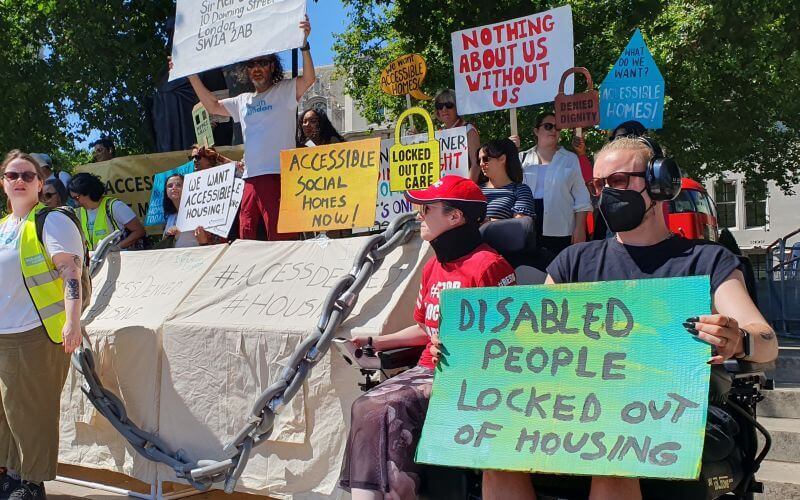
Scores of disabled people took their demand for the new Labour government to act on accessible housing to the gates of Downing Street on Monday.
They say accessible housing is the “cornerstone of independent living” and that hundreds of thousands of disabled and older people are living in unsuitable and unaffordable homes.
The protest (pictured), which began in Parliament Square, opposite the House of Commons, was timed to coincide with the second anniversary of a pledge by the last government – which was never fulfilled – to take action to address the shortage of accessible homes.
Chants were aimed at prime minister Keir Starmer and deputy prime minister Angela Rayner, who as housing secretary is leading on delivering the government’s pledge to build 1.5 million new homes over the next five years.
But just a day after the protest, Rayner delivered a speech to MPs about the government’s plan to “get Britain building” and “breathe life back into towns and cities” without once mentioning disabled people and the accessible housing crisis.
Inclusion London, which organised the protest, told campaigners in Parliament Square that an estimated 400,000 wheelchair-users are living in unsuitable homes, while it says that more than 100,000 disabled people are on council waiting-lists for accessible and adaptable homes.
Protesters later delivered a letter to Number 10, calling on the prime minister to take “immediate and decisive action” to address the shortage of accessible and affordable homes.
The letter calls on the government to strengthen guidance so all new homes will have to be built to the stricter M4(2) “accessible and adaptable” standard, and a minimum of 10 per cent of new homes meet the M4(3) standard, which means they would be suitable for a wheelchair-user.
But Inclusion London and its campaign allies also want most of these accessible new homes to be built in the social rented sector.
More than 40 disabled people’s organisations, and allies, signed the letter, and many of them were represented at Monday’s protest.
Laura Vicinanza, policy and stakeholder engagement manager at Inclusion London, told the protest: “Hundreds of thousands of disabled people and older people in this country are living in homes which are inaccessible, unsafe and unaffordable.
“This is unacceptable.”
She said disabled people were “tired of being ignored” and now expected “action”.
She said: “We are here to send an important message to the new Labour government: make accessible housing a priority.”
Adam Gabsi, Inclusion London’s chair, told protesters under the shadow of the statue of Mahatma Gandhi in Parliament Square: “Injustice anywhere is a threat to justice everywhere, and the lack of accessible housing is an extreme injustice that the new government needs to address.
“Living comfortably, safely and independently is a fundamental human right.
“All new-build homes should be safe, affordable and accessible.”
Wheelchair-user Osayuki Igbinoba, who herself lives in an inaccessible home – which means she cannot cook independently or push herself freely in her wheelchair – stressed the importance of enforcing the new standards if they are introduced.
She told protesters: “Every disabled person has the right to live independently in a home that is suitable for them.
“It’s time for our voices to be heard and our needs to be met.”
Angie Airlie, chief executive of Stay Safe East, a user-led organisation which provides advocacy and support to disabled Londoners who have survived domestic and sexual violence, hate crime and other abuse, said: “Because there are not enough accessible properties to meet the needs of the disabled community, when the home is no longer a safe place, due to abuse, harassment, or crime, there is often no place for the victim to go.”
She said she had often made the argument to the last government that safe accommodation for disabled people in such situations was “almost mythical”.
“It is far more likely that the choice is between unsafe accommodation, or not particularly safe, and this isn’t good enough.”
She said that raising accessible housing standards could mean “a very real potential for creating a network of safe accommodation provision for disabled people to leave their homes”.
Among those supporting the protest was Ben Coleman, former deputy leader of Hammersmith and Fulham council – currently the only council in England that does not charge for social care – and now the new Labour MP for Chelsea and Fulham.
He told Disability News Service (DNS) it was too early to say what action the new government would take, but he said the 1.5 million homes would need to be accessible.
He said it was the kind of issue that he and other backbench MPs would be looking to raise with ministers.
On the demands made in the letter to the prime minister, he said: “I’m personally in favour of more homes being accessible.
“I think it sounds reasonable, but I just want to look at it more, I want to understand it more.”
He said it would be crucial to ensure that local councils had the capacity to enforce any new measures that were introduced, after years of “terrible cuts” to their funding, while any new regulations would need to be accompanied by “an implementation plan to make it stick”.
After the letter was delivered to 10 Downing Street, Svetlana Kotova, director of campaigns and justice for Inclusion London, told DNS: “I think we just need to build more pressure.”
She said the government had “no excuse” for not accepting their demands, as it was “so easy to do” if the government wanted to “deliver change”.
She said: “It’s just that someone needs to pay attention to this and make it a priority. It’s an easy win.
“We will put pressure on them. We will build a coalition in parliament to push them.
“We need to raise standards now, today. Don’t kick it into the long grass like the previous government.”
A Ministry of Housing, Communities and Local Government spokesperson said: “Housing is one of the government’s top priorities.
“Everyone deserves to live in a decent, accessible home they feel safe in.
“We will set out policies on accessible housing in due course.”
A note from the editor:
Please consider making a voluntary financial contribution to support the work of DNS and allow it to continue producing independent, carefully-researched news stories that focus on the lives and rights of disabled people and their user-led organisations.
Please do not contribute if you cannot afford to do so, and please note that DNS is not a charity. It is run and owned by disabled journalist John Pring and has been from its launch in April 2009.
Thank you for anything you can do to support the work of DNS…
 Government freezes funding for life-changing housing adaptations, despite minister’s claims
 Government announces £400 care charges ‘cash boost’, while quietly snatching funds from savings
 Transport for London finally admits it included contract option to close half Elizabeth line ticket offices