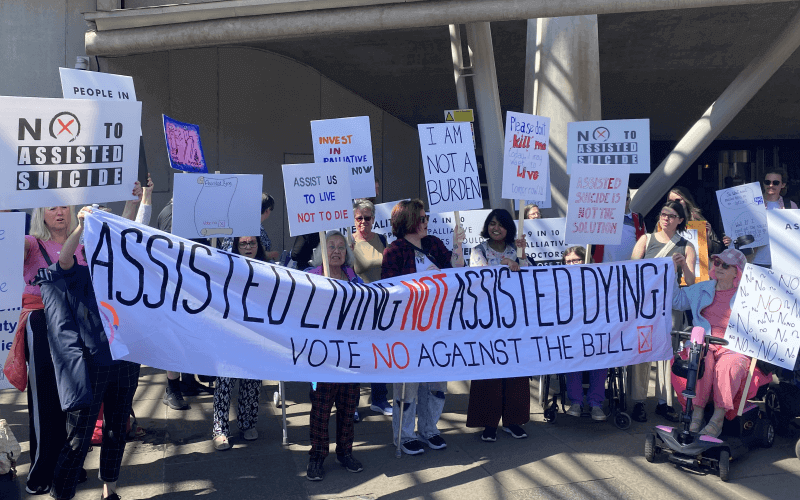
Disabled campaigners say they are shocked, angry and “confounded” by a vote by the Scottish parliament in favour of legalising assisted suicide in Scotland, but they have vowed to keep fighting to defeat the proposals.
Members of the Scottish parliament voted 70 to 56 in favour of the assisted dying for terminally ill adults (Scotland) bill on Tuesday, despite scores of disabled people protesting against the plans outside parliament (pictured).
The member’s bill has been drafted by Liberal Democrat MSP Liam McArthur, but Tuesday’s vote – just three days before similar proposals for England and Wales will be debated by MPs – was only on the bill’s general principles, as the final part of stage one of its parliamentary scrutiny.
The bill will now enter stage two, where amendments can be proposed and voted on by a committee of MSPs.
On the day of the vote, the disabled people’s organisation Not Dead Yet UK published the results of polling it commissioned which showed 62 per cent of Scots believe that disabled people who struggle to access the health, social care and other support they need could be more likely to seek assisted suicide if it is legalised, rising to 71 per cent of disabled people.
Two-thirds of Scots (66 per cent) agree that the Scottish parliament should prioritise improving access to care and support for disabled people before considering whether to introduce assisted suicide, with this proportion rising to 76 per cent of disabled people.
And nearly six in 10 (59 per cent) Scots agree that disabled people who feel they are a burden on family, friends or society could feel a sense of responsibility to access an assisted death if it is legalised, rising to two-thirds (66 per cent) of disabled people.
Among disabled people’s organisations that oppose the bill are Disability Equality Scotland, Inclusion Scotland, Glasgow Centre for Inclusive Living, Glasgow Disability Alliance, People First (Scotland) and Self Directed Support Scotland.
Tressa Burke, chief executive of Glasgow Disability Alliance, told Disability News Service (DNS) she had been left “confounded” after sitting through almost five hours of debate on Tuesday.
She said it was “bewildering” that MSPs had repeatedly “given primacy” to the experiences of their own loved ones and constituents over “so much evidence about the vulnerability of disabled people, the poverty and inequality and the barriers, the exclusion, and the social isolation” they face.
She said: “When you look at the reasons people give for choosing assisted suicide, they cite things like lack of access to services, lack of housing and social isolation.
“So what I’m confounded by is they are picking and choosing the lived experience that they are giving primacy to, as legislators, and I find that utterly staggering.”
She said she was “devastated” by the vote but would “100 per cent” continue to fight to “build understanding and insight into the lived reality of disabled people’s lives, which is very low”.
Inclusion Scotland also pledged to continue to oppose the bill.
Heather Fisken, Inclusion Scotland’s chief executive, said: “Despite the fear and anger that disabled people feel and the clear and unwarranted risks to our lives, we are shocked that so many members of the Scottish parliament voted for it.
“We will continue to fight this, and other denial of our human rights, until MSPs take note of the social and political context disabled people are forced to endure, including mounting unmet social care needs and cuts to services, higher costs of living amidst a cost of living crisis, and the hugely detrimental cuts to benefits proposed in the UK government’s Pathways To Work green paper – all of which can lead to untimely death, and opportunity for coercion.”
Disabled actor, writer and activist Liz Carr, whose award-winning BBC documentary about assisted suicide, Better Off Dead? – still available to watch – explains the dangers of legalisation, was at the Scottish parliament on Tuesday, and joined other disabled people protesting against the bill.
She told DNS that, despite Tuesday’s vote, she believed the bill would not be voted into law.
She said both MSPs and MPs now want to hear the arguments on both side of the debate.
Carr said she spoke to many undecided MSPs on Tuesday who said they had questions and concerns about the bill and wanted to “hear a bit more”, and that she had been impressed by their “level of thinking” on the issue.
She said that some of the MSPs she spoke to did not feel they could justify voting against the bill at this stage but now needed to examine whether legalisation could work.
She said she hoped that once there has been further examination of the bill, MSPs will be able to vote again – and vote no – “in a more informed, legitimate way”.
She said: “I was disappointed [by the vote], but I was not surprised at all.
“I expected, from what I witnessed in the 24 hours I was there, that it would go through narrowly, which it did.
“But do I think it will get voted in? No, I don’t.”
A note from the editor:
Please consider making a voluntary financial contribution to support the work of DNS and allow it to continue producing independent, carefully-researched news stories that focus on the lives and rights of disabled people and their user-led organisations.
Please do not contribute if you cannot afford to do so, and please note that DNS is not a charity. It is run and owned by disabled journalist John Pring and has been from its launch in April 2009.
Thank you for anything you can do to support the work of DNS…
 Disabled peer hits back at claims of ‘filibustering’ over ‘vague’ and ‘poorly drafted’ assisted suicide bill
 Disabled activists call on Clooney to abandon movie that is set to paint Alzheimer’s as ‘fate worse than death’
 Inquiry hears how lack of accountability for disabled people’s Covid deaths caused lasting harm